What is Bulk Fermentation? A Complete Sourdough Guide
⚡ What You’ll Learn in 60 Seconds
- Definition: Bulk fermentation happens after mixing and before dividing or shaping.
- Duration: Dough temperature matters greatly, but starter, inoculation, flour, hydration, salt, and handling also change the speed.
- Target rise: Use the target from a tested formula; protein percentage alone does not determine it.
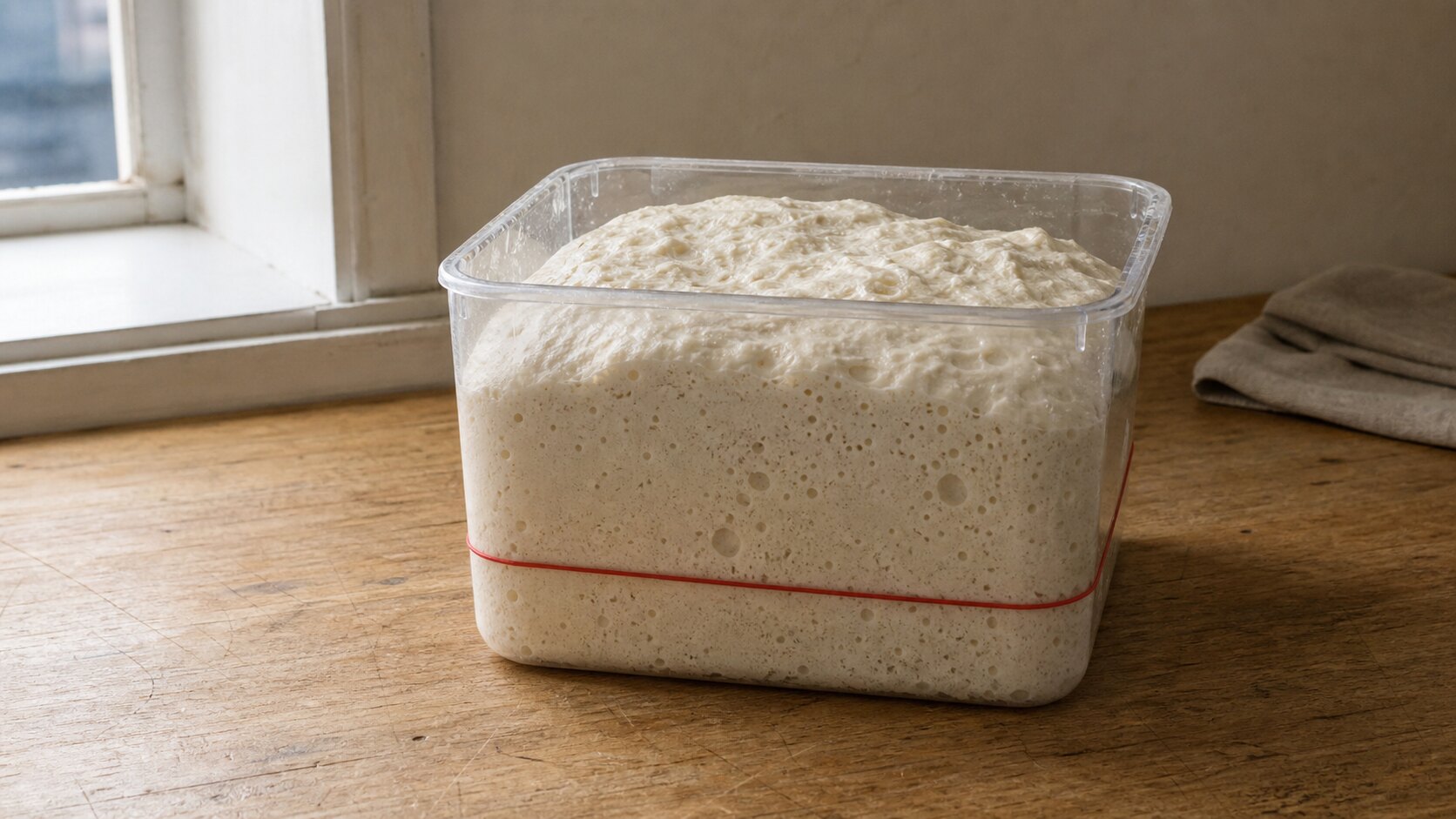
- Useful tool: A clear, straight-sided container with the starting level marked.
- Key insight: Treat recipe time as a range, then confirm with rise, aeration, and strength.
↓ Full 12-min guide with timing variables, volume targets, visual cues, common mistakes, and how to adjust for your kitchen
Bulk fermentation has an outsized effect on sourdough structure, flavor, and schedule, but it is not the cause of every dense or flat loaf. Starter activity, gluten development, shaping, hydration, and baking can produce similar symptoms.
A recipe’s bulk time assumes a particular dough temperature, inoculation, flour, and starter condition. If any of those change, the clock can move substantially. A marked container reveals the trend, while the formula tells you what rise and dough condition you are aiming for.
The goal is not to ignore time. Time is useful process data. The goal is to stop treating it as the only endpoint and instead compare it with temperature, rise, aeration, and dough strength.
A recipe gives the baseline. Your measurements show how closely this dough matches the conditions in which that baseline was tested.
What Bulk Fermentation Actually Is
The first rise, in plain language
Bulk fermentation is the stage between mixing your dough and shaping it. The dough sits as a single mass in a container: that’s why it’s called “bulk.” Some bakers call it the first rise, primary fermentation, or bulk ferment. They all mean the same thing.
This stage conventionally starts after the dough’s final mix and ends when it is divided or turned out for pre-shaping. A preferment, fermentolyse, or other process may mean fermentation began before the final mix; the formula should make its own timing convention clear. The rests, folds, and rise before dividing or shaping belong to bulk fermentation.
During bulk, fermentation becomes visible, gluten continues developing, and folds can organize and strengthen the dough. The endpoint affects how well the dough handles shaping and final proof.
Bulk fermentation is the first fermentation stage before dividing or shaping. It develops gas, flavor, and strength, while final proof continues fermentation in the shaped loaf.
What’s Happening Inside the Dough
Fermentation and dough development at the same time
Three relevant processes continue together during bulk fermentation.
1. Yeast produces CO2 gas
Wild yeast in your sourdough starter consumes available sugars and releases CO2. Gas retained by the dough’s structure contributes to the cells that become the crumb. Visible rise therefore depends on both gas production and the dough’s ability to retain that gas.
2. Lactic acid bacteria produce acids
Sourdough yeasts and lactic acid bacteria form a mixed culture. Bacteria contribute acids and aroma compounds, while yeasts are major gas producers. Temperature matters, but flour, hydration, feeding history, inoculation, and time also affect flavor; “warm equals lactic, cold equals acetic” is too simple as a universal rule.
3. Gluten develops and matures
Gluten proteins form a network through hydration, mixing, time, and movement. Folds can strengthen and organize that network during bulk, while shaping later adds tension. If fermentation runs too far, acidity, enzyme activity, and stretching can eventually reduce dough strength.
To calibrate bulk, repeat one formula and record the starter condition, dough temperature, rise, bulk time, handling feel, and center-slice photo. Change one variable at a time.
How Long Bulk Fermentation Should Take
Why a recipe gives a range, not a universal deadline
Bulk time belongs to a formula and a set of conditions. A warmer version of the same dough generally ferments faster, but there is no dependable rule that every 10°F increase doubles the rate. These variables interact:
| Variable | How It Can Change Bulk |
|---|---|
| Dough temperature | Warmer dough usually ferments faster; cooler dough usually ferments slower |
| Inoculation | More ripe starter or levain generally shortens the schedule |
| Starter condition | A vigorous culture can move faster than a recently refrigerated or weak one |
| Flour | Whole grain, rye, extraction rate, and enzyme activity alter fermentation and strength |
| Hydration and salt | Both affect dough handling and microbial activity |
| Mixing and folds | Change gluten development, gas retention, and visible rise |
| Final-proof plan | A long room-temperature or cold proof changes how far bulk should progress |
This is why a timing chart detached from a complete formula is misleading. Use your recipe’s dough temperature, time range, and target rise together. If your measured conditions differ, expect the schedule to differ and make notes for the next bake.
If your dough is colder than the formula’s target, expect bulk to take longer. Do not add a universal percentage of time; measure the actual dough and follow its development.
Reading Volume Increase
A useful measurement when paired with a tested target
Volume increase is easier to compare than a vague instruction such as “until puffy,” but it is not universal. The appropriate rise depends on the full formula and the proof that follows.
The setup:
- Use a clear, straight-sided container large enough for the dough and expected rise
- Place dough inside after mixing and cover it to prevent the surface from drying
- Mark the starting level with a rubber band, painter’s tape, or a dry-erase marker
- As fermentation progresses, compare the new dough level with the starting mark
- When the dough nears the formula’s target, confirm with aeration and strength before shaping
The math:
If a tested formula calls for a 50% rise, the target volume is 1.5 times the starting volume. In a truly straight-sided container, a 4 cm starting height would become about 6 cm. Height does not map cleanly to volume in a tapered or round bowl.
Why protein percentage is not enough:
Two flours with similar protein labels can have different gluten quality, extraction, enzyme activity, and water absorption. Whole-grain bran can weaken gas retention even while its nutrients change fermentation speed. Rye behaves differently from wheat because its structure depends much less on a wheat-like gluten network. Use the tested formula for that flour blend rather than assigning a target from protein alone.
An aliquot jar can make expansion easier to see. Keep the sample at the same temperature as the main dough, mark it clearly, and remember that the sample does not experience the same folds, degassing, and temperature changes. Calibrate its reading against repeated bakes instead of assuming an exact match.
Visual and Tactile Cues
Cues that may support the formula’s rise target
Volume increase gives one part of the story. Use these additional cues to decide whether the dough is developing as the formula expects.
Many wheat doughs near their intended endpoint may show:
- Visible aeration: bubbles may appear along the sides or surface, although not every flour and hydration shows them clearly.
- A smoother or gently domed top: useful when it is normal for that formula, not a universal requirement.
- Changed container contact: some developed wheat doughs release slightly from the sides, while wet, enriched, whole-grain, and rye-rich doughs may not.
- Movement: many developed doughs jiggle when the container is moved, but very wet or rye-rich doughs behave differently.
- Lighter feel: the dough should feel more aerated than after mixing while retaining enough strength for the next step.
Possible signs bulk is still incomplete:
- Little aeration compared with the same dough after a successful bulk
- Dough still feels dense and heavy
- Rise remains below the formula’s target
Possible signs bulk has gone too far:
- Dough has passed its peak rise and begun to fall or collapse
- Strength has noticeably declined compared with earlier checks
- Dough becomes unusually fragile and difficult to shape
Read these cues together and compare them with the same formula. Stickiness alone can come from high hydration or flour choice, and a smooth surface alone does not establish underfermentation. For the later stages and baked loaf, see the underproofed vs. overproofed dough guide.
Stop Guessing When Bulk Is Done
Record dough temperature, bulk time, measured rise, and the crumb result in the bake notes. Repeating one formula makes those comparisons meaningful.
What Flourwise does for bulk fermentation:
- Calculate baker’s percentages and hydration for a repeatable formula
- Use step-by-step baking mode with active timers for folds and rests
- Add process notes and crumb photos to the bake journal for later comparison
The dough tells you when bulk is done. The journal tells you which patterns repeat.
Stretch-and-Folds During Bulk
Developing strength with gentle folds
Stretch-and-folds are one way to develop dough strength during bulk. Some formulas use them instead of intensive kneading; others use mixing, coil folds, lamination, or no folds at all.
The basic technique:
- Wet your hand to prevent sticking
- Reach under one side of the dough, lift it up, stretch gently, and fold over the top
- Rotate the container 90° and repeat: four sides total per set
- Cover and wait for the interval specified by the formula before the next set
How many sets and when:
Follow the formula first. Three or four sets spaced roughly 30 minutes apart early in bulk is a common starting pattern for wheat sourdough, not a law. Flour strength, mixing intensity, hydration, inclusions, and dough response determine whether you need fewer or more.
Why the timing matters:
Folds redistribute temperature and fermentation products while strengthening and organizing the dough. As the dough becomes aerated, aggressive late handling can expel gas or tear the network. Stop when it has the strength required by the formula, not at a universal hour.
Record not just the number of folds, but how the dough changed after each set. If it already holds shape, stretches without tearing, and retains tension, another fold may add little value.
Why Dough Temperature Matters
A major variable you can measure and control
Temperature is one of the strongest controls on fermentation speed. It does not erase the effects of inoculation, starter health, flour, hydration, or salt.
Dough temperature, not room temperature
When a formula specifies a desired dough temperature, measure the dough rather than assuming it matches the room. Friction from mixing, flour temperature, water temperature, preferment, and the container can make the dough warmer or colder than the kitchen.
How to measure dough temperature
Use a clean digital probe thermometer in the center of the dough after mixing. Roughly 75–79°F (24–26°C) is a common desired range for many wheat doughs, but use the target in your formula. Adjust mix-water temperature deliberately with a desired dough temperature calculation.
Adjusting for your kitchen
If the dough is colder than the formula’s intended range:
- Calculate warmer mix water without exceeding safe limits for your culture or mixer
- Use a stable proofing area and measure the dough rather than placing it near uncontrolled heat
- Expect a longer schedule and watch the formula’s target cues
If the dough is warmer than the formula’s intended range:
- Calculate cooler mix water if needed
- Keep the dough away from direct sun or a hot appliance
- Watch more frequently because the same formula will usually move faster
- Change inoculation only as a deliberate formula adjustment, then record the result
Common Bulk Fermentation Mistakes
Common sources of confusing results
These five mistakes make bulk harder to interpret.
Mistake 1: Following the recipe time exactly
Recipe time reflects the conditions used by the author. If your dough temperature or starter differs, your schedule may differ too. Keep time as a measurement, but confirm the endpoint with the target rise and dough cues.
Mistake 2: Estimating percentage rise from bowl height
A round or tapered bowl makes percentage rise harder to estimate because height is not proportional to volume. A clear, straight-sided container improves the measurement, although it does not diagnose dough strength by itself.
Mistake 3: Using starter at the wrong maturity for the formula
Use starter or levain at the maturity specified by the formula. Doubling, aroma, bubbles, and time-to-peak are useful observations, but no single feeding ratio fits every culture. See the feeding guide for the full process.
Mistake 4: Confusing bulk with final proof
Some formulas call for doubling during bulk; others end bulk much earlier because of dough temperature, inoculation, flour, or a long final proof. Use the target attached to your formula rather than importing a percentage from another bread.
Mistake 5: Folding too late
Late or aggressive folds can degas an already aerated dough. Stop when the dough has the strength the formula requires, and handle it more gently as fermentation progresses.
If bread is consistently dense, audit bulk fermentation alongside starter activity, gluten development, shaping, hydration, bake completion, and cooling. Change one variable at a time so the result is interpretable.
Conclusion: Use the Dough and the Clock Together
Bulk fermentation establishes much of the gas, flavor, and dough strength carried into shaping and final proof. It matters greatly, but good shaping, proofing, scoring, and baking still affect the result.
A clear, straight-sided container with a starting-level mark makes rise visible. Combine that measurement with the formula, dough temperature, aeration, and strength.
For your next bake, measure dough temperature after mixing, mark the starting volume, and use the target in a tested formula. Record the actual time and result so the next bake starts with evidence from your own kitchen.
Quick Reference
- Bulk fermentation = fermentation after mixing and before dividing or shaping.
- Use the formula’s target rise; flour protein alone does not determine a percentage.
- Dough temperature strongly affects time, but it is not the only variable.
- Use a clear, straight-sided container with a rubber band marking the starting level
- An aliquot jar can help, but it must be calibrated against the main dough.
- Follow the formula for folds and stop when the required strength is present.
- Doubling is correct for some formulas and excessive for others.
- Measure dough temperature, not room temperature alone.
- Use time, rise, aeration, and strength together.
Further Reading
- The Perfect Loaf: Bulk Fermentation Guide - fermentation stages, folds, and assessing dough development.
- King Arthur Baking: Dough Temperature - controlling the temperature after mixing.
- King Arthur Baking: Sourdough Glossary - fermentation and baking terminology.
Frequently Asked Questions
What is bulk fermentation in sourdough?
Bulk fermentation is the stage after mixing and before dividing or shaping, while the dough ferments as one mass. Yeasts produce carbon dioxide, bacteria contribute acids and aroma compounds, and the dough develops through hydration, time, and any folds. Its duration and endpoint depend on the formula, inoculation, starter activity, dough temperature, flour, hydration, salt, handling, and the final-proof plan.
How long should bulk fermentation last?
There is no universal bulk-fermentation time. Dough temperature strongly affects speed, but inoculation, starter vigor, flour, hydration, salt, mixing, and dough size matter too. Use the time and rise target from a tested formula as a baseline, keep the dough near that formula’s intended temperature, and confirm the endpoint with rise, aeration, strength, surface bubbles, and handling feel.
How do I know when bulk fermentation is done?
Start with the rise target in your formula, then look for aeration, bubbles at the sides or surface, a smoother or gently domed top, increased elasticity, and a lighter feel. Not every dough shows every cue, and doubling is correct for some formulas but excessive for others. A clear marked container helps measure rise, but it does not replace the recipe and the dough’s strength.
What’s the difference between bulk fermentation and proofing?
Bulk fermentation happens before dividing and shaping, while final proof happens after shaping. Fermentation, gas production, and dough development continue across both stages, but bulk also provides the working window for folds and strength building. The duration of either stage depends on the formula and temperature; fixed hour ranges are only examples, not definitions.
What happens if bulk fermentation goes too long?
If bulk runs too long for the formula, the dough may become very gassy, slack, sticky, fragile, or unable to hold shape. Acidity, enzyme activity, and stretching can reduce the network’s gas-holding capacity. The baked result may spread and have weak oven spring, but the crumb pattern varies. A marked container and process notes help, but prevention still depends on using the formula’s target with dough temperature and strength cues.