Dutch Oven vs Baking Steel vs Pizza Stone: Which to Buy
⚡ What You’ll Learn in 60 Seconds
- Dutch oven: Enclosed vessel that simplifies steam retention for one loaf.
- Baking steel: Fast heat transfer and strong pizza browning, but heavy and sometimes too aggressive.
- Pizza stone: Gentler heat transfer and lower weight, but brittle and sensitive to thermal shock.
- Preheat: Follow the product and recipe; thickness and oven power matter more than one universal time.
- Key insight: Match the tool to the bake, oven behavior, dimensions, and safe handling limits.
↓ Full 12-min guide with side-by-side comparison, when each excels, sizing, and how to pair them
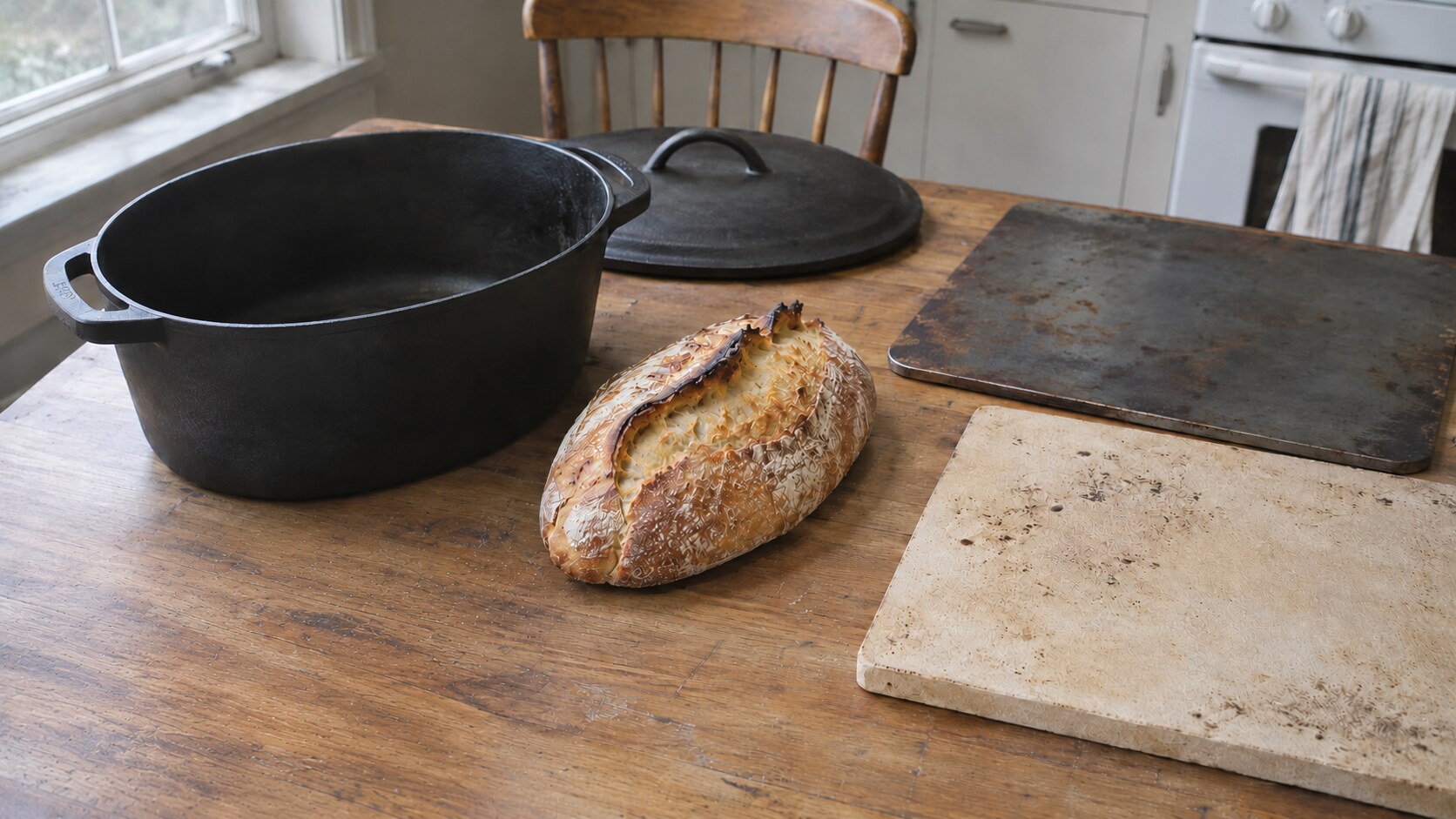
These are three different tools, not three interchangeable heat-retention surfaces. A Dutch oven is an enclosed vessel that manages steam. Steel and stone are open decks that change heat transfer into the base of bread or pizza.
The practical choice depends on the failure you are trying to solve. If a free-standing loaf forms a crust too early, a covered vessel simplifies steam retention. If pizza bottoms stay pale, a deck with more heat transfer can help. If steel scorches the base before the top browns, a stone or a different rack position may be the better match.
Before buying, check the oven cavity, rack load rating, maximum safe temperature, product dimensions, and whether you can lift the tool safely when hot. Those constraints are more useful than a universal winner.
A covered vessel solves steam management. Steel and stone solve deck heat transfer. Choose the problem first, then the material.
Why Your Baking Surface Matters
How deck heat and steam differ
Home ovens can make excellent bread and pizza, but they usually have less deck heat and less steam control than purpose-built bakery or pizza ovens. A preheated vessel or deck changes how heat reaches the dough.
Steel and stone store heat and transfer it into the base on contact. A Dutch oven adds an enclosure that retains moisture around bread during the early bake. The outcome still depends on oven temperature, rack position, dough, and preheat.
The two key properties:
- Heat capacity: how much energy it takes to raise the tool’s temperature, which depends on its mass and material. A heavier deck of the same material can supply more energy before its temperature falls.
- Thermal conductivity: how readily heat moves through the material. Conductivity helps explain why steel delivers bottom heat rapidly, but contact, thickness, surface temperature, and the dough also affect browning.
| Surface | Heat capacity | Thermal conductivity |
|---|---|---|
| Cast iron Dutch oven | Depends on mass and design | Much higher than stone; same general range as common carbon steels |
| Baking steel | High, depending on thickness | High |
| Pizza stone (cordierite or ceramic) | Varies by material and thickness | Lower than steel |
Plus a third factor for sourdough: steam
Many lean hearth breads benefit from a humid environment early in the bake. Moisture delays crust setting and supports expansion. The exact covered or steamed time belongs to the recipe.
A covered Dutch oven traps moisture released by the dough. A steel or stone can be preferable for long loaves or multiple loaves. If the recipe calls for steam, use a suitable cover or a steam method approved for your oven.
For pizza, balance bottom heat with top heat. For many free-standing loaves, early steam matters. Different jobs call for different tools.
Dutch Oven: Simple Steam Retention
Why enclosed baking simplifies steam
A Dutch oven is a heavy lidded pot, commonly bare or enameled cast iron. During bread baking, the lid retains moisture released by the dough. A dedicated bread cloche or combo cooker can provide the same basic enclosed-bake function.
Specs to check:
- Material and coating: bare or enameled cast iron, carbon steel, or a purpose-built cloche
- Internal dimensions: enough room for the shaped loaf to expand without touching the lid
- Maximum temperature: include the lid knob and handles, not just the pot body
- Weight and loading: make sure you can safely move or uncover it when hot
What it excels at:
- Sourdough and lean artisan breads that benefit from retained steam
- Boules and round loaves
- Simple enclosed bake with no separate oven-wide steam setup
- Repeatable workflow when used according to the recipe and manufacturer
What it’s not great at:
- Launching and retrieving pizza from a deep pot
- Long bâtards that need more room than a round pot provides
- Baking several loaves at once in a standard-size pot
- Very heavy if you have wrist or shoulder issues
Check whether your particular vessel permits empty preheating: some enameled cookware makers advise against it. In that case, use a compatible cold-vessel bread method rather than following a recipe that requires a preheated pot. Low-sided bases and combo-cooker designs can make loading easier than lowering dough into a deep hot pot. Whichever design you choose, use heat-resistant gloves, keep hands clear of escaping steam, and follow the product’s preheating guidance.
Baking Steel: Fast Bottom Heat
Fast heat transfer for pizza, with a scorching tradeoff
A baking steel is a flat slab of steel placed on an oven rack. Steel generally conducts heat much faster than ceramic or cordierite, so it can brown a pizza base quickly. Material grade, thickness, surface temperature, and oven top heat determine the actual result.
Specs to check:
- Material and finish: follow the maker’s seasoning and cleaning instructions
- Thickness: more thickness usually means more mass and weight
- Size and clearance: preserve the airflow required by the oven and product
- Rack load: verify that the rack can support the steel safely
What it excels at:
- Pizza styles that benefit from rapid bottom browning in a home oven
- Focaccia recipes that call for setting a suitable pan on a preheated deck
- Pita and other flatbreads that benefit from strong deck heat
- Bread when paired with steam (more setup than Dutch oven but works well)
- Resistant to the cracking that can affect ceramic or cordierite
What it’s not great at:
- Recipes that call for steam unless you also have a suitable cover or steam setup
- Anyone with weight constraints (these are heavy)
- Ovens with weak top heat, where the base may scorch before the toppings finish
- Storage and safe handling because of the weight
Thinner steels are easier to lift and may be sufficient for one pizza. For the same material and footprint, thicker steels store more energy at a given temperature and may cool less during a bake. They also take longer to heat through, add weight, and do not guarantee a shorter reheating interval. Oven power and the heat needed by each pizza still determine recovery. Choose from the manufacturer’s oven guidance rather than buying unfinished metal of unknown food-contact suitability.
A steel is a strong option when pizza bottoms stay pale despite proper preheating. If your oven already burns the base before the top is ready, a stone, higher rack, or lower deck temperature may work better.
Right Surface, Right Recipe
Save the recipes you bake on each tool and record the actual surface temperature, rack position, and bake time that work in your oven.
What Flourwise gives you for equipment-aware baking:
- Step-by-step baking mode with timers for covered, uncovered, and finishing stages
- Recipe calculator handles baker’s percentage and hydration automatically
- Journal every bake: log which surface gave the best results
Different surfaces need different timing. The right tool helps you remember what works.
Get Flourwise Free
1,000+ downloads · iOS & Android · Free to download · No adsPizza Stone: Gentler Open-Deck Heat
Lower heat flux with a brittle material
Pizza stones made from ceramic, clay, or cordierite create an open baking deck with gentler heat transfer than steel. That is not automatically a limitation; it can help match bottom browning to top heat in some ovens.
Specs to check:
- Material: cordierite, ceramic, clay, or another manufacturer-specified refractory material
- Thickness and mass: affect preheat and heat recovery
- Size and shape: leave the clearance required for airflow
- Temperature and care limits: vary by product
What it excels at:
- Often lower cost and lighter than a similarly sized steel
- Gentler bottom heat for ovens that scorch pizza on steel
What it’s not great at:
- Lower conductivity than steel, which can mean slower bottom browning
- Brittle construction that can break from impact or thermal shock
- Porosity and cleaning restrictions that vary by material
Why stones crack:
The most common ways pizza stones break:
- Thermal shock: sudden temperature changes or liquid on a very hot stone
- Drops: stones are brittle and shatter on impact
- Use outside instructions: direct flame, broiler exposure, or temperature changes not approved by the manufacturer
Care:
- Follow the manufacturer’s preheat, broiler, and temperature limits
- Let the stone cool gradually and never quench it
- Follow the product-specific cleaning instructions; avoid soaking porous stone
- Expect staining and patina, which do not necessarily mean the stone is dirty or damaged
Choose stone when its gentler heat transfer, lower weight, or lower price fits your oven and baking style. Choose steel when faster browning and durability matter more.
Side-by-Side Comparison
All three at a glance
| Property | Dutch Oven | Baking Steel | Pizza Stone |
|---|---|---|---|
| Material | Cast iron / enameled | Solid steel | Cordierite/ceramic |
| Thickness | Product-specific walls | Product-specific slab | Product-specific slab |
| Weight | Often heavy | Increases with size and thickness | Check the model weight |
| Heat conductivity | High relative to stone; varies by alloy | High relative to stone; varies by alloy | Lower than common cast iron and carbon steel |
| Heat storage | Depends on mass and material | Increases with thickness at the same footprint | Depends on mass and material |
| Preheat time | Product and recipe specific | Product and oven specific | Product and oven specific |
| Bake time (pizza) | Usually impractical in a deep pot | Often shorter, but may scorch | Often gentler and longer |
| Steam for bread | Lid retains moisture released by the dough | Add a suitable cover or oven-approved setup if the recipe calls for steam | Add a suitable cover or oven-approved setup if the recipe calls for steam |
| Multiple loaves | Usually one | Depends on deck and oven size | Depends on deck and oven size |
| Durability | Long with correct care | Resistant to cracking; may rust if neglected | Can last for years but is brittle |
| Price | Varies by material and brand | Varies by size and thickness | Varies by material and size |
| Typical strength | One covered hearth loaf | Fast pizza browning | Gentler pizza and flatbread baking |
| Cleaning | Follow coating and maker | Follow finish and maker | Follow stone material and maker |
| Main safety issue | Hot heavy vessel and escaping steam | High weight and very hot surface | Thermal shock and impact |
Choose by what you bake:
- Mostly sourdough? Dutch oven first. Add steel later if you also want pizza.
- Mostly pizza? Steel for aggressive browning, stone for gentler heat; match the oven.
- Equal mix of bread and pizza? A covered vessel plus the deck that fits your oven covers many common needs.
- Tight budget or weight limit? A stone may be the practical first deck.
Which to Buy First
A decision tree based on what you bake
The right first purchase depends mainly on what you bake most, how your oven heats, and what you can handle safely.
If you bake sourdough or artisan bread weekly: Dutch oven
A covered vessel is often the simplest route to steam retention for one loaf. Choose internal dimensions and a temperature rating that fit your recipe, and make sure you can load and uncover it safely.
If your pizza base stays pale: Baking steel
A steel’s fast heat transfer can solve weak bottom browning. If your base already finishes too early, do not assume steel is an upgrade; a stone or different rack position may balance the bake better.
If you bake both equally: Covered vessel plus the deck that fits your oven
A covered vessel handles one bread loaf. Add steel or stone only after identifying whether your pizza needs more or gentler bottom heat.
If you make pizza casually and want a lighter deck: Consider a pizza stone
If you make pizza occasionally and want a deck lighter than steel, a stone can be a durable long-term tool when used within its instructions.
If you’re brand new to bread baking: Start with suitable equipment you own
Start with the baking sheet or covered oven-safe vessel you already own if it meets the recipe’s temperature and size requirements. Buy equipment only after you know which limitation you need to solve.
For one free-standing loaf, a covered vessel is the simplest specialist tool. For pizza, steel versus stone depends on the balance between bottom and top heat in your oven.
Sizing and Capacity
How big each surface should be
Dutch oven sizing:
Use internal diameter, length, and height rather than quart capacity alone. The shaped loaf needs clearance to expand without touching the walls or lid, and the lid should close fully. A round vessel often suits a boule, while a sufficiently wide oval vessel can fit a bâtard. Check the recipe and maker’s guidance.
Baking steel sizing:
- Measure the usable rack and oven cavity, including door and rear clearances
- Leave the airflow clearance specified by the oven and steel manufacturer
- Confirm rack load capacity before choosing thickness
- Make sure the intended pizza and peel fit the usable deck area
Pizza stone sizing:
- Rectangular stones maximize usable rack area
- Round stones can suit a round pizza, but usually provide less usable area than a rectangle fitting the same rack
- Larger or thicker stones add mass but remain brittle and harder to handle
Using Multiple Surfaces Together
When to keep more than one
Multiple tools can be useful, but they should be treated as separate setups with their own clearances and preheat instructions.
The hybrid setup (steel + Dutch oven):
- Dutch oven on a middle rack for sourdough
- Baking steel installed only where its manufacturer and the oven permit
- Avoid leaving another heavy deck in place if it disrupts airflow or changes the bake
Adding steam or a cover for bread on a deck:
For long or multiple loaves, a steel or stone can support an open bake. Use the steam or cover method specified by a tested recipe and approved by the oven manufacturer. A heat-safe cloche or inverted roasting cover contains steam near the loaf without filling the entire oven.
Do not improvise with water or ice in a hot oven. Steam can cause serious burns, and sudden cooling can damage enamel, glass, stone, or oven components. Use a dedicated steam pan only when the oven manual, vessel maker, and recipe permit it; never place water or ice on the oven floor or door glass.
Storage:
- Let a Dutch oven cool fully before storage and protect enameled or seasoned surfaces according to the maker
- Store steel according to the maker’s rust-prevention guidance and remove it when the oven manual requires unrestricted airflow
- Store stone where it cannot fall or be struck; follow the maker’s orientation guidance
Conclusion: Match the Tool to the Bake
A Dutch oven, baking steel, and pizza stone solve different problems. The covered vessel retains steam. Steel transfers bottom heat quickly. Stone transfers it more gently.
For many bread bakers, a covered vessel is the simplest specialist purchase. For pizza, choose steel when you need more bottom browning and stone when you need gentler heat, lower weight, or lower cost.
Before purchasing, measure the oven and rack, check the rack-load and temperature limits, and identify the baking problem you want to solve. That produces a safer and more useful choice than a generic ranking.
Quick Reference
- Dutch oven: covered vessel for simple steam retention around one loaf
- Baking steel: fast bottom heat, high weight, durable, sometimes prone to scorching
- Pizza stone: gentler bottom heat, lower weight, brittle, product-specific care
- Preheat time comes from product mass, oven power, target temperature, and instructions
- Mostly free-standing bread? Consider a covered vessel first
- Pizza base too pale? Consider steel
- Pizza base burns before the top is ready? Consider stone or adjust rack and temperature
- Never put water or ice on oven glass or the oven floor; follow manufacturer guidance
Sources and Further Reading
- King Arthur Baking: Baking Bread with Steam at Home - covered baking and steam methods.
- Le Creuset: No Knead Dutch Oven Bread - an example of a manufacturer advising against empty preheating.
- Baking Steel: Product FAQs - product-specific preheat and care guidance.
- Varlamov, Glatz, and Grasso: The Physics of Baking Good Pizza - heat transfer to dough from steel and a brick deck.
- GE Appliances: Understanding the Preheat Indicator - how the ready signal varies across ovens.
- Émile Henry: Ridged Pizza Stone - an example of model-specific preheating instructions.
- Fluke: Getting Reliable Infrared Thermometer Readings - why shiny surfaces and emissivity affect measurements.
Frequently Asked Questions
What’s the difference between Dutch oven, baking steel, and pizza stone?
A Dutch oven is an enclosed vessel that traps moisture from bread dough, while a baking steel and pizza stone are open baking decks. Steel generally transfers heat into pizza faster than ceramic or cordierite, which can shorten bakes and brown the base aggressively. Stone transfers heat more gently and can suit ovens that scorch pizza on steel. The best first tool depends on what you bake, your oven’s maximum temperature and heating pattern, weight limits, dimensions, and the manufacturer’s instructions.
Is a baking steel better than a pizza stone?
Not in every oven. Steel is durable and transfers heat quickly, which can improve bottom browning. In some ovens the base can burn before the top is ready. A stone transfers heat more gently and can suit ovens with strong bottom heat. Compare size, thickness, weight, care, and oven behavior rather than treating either material as universally superior.
Which is best for sourdough bread?
For one free-standing loaf, a covered Dutch oven or bread cloche is often the simplest way to retain steam during the early bake. Steel and stone can also bake excellent bread, especially long loaves or multiple loaves, but an open bake needs a safe steam plan or a cover. Check the vessel’s temperature rating, knob material, dimensions, and the oven manufacturer’s guidance.
How long do you need to preheat each one?
There is no single preheat time. Thickness, mass, rack position, oven power, target temperature, and the manufacturer’s directions all matter. Depending on the oven, the ready signal can sound before it reaches the set temperature. Allow any additional preheat specified for the deck or vessel. Start with the product and recipe instructions. An infrared thermometer reads surface temperature, not the temperature through the tool. Shiny metal can give misleading readings unless the instrument and emissivity setting suit that surface. Record the setup that works in your oven.
Can I use a baking steel for sourdough bread?
Yes. A steel can provide strong bottom heat for bread, but the loaf still needs the steam or cover specified by the recipe. A heat-safe cloche or inverted cover can be simpler than filling the oven with steam. Pouring water or placing ice in a very hot oven can cause burns, damage enamel or glass, and create thermal shock; never put either on the oven floor or glass, and follow the oven and accessory manufacturers’ instructions.