Pizza Dough Hydration Chart: Best % for Every Style
⚡ What You’ll Learn in 60 Seconds
- 60–65% hydration: Classic Neapolitan, easy to stretch, crisp & slightly chewy – best for beginners
- 68–72% hydration: Lighter crust, more air pockets, still manageable – great all-rounder
- 75–80% hydration: Ultra-light, huge blistered bubbles, spectacular crust – requires experience
- Formula: hydration % = water weight ÷ flour weight × 100
- Key insight: Higher hydration = lighter, airier crust BUT stickier and harder to handle. Master 65% before going higher.
- Quick rule: Neapolitan? 60–65%. NY-style? 65–70%. Light & airy? 70–75%. Showstopper? 78–80%.
Full guide below: hydration chart, formula, tested results at each level, handling tips, and side-by-side comparison.
I spent years making pizza at 62% hydration – the classic Neapolitan approach. The pizzas were consistently good: crisp crust, easy to stretch, reliable results. Then I tried 80% hydration.
The dough is stickier and more delicate, but the results are spectacular: enormous, blistered air pockets, lighter texture, that almost ethereal quality in the puffy edges. Once you nail the technique, there’s no going back.
Hydration isn’t just about water percentage – it’s about choosing the texture, handling characteristics, and final result you want from your pizza. There’s no “perfect” number, just the right one for your style.
Calculate flour, water, salt and yeast for your chosen hydration and fermentation schedule with the free pizza dough calculator.
Pizza Dough Hydration Chart
The short answer: choose the water percentage by pizza style and handling difficulty
Pizza dough hydration is water weight divided by flour weight. If you use 650g water with 1000g flour, the dough is 65% hydration. Use the chart below as a starting point, then adjust for your flour and oven.
| Pizza style or goal | Best hydration range | Dough feel | Best for |
|---|---|---|---|
| Classic Neapolitan | 60-65% | Smooth, firm, easy to stretch | Beginners, 00 flour, predictable shaping |
| NY-style pizza | 65-70% | Soft, slightly tacky | Chewy foldable slices, home ovens |
| Modern Neapolitan | 68-72% | Soft and extensible | Puffy edges, lighter crust, pizza steel |
| Roman-style / pan pizza | 70-80% | Sticky, airy, delicate | Open crumb, crispy base, longer fermentation |
| High-hydration artisan pizza | 75-85% | Very sticky and fragile | Experienced handling, very hot oven |
Quick formula: pizza dough hydration = water ÷ flour × 100.
Example: 650g water ÷ 1000g flour × 100 = 65% hydration.
Calculate the Dough Before You Mix
Hydration changes every ingredient weight. Set your target percentage first, then let the calculator scale flour, water, salt, yeast, and preferments together.
- Choose a pizza hydration percentage
- Scale dough balls by count and size
- Include poolish, biga, or sourdough starter water
What Pizza Dough Hydration Actually Means
The foundation of every pizza crust decision
Hydration is the ratio of water to flour by weight, expressed as a percentage. In baker’s percentage, flour is always 100%, so 70% hydration means 700g of water for every 1000g of flour.
But hydration affects far more than just “how wet” the dough feels:
- Texture: Higher hydration creates lighter, airier crusts with more open crumb structure
- Handling: Lower hydration is easier to shape and stretch without tearing
- Baking characteristics: Wetter doughs produce more steam, creating bigger air pockets
- Fermentation: Hydration affects how fast dough ferments and develops flavor
- Pizza style: Different regional styles use different hydration ranges
Pizza hydration typically ranges from 55% (very stiff, rare) to 85% (extremely wet, difficult). The sweet spot for most home bakers is 60-75%, with 65-70% being the most forgiving starting point.
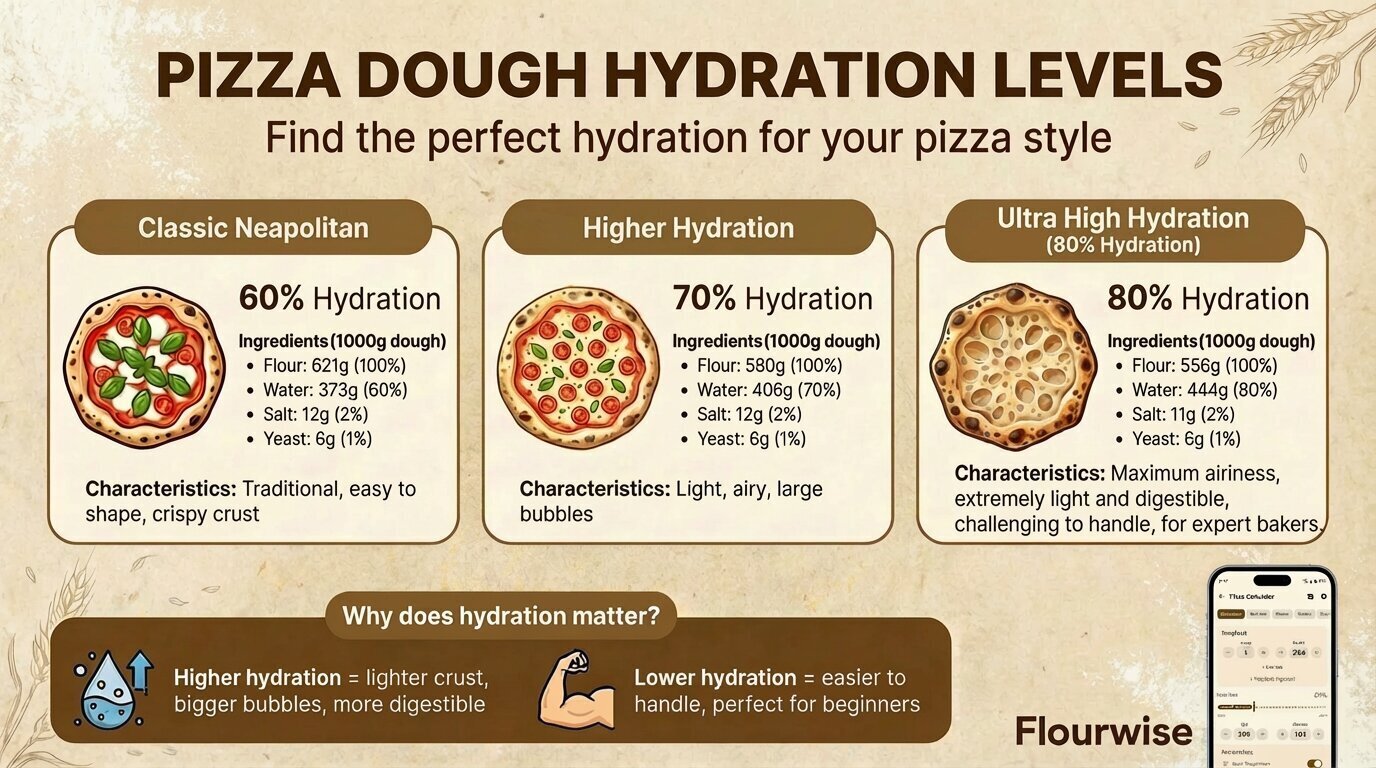
60% Hydration: Classic Neapolitan
Traditional texture, easiest handling
Traditional Hydration
Best for: Neapolitan pizza, thin NY-style, beginners
- Dough feels smooth and firm, similar to soft bread dough
- Easy to knead by hand, minimal sticking to work surface
- Shapes and stretches predictably without tearing
- Produces a crisp, slightly chewy crust with moderate chew
- Most forgiving for beginners – behaves consistently
My Testing Results at 60% Hydration
I tested 62% hydration (620g water per 1000g flour) using 00 pizza flour with 24-hour cold fermentation.
| Characteristic | My Observations |
|---|---|
| Dough Feel | Smooth, firm, easy to handle. Doesn’t stick to hands even without flour dusting. |
| Stretching | Stretches easily without tearing. Handles aggressive shaping. Holds shape well on the peel. |
| Crust Texture | Crisp outside, tender inside. Moderate chew. Air pockets were small and even – no huge bubbles. |
| Thickness | Stretched thinner than higher hydration. Could achieve that classic thin Neapolitan center. |
| Browning | Great browning and leopard spotting. Crisped nicely without being hard. |
At 60-62% hydration, I get remarkably predictable results. The dough produces consistently good pizzas with classic Neapolitan texture – crisp, slightly chewy, satisfying bite. The trade-off? Denser crumb without those spectacular air bubbles you see in high-end pizzerias. For that, I need higher hydration.
When to Use 60% Hydration
- You’re new to pizza making and want forgiving, consistent results
- You prefer traditional Neapolitan texture – crisp outside, tender inside, moderate chew
- You’re making pizza for a crowd and need reliable, fast shaping
- Your oven isn’t super hot (under 450°F) – lower hydration won’t dry out as much
- You like thin-crust pizza – easier to stretch 60% dough paper-thin
70% Hydration: Higher Hydration
Light, airy texture with large bubbles
Balanced Hydration
Best for: Modern Neapolitan, artisan pizza, NY-style
- Dough is slightly tacky but still manageable with flour dusting
- Noticeably softer and more extensible than 60% hydration
- Produces lighter, airier crust with larger air pockets
- More forgiving in the oven – stays tender even if slightly overbaked
- Sweet spot for home ovens that can reach 500-550°F
My Testing Results at 70% Hydration
I tested 70% hydration (700g water per 1000g flour) – this is my go-to for home oven pizza when I want lighter, airier texture.
| Characteristic | My Observations |
|---|---|
| Dough Feel | Soft and slightly sticky. Needed light flour dusting but wasn’t unmanageable. Felt alive and elastic. |
| Stretching | Stretches beautifully with minimal effort. More delicate than 60% – requires patient handling. Relaxes quickly after shaping. |
| Crust Texture | Noticeably lighter and airier. Crispy outside, tender and almost fluffy inside. Larger, irregular air pockets in the cornicione (edge). |
| Thickness | Harder to stretch paper-thin – dough wanted to spring back. Resulted in slightly thicker, puffier crust. |
| Browning | Excellent blistering and charring. Beautiful leopard spotting. Crust stayed tender even with aggressive browning. |
70% hydration is where I landed after testing the full range. The dough stretches with minimal resistance, relaxes beautifully, and produces that puffy, blistered edge I want. It’s trickier to handle than 60%, but the technique is straightforward. The texture improvement is worth it. This is my default hydration for home oven pizza at 500°F.
When to Use 70% Hydration
- You want airier, lighter crust without the extreme challenge of 80%
- You have a hot home oven (500°F+) or pizza steel/stone
- You’re comfortable with slightly sticky dough and gentle handling
- You prefer modern Neapolitan style – puffy edges with open crumb
- You want the best of both worlds – great texture with manageable handling
80% Hydration: Ultra High & Spectacular
Maximum airiness, requires experience and confidence
High Hydration
Best for: Contemporary artisan pizza, experienced bakers, show-stopping results
- Dough is very sticky and delicate – feels almost wet to touch
- Requires wet hands, confident movements, and patience
- Produces the lightest, most open crumb structure possible
- Spectacular visual results – enormous air bubbles and dramatic puffing
- Demands high heat and fast bake time to avoid sogginess
My Testing Results at 80% Hydration
I tested 78-80% hydration (780-800g water per 1000g flour). Challenging technique, but the results are worth it.
| Characteristic | My Observations |
|---|---|
| Dough Feel | Very wet and sticky – like thick batter that holds shape. Required wet hands and gentle handling at all times. |
| Stretching | Extremely delicate. Traditional stretching technique doesn’t work. Requires gentle pressing and gravity-assisted spreading. Tears easily without proper technique. |
| Crust Texture | Jaw-dropping results. Incredibly light, almost cracker-thin in center. Edges puffed dramatically with huge, irregular air pockets. Restaurant-quality appearance. |
| Thickness | Stretched thin naturally under its own weight. Center was very thin, edges were enormous and puffy – dramatic contrast. |
| Browning | Spectacular leopard spotting and blistering. Required very hot oven (550°F+) – at lower temps, bottom got soggy before top browned. |
80% hydration demands a completely different approach. I use wet hands, zero aggressive movements, and let gravity do the work. Get it right, and the results are spectacular – puffy, blistered edges with air pockets large enough to see through. The center stays crisp and light, almost crackery. This is show-off pizza that impresses every time.
When to Use 80% Hydration
- You’re experienced with pizza dough and comfortable with wet dough handling
- You have a very hot oven (550°F+) or outdoor pizza oven
- You want spectacular results and are willing to practice technique
- You’re making pizza for special occasions where appearance matters
- You prefer extremely light, airy texture over structural integrity
80% hydration isn’t better than 70% or 60% – it’s different. The handling difficulty increases significantly, and you need proper oven heat to make it work. Start at 65-70% and work your way up only if you want that ultra-light texture.
Calculate Any Pizza Hydration Instantly
- Presets for Neapolitan, NY-style, Roman & more
- Slide to adjust hydration, see weights instantly
- Poolish or biga? True hydration calculated automatically
Get Flourwise Free
iOS & Android · Free · No adsSide-by-Side Comparison
All three hydrations compared directly
| Factor | 60% Hydration | 70% Hydration | 80% Hydration |
|---|---|---|---|
| Handling Difficulty | Easy – minimal sticking | Moderate – slightly sticky | Difficult – very sticky |
| Stretching Ease | Easy, predictable | Easy with practice | Requires gentle technique |
| Crust Lightness | Moderate density | Light and airy | Extremely light, open |
| Air Pockets | Small, even | Medium to large | Huge, irregular |
| Chewiness | Moderate chew | Tender with slight chew | Very light, minimal chew |
| Oven Temperature Needed | 400-500°F works | 500-550°F ideal | 550°F+ required |
| Beginner Friendly | Very friendly | Friendly with practice | Not recommended |
| Visual Impact | Classic, consistent | Attractive, puffy edges | Show-stopping, dramatic |
How to Choose Your Hydration Level
Match hydration to your goals, equipment, and experience
Choose 60-65% If You:
- Are new to pizza making or want consistent, reliable results
- Prefer traditional Neapolitan texture – crisp outside, tender inside
- Like thin-crust pizza you can stretch paper-thin
- Have a standard home oven (400-500°F)
- Want pizza dough that shapes quickly for multiple pizzas
- Don’t want to deal with sticky dough
Choose 68-72% If You:
- Want lighter, airier crust with puffy edges
- Have a hot home oven (500°F+) with pizza steel or stone
- Are comfortable with slightly sticky dough and gentle handling
- Want the best balance of texture and manageability
- Prefer modern Neapolitan or high-end pizzeria style
- Have made a few dozen pizzas and want to level up
Choose 75-80% If You:
- Are experienced with wet dough handling
- Have a very hot oven (550°F+) or outdoor pizza oven
- Want spectacular, show-stopping visual results
- Prefer extremely light, delicate texture
- Are willing to develop technique with challenging dough
- Make pizza for special occasions rather than weeknight dinners
My recommendation:
Start at 65% for reliable results. Once comfortable, try 70% for lighter texture. With a pizza oven or very hot home oven, experiment with 80-85%. Most pizzerias use 65-72% – that range works for a reason.
Handling Tips for Each Hydration Level
Techniques I learned through trial and error
For 60% Hydration:
- Knead thoroughly – 8-10 minutes by hand to develop gluten
- Minimal flour dusting needed during shaping
- Can use aggressive stretching techniques without tearing
- Dough balls hold shape well – can stack in containers
- If too stiff, increase to 62-63% rather than jumping to 70%
For 70% Hydration:
- Use stretch-and-fold technique during bulk fermentation instead of aggressive kneading
- Flour your work surface generously when shaping
- Use gentle, gravity-assisted stretching – let dough relax and stretch naturally
- Oil your dough container to prevent sticking during proofing
- Keep hands slightly wet or floured when handling
- Give dough 5-10 minutes to relax if it resists stretching
For 80% Hydration:
- Use wet hands at all times – flour creates clumps
- Master the stretch-and-fold technique – this dough can’t be kneaded traditionally
- Shape on oiled surface, not floured
- Use pressing motion to flatten, then let gravity stretch it
- Transfer to peel immediately after shaping – it won’t hold shape long
- Work quickly once shaped – dough spreads and relaxes fast
- Use well-floured or semolina-dusted peel to prevent sticking
- Consider using a pizza turning peel for easier transfer
The key shift from 60% to 80% is working with the dough instead of fighting it. At 60%, I can force dough into shape. At 80%, forcing tears it – I use patience, gentle movements, and minimal intervention. The dough stretches on its own with the right technique.
Conclusion: There’s No “Perfect” Hydration
After testing all three hydration levels extensively, I’ve found that 60%, 70%, and 80% all produce excellent pizza – just different styles with different characteristics.
60% gives you reliable, traditional Neapolitan texture with easy handling. 70% offers the best balance of airiness and manageability for most home bakers. 80% creates spectacular results but demands experience and proper equipment.
My personal rotation:
- 65% for weeknight pizzas when I want fast, reliable results
- 70% for weekend pizzas when I have time to be careful
- 78% when I’m making pizza for guests and want to show off
Your ideal hydration depends on your oven, your flour, and your preferences. Test and compare to find what works for you.
Start at 65%, test thoroughly, document results. Then try 70% and compare. Most home bakers find their sweet spot in the 65-72% range – the optimal balance between texture and handling.
Quick Reference
- 60% = Traditional texture, easy handling, crisp crust, moderate chew
- 70% = Light and airy, balanced difficulty, puffy edges, ideal for most
- 80% = Spectacular results, difficult handling, requires experience and heat
- Start at 65% for initial testing, then experiment upward
- Hydration affects texture more than “wetness” – it’s about final crust structure
- Use a pizza dough calculator to dial in exact water amounts for any hydration level
- Need to convert oven temperatures? Use our temperature converter to switch between °F and °C
Frequently Asked Questions
What is pizza dough hydration?
Pizza dough hydration is the water weight divided by the flour weight, shown as a percentage. A 65% hydration pizza dough has 650g water for every 1000g flour. Higher hydration means a softer, stickier dough and usually a lighter, airier crust.
How do you calculate pizza dough hydration?
Divide the water weight by the flour weight and multiply by 100. For example, 650g water and 1000g flour gives 65% hydration. If you use poolish, biga, or sourdough starter, include the flour and water inside the preferment in the total flour and total water.
What hydration should pizza dough be?
Most pizza dough works best between 60% and 72% hydration. Use 60-65% for classic Neapolitan and easy handling, 65-70% for NY-style or a balanced home oven pizza, and 70-80% for lighter, airier artisan pizza if you can handle stickier dough.
What is the best hydration for Neapolitan pizza?
Traditional Neapolitan pizza uses 60-65% hydration for easy handling and a crisp, slightly chewy texture. I use 63% for authentic Neapolitan – it gives that classic texture without the stickiness of higher hydration doughs. For modern Neapolitan style with puffier edges, I go 68-70%.
Why use high hydration pizza dough?
High hydration (75-80%) creates an incredibly light, airy crust with large air bubbles and an open crumb structure. The texture is almost cracker-thin in spots with huge, puffy edges. However, it requires confident handling and experience with wet doughs. I use 75%+ when making pizza for special occasions where I want show-stopping results.
What hydration is best for beginners?
Start with 65% hydration. It’s forgiving to work with, shapes easily, and produces consistently good results. Once comfortable with the fundamentals, experiment with 68-70% for airier crust. Reserve 75%+ for after mastering sticky dough handling – the technique demands precision.
Does pizza dough hydration affect fermentation time?
Yes, but minimally. Higher hydration doughs ferment slightly faster because water facilitates enzyme activity. In my testing, 80% hydration fermented about 10-15% faster than 60% at the same temperature. The difference is noticeable over long cold ferments (24-72 hours) but negligible for same-day pizza. Temperature and yeast amount affect fermentation far more than hydration.
Can I change hydration in an existing recipe?
Yes, but expect different handling characteristics and texture. If a recipe calls for 65% and you want 70%, simply increase water by 5% of the flour weight (50g water per 1000g flour). The recipe ratios stay the same – you’re only adjusting water. Test the new hydration with a small batch first before making a full recipe.