AP vs Bread Flour vs 00 Flour: Pizza, Bread & Sourdough
⚡ What You’ll Learn in 60 Seconds
- AP flour: 10-11.7% protein, medium grind. Versatile for cookies, biscuits, soft sandwich bread, and casual sourdough.
- Bread flour: 12-13% protein, medium grind. The default for sourdough, bagels, NY pizza, and chewy artisan bread.
- 00 flour: “00” = grind fineness, not protein. Pizza-grade 00 (like Caputo Pizzeria) is 12.5% protein. Best for Neapolitan pizza and ultra-thin doughs.
- Absorption rule: Bread flour absorbs ~2-3% more water than AP. 00 absorbs slightly more than bread flour, but the dough feels different at the same hydration.
- Key insight: Protein percentage tells you how strong the gluten will be. Grind fineness tells you how the dough will feel. Both matter.
- Fast choice: Sourdough and chewy bread = bread flour. Cakes, cookies, and soft sandwich bread = AP. Neapolitan pizza = 00. Home-oven NY pizza = bread flour.
↓ Full 12-min guide with detailed comparisons, substitution rules, hydration adjustments, and which flour to use for what
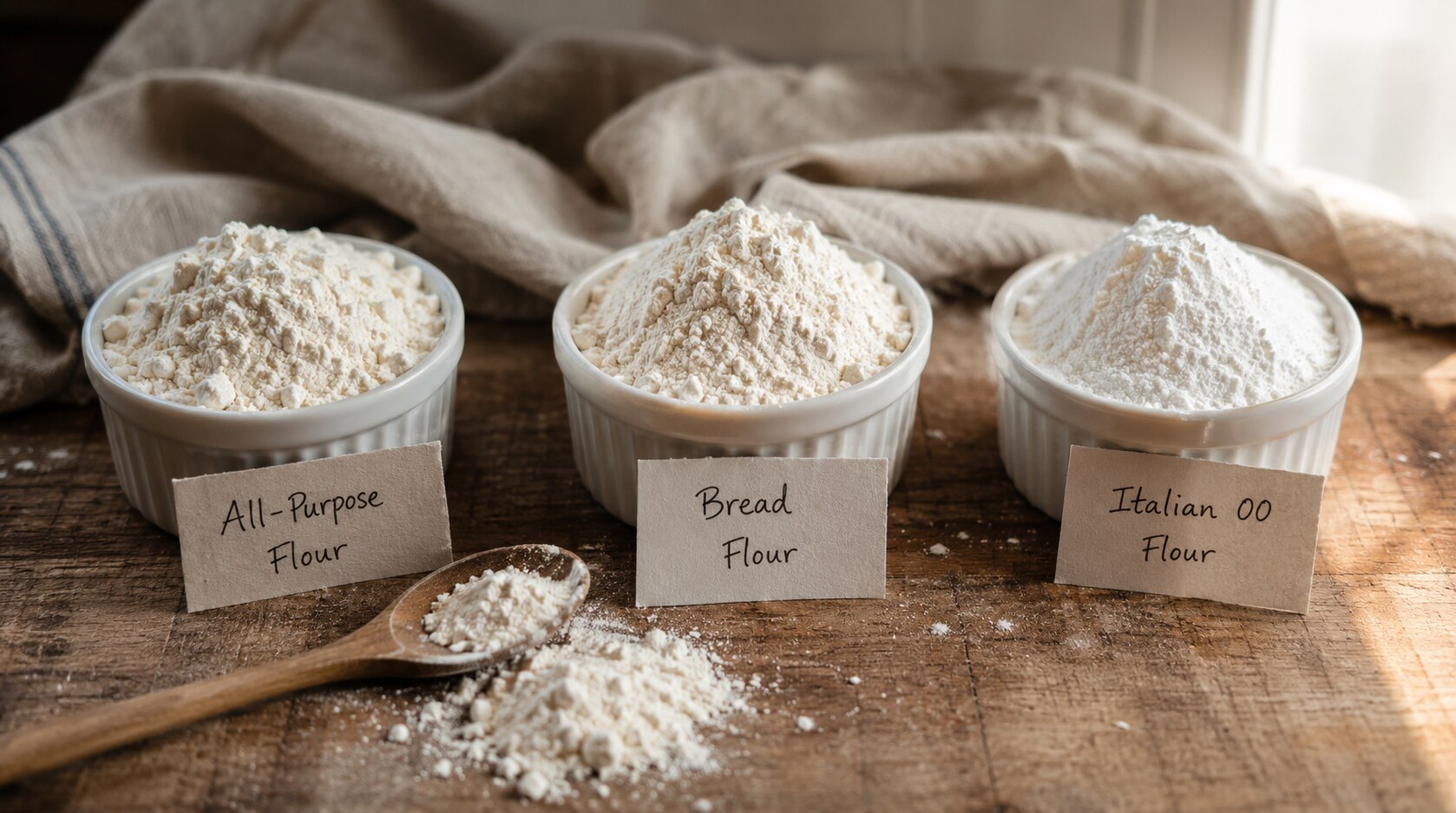
Flour choice changes everything about your bread. Same recipe, three different flours, three completely different loaves. If you’re comparing AP flour vs bread flour, bread flour vs 00 flour, or 00 flour vs all-purpose flour, the decision comes down to protein, grind, absorption, and what you’re baking.
I baked the same sourdough recipe three times in one week using three different flours: King Arthur AP (11.7% protein), King Arthur Bread Flour (12.7%), and Caputo Pizzeria 00 (12.5%). Same hydration target, same starter, same kitchen temperature, same fermentation schedule.
The AP loaf was soft, slightly tighter crumb, easier to shape. The bread flour loaf had more chew, better oven spring, more open crumb. The 00 loaf was the most extensible, almost too soft for a freestanding loaf, but had a tender, light texture that would be perfect for a Neapolitan-style pizza or focaccia.
That experiment told me what numbers on a flour bag couldn’t: AP, bread, and 00 flour aren’t interchangeable. They behave differently because they’re built differently. Once I understood the why, picking the right flour became automatic, and substitutions stopped being guesswork.
The “00” on Italian flour packaging is about how fine the flour is ground, not how strong it is. A bag of 00 pasta flour and a bag of 00 pizza flour look identical but bake completely differently. Always check the protein content, not just the grade.
Quick Answer: Which Flour Should You Use?
The practical answer before the deep dive
| If you are baking… | Use this flour | Why |
|---|---|---|
| Sourdough boule, batard, or chewy artisan bread | Bread flour | 12-13% protein gives stronger gluten, better gas retention, and better oven spring |
| Soft sandwich bread, cookies, cakes, biscuits, pancakes | All-purpose flour | Lower protein keeps the crumb tender instead of chewy |
| Neapolitan pizza or very thin pizza | Pizza-grade 00 flour | The fine grind makes the dough stretch thin without tearing |
| New York style or home-oven pizza | Bread flour | It gives more chew and handles longer bakes better than 00 |
| Focaccia or soft flatbread | Bread flour, 00 flour, or a blend | Bread flour adds structure; 00 makes the crumb softer and more extensible |
| Pasta | Pasta-grade 00 flour or semolina | The grind and wheat type are better suited to rolling and cutting |
For substitutions, use this rule first: bread flour absorbs about 2-3% more water than all-purpose flour. If you replace bread flour with AP flour, lower the water slightly. If you replace AP with bread flour, raise the water slightly. Pizza-grade 00 flour is close to bread flour in protein, but it feels softer and stretchier because it is milled much finer.
What Actually Defines a Flour
The two variables that matter most
Flour is more variable than people realize. Two bags labeled “all-purpose” from different brands can behave like different flours entirely. Once you know what to look at, the picture clears up.
1. Protein content (10-14% range for wheat flours)
Protein content determines how much gluten the flour can form when mixed with water. Higher protein = stronger gluten = chewier, more elastic dough = better oven spring and structure. Lower protein = weaker gluten = more tender, softer baked goods.
This is by far the biggest variable. A 10.5% AP flour and a 13% bread flour will produce visibly and texturally different bread, even with identical recipes.
2. Grind fineness
The flour’s particle size affects how it absorbs water and how the dough feels. Finely ground flour (like Italian 00) absorbs water faster and produces smoother, more extensible dough. Coarser-ground flour (like American bread flour) absorbs more slowly and produces more elastic, structured dough.
Grind matters less than protein for most baking, but it’s the secret behind why 00 flour and bread flour at the same protein content still behave differently.
Other factors worth noting:
- Bleached vs unbleached: Bleached flour produces softer crumb and lighter color but slightly weakens gluten. Unbleached is preferred for artisan bread.
- Malted vs unmalted: Some flours include barley malt for enzyme activity, which speeds fermentation. Most American flours are malted; many European flours aren’t.
- Wheat type: Hard red wheat (high protein, used for bread flour), soft red wheat (lower protein, used for AP and pastry), durum (very high protein, used for pasta).
Protein percentage is the most important number on the flour bag. If a brand doesn’t print it, look it up before buying. Two flours labeled “AP” can have wildly different protein content, and your bread will reflect that.
All-Purpose Flour: The Versatile Default
Medium protein, medium grind, designed for everything
All-purpose flour is the compromise flour. The protein and grind are calibrated to work passably for cakes, cookies, pancakes, biscuits, pizza, and bread, but it doesn’t excel at any single one.
Typical specs:
- Protein: 10-11.7% (varies by brand and region)
- Grind: Medium
- Hardness: Usually a blend of hard and soft wheat
- Color: Cream-white (unbleached) or bright white (bleached)
Brand variation is significant:
| Brand | Protein |
|---|---|
| King Arthur AP (US) | 11.7% |
| Bob’s Red Mill AP (US) | 10-11% |
| Gold Medal AP (US) | ~10.5% |
| Pillsbury AP (US) | ~10.5% |
| White Lily AP (Southern US) | 8-9% (unusually low) |
Note that “AP” in the southern US means something different from northern US. Southern AP (White Lily) is significantly lower in protein because it’s made for biscuits, using it for sourdough produces dense, soft, sandwich-style bread.
What AP flour does well:
- Cookies, cakes, pancakes, biscuits, scones (soft baked goods benefit from lower protein)
- Soft sandwich bread (mild chew, tender crumb)
- Pie crusts and pastries (less gluten = more tender)
- Casual same-day sourdough (works fine, produces softer crumb than bread flour)
- Roux, sauces, breading
What AP flour doesn’t do well:
- Long-fermented sourdough (gluten can break down over 12+ hour ferments with weaker AP)
- Bagels, pretzels, chewy artisan bread (lacks structure)
- Neapolitan pizza (wrong grind, wrong gluten characteristics)
- Pasta (needs durum or 00)
When my bread flour ran out mid-week, I substituted King Arthur AP at the same hydration. The dough handled almost identically and the loaf came out very close, slightly softer crumb, slightly less oven spring, but easily good bread. With Gold Medal AP (~10.5%), the same swap produced visibly tighter crumb and weaker structure. The protein percentage matters more than the brand label. If your AP is 11%+ it can mostly stand in for bread flour. If it’s below 10.5%, expect a noticeable downgrade.
Bread Flour: Strength for Structure
Higher protein for chewy, well-risen bread
Bread flour is what most American sourdough recipes assume by default. The higher protein creates a stronger gluten network that holds gas better during long fermentation and produces better oven spring.
Typical specs:
- Protein: 12-13% (some brands go up to 14%)
- Grind: Medium (similar to AP)
- Hardness: Hard red wheat (high protein varieties)
- Color: Cream-white (most are unbleached)
Brand examples:
| Brand | Protein |
|---|---|
| King Arthur Bread Flour | 12.7% |
| Bob’s Red Mill Artisan Bread Flour | 12.5% |
| Pillsbury Bread Flour | ~12% |
| Hodgson Mill Bread Flour | ~13% |
| Central Milling Type 70 | 13.5-14% |
What bread flour does well:
- Sourdough (the default choice, handles long fermentation, produces open crumb)
- Bagels, pretzels, chewy artisan bread (high protein = high chew)
- New York style pizza (chewy, crisp, sturdy crust)
- Focaccia (good structure, holds shape)
- Sandwich bread when you want chew (deli-style rye, sourdough sandwich)
What bread flour doesn’t do well:
- Cakes, cookies, pastries (too tough)
- Tender quick breads (banana bread, muffins, scones)
- Neapolitan pizza (grind isn’t fine enough)
- Pie crust (too elastic, won’t be flaky)
The hydration adjustment:
Bread flour absorbs 2-3% more water than AP flour. So a recipe that calls for 65% hydration with AP flour translates to 67-68% with bread flour to match the same dough feel. Recipes written for bread flour at 75% hydration become 72-73% with AP flour.
If you bake bread regularly, bread flour is worth the small price difference. King Arthur Bread Flour at 12.7% is a reliable benchmark, most sourdough recipes online assume something close to it.
00 Flour: The Fine-Grind Italian
Why grind fineness changes everything
00 flour confuses a lot of bakers. The “00” sounds like a strength rating but it actually refers to how finely the flour is milled. Italian flour grades go from 2 (coarsest) to 1, 0, then 00 (finest).
Typical specs (varies by type):
- Pizza-grade 00 (Caputo Pizzeria): 12.5% protein, very fine grind
- Pasta-grade 00 (Caputo Chef’s, similar): ~12-13% protein, very fine grind
- Cake/pastry 00: 9-10% protein, very fine grind
Why the fine grind matters:
The smaller particle size means flour particles hydrate faster and more evenly. This produces dough that’s:
- More extensible (stretches further before tearing)
- Smoother and silkier to handle
- Better at thin-stretching for pizza
- Less elastic, doesn’t snap back as much when stretched
Why protein still matters within 00:
A bag of pasta-grade 00 and a bag of pizza-grade 00 look identical but bake completely differently. Pasta 00 is bred for cake-like flour with low protein, using it for pizza produces dough that won’t hold together. Always check the protein content, not just the grade.
What 00 flour does well:
- Neapolitan pizza (the traditional choice, soft, extensible dough that stretches thin without tearing, see our Neapolitan pizza calculator for the matched dough math)
- Fresh pasta (the lower-protein 00 produces tender pasta)
- Focaccia (especially when you want very tender, soft crumb)
- Tuscan-style flatbreads
- Some cakes and pastries (the fine grind = soft texture)
What 00 flour doesn’t do well:
- Sourdough boules (too extensible, the loaf spreads more than rises)
- New York pizza (lacks the chew bread flour provides)
- Bagels, pretzels (protein is high enough but grind makes for less chew)
- High-hydration breads (gets sticky faster than bread flour at the same percentage)
The first time I made sourdough pizza using only Caputo Pizzeria 00 flour, the dough was dreamy to stretch, it pulled paper-thin without tearing. But when I made a regular sourdough boule with the same flour, the dough was so extensible that the loaf spread sideways during the bake instead of springing up. Same flour, different application, opposite results. Now I keep both bread flour and 00 in the pantry, bread flour for loaves, 00 for pizza nights.
Bake the Test, Remember the Result
The only way to feel the flour difference is to bake matched loaves and compare. Flourwise keeps the recipe identical and captures what came out of the oven.
- Baker’s percentage calculator scales one formula to three matched dough weights, only the flour changes
- Pizza calculator with Neapolitan, NY, Roman, Sicilian, and Detroit presets when 00 vs bread flour is the question
- Journal stores photos, ratings, and notes so two weeks later you remember which loaf was which
Three flours, three loaves, three journal entries. By the third bake you stop guessing and start picking on purpose.
Side-by-Side Comparison
All three flours at a glance
| Property | All-Purpose | Bread Flour | 00 Flour (Pizza) |
|---|---|---|---|
| Typical protein | 10-11.7% | 12-13% | 12.5% (Caputo Pizzeria) |
| Grind | Medium | Medium | Very fine |
| Water absorption | Baseline | +2-3% vs AP | Slightly higher than bread flour, but feels different |
| Gluten strength | Moderate | High | High but more extensible |
| Dough feel | Soft, manageable | Elastic, springy | Silky, very stretchy |
| Shaping | Forgiving | Holds shape well | Spreads more |
| Best for sourdough | Casual, soft loaves | Standard artisan | Not ideal alone |
| Best for pizza | OK for thick-crust | NY style | Neapolitan |
| Crumb texture | Tender, tighter | Chewy, more open | Tender, soft |
| Oven spring | Moderate | Strong | Moderate |
| Color of crumb | Slightly off-white | Cream | Bright white |
| Price (per pound) | Lowest | Mid | Highest (imported) |
Which Flour for Which Bake
A practical guide by recipe type
Sourdough boule, batard, or sandwich loaf: Bread flour (12-13% protein). King Arthur Bread Flour is the safe default. AP works if it’s at least 11% protein (King Arthur AP at 11.7% is fine), but expect softer crumb and slightly less oven spring.
Neapolitan pizza: 00 pizza flour (Caputo Pizzeria or similar). The fine grind and protein balance produce dough that stretches thin without tearing, essential for the 3-minute bake at 700°F+.
New York or American-style pizza: Bread flour. The chew and structure handle a longer, lower-temperature home oven bake better than 00. King Arthur Bread Flour is excellent here.
Detroit or pan pizza: Bread flour or high-protein AP. Needs structure for the deep-pan rise.
Focaccia: Bread flour for chewy texture, or a 50/50 bread flour and 00 blend for tender, light texture. 00 alone tends to spread too much.
Bagels, pretzels, chewy buns: Bread flour, ideally 13%+ protein. King Arthur Bread Flour, Hodgson Mill, or specialty high-gluten flours.
Soft sandwich bread (white, milk bread, brioche): AP flour. The lower protein produces the soft crumb you want. Bread flour makes brioche too chewy.
Sourdough discard pancakes, muffins, cookies: AP flour. Bread flour makes them tough.
Pie crust: AP or pastry flour. Bread flour creates a tough crust.
Pasta: 00 pasta flour or semolina (durum wheat). Bread flour or AP is too elastic and not extensible enough.
Whole wheat or rye blends: Use bread flour as the base white flour. It compensates for the gluten-disrupting bran in whole grains.
How to Substitute Between Them
When you don’t have the right flour
You can substitute most of these flours for each other if you make the right adjustments. Here’s how.
Bread flour → AP flour:
- Reduce hydration by 2-3% (bread flour absorbs more water)
- Expect slightly tighter crumb and less oven spring
- Reduce bulk fermentation by 30-60 minutes, weaker gluten can’t sustain as long a ferment
- Works well: short-ferment sourdough, soft sandwich bread
AP flour → bread flour:
- Increase hydration by 2-3%
- Expect chewier texture and better oven spring
- Bulk fermentation can run 30-60 minutes longer if needed
- Works great: standard artisan sourdough
Bread flour → 00 flour (pizza grade):
- Roughly equal hydration, but expect more extensible dough
- Reduce starter percentage slightly to keep dough manageable
- Shape immediately after dividing, 00 dough relaxes faster
- Works great: Neapolitan-style pizza
- Doesn’t work well: tall freestanding loaves
00 flour → bread flour:
- Roughly equal hydration, but expect more elastic, springier dough
- For pizza, give the dough longer to relax before stretching (or it’ll snap back)
- Works fine: pizza will be chewier and less authentically Neapolitan
AP flour → 00 flour:
- Increase hydration by 2-3% (00 has more protein)
- Same as bread flour to 00, more extensible dough
- Works for: pizza, focaccia
- Skip for: sandwich bread (the result will be too soft)
Mixing for desired effect:
- 50/50 bread flour and AP: middle ground, good for soft-but-structured sandwich bread
- 75% bread flour, 25% whole wheat: classic country sourdough
- 80% bread flour, 20% 00: hybrid pizza dough that’s chewier than pure 00 but stretchier than pure bread flour
- 50% AP, 50% whole wheat: hearty rustic bread, lower protein offset by whole wheat fiber
The 2-3% hydration adjustment between bread flour and AP is the single most useful rule for substituting. Forget the rule and your dough is either too dry (with AP at bread-flour hydration) or unmanageably wet (with bread flour at AP hydration). The recipe still works, just shift the water.
Brand Notes Worth Knowing
Specific flours that matter
A few brand-specific things worth knowing, many sourdough recipes are tested with specific flours, and the brand matters as much as the category.
King Arthur Flour (US):
- AP: 11.7% protein, high for AP, behaves almost like a low-protein bread flour
- Bread flour: 12.7%, the benchmark most sourdough recipes assume
- Most reliable for consistent results, batch to batch
Caputo (Italy):
- Pizzeria (red bag): 12.5% protein, the Neapolitan pizza standard
- Chef’s (blue bag): 13% protein, more elastic, better for longer fermentation
- Cuoco (also red bag, Italian market): same as Pizzeria, marketed for restaurants
Bob’s Red Mill (US):
- AP: ~10-11% protein, softer than King Arthur AP
- Artisan Bread Flour: 12.5%
- Their AP behaves more like Southern US AP, softer crumb
Gold Medal / Pillsbury (US):
- Standard AP: ~10.5%, middle of the range
- Better for tender baked goods than for sourdough
- Both make decent everyday flour but underperform for artisan bread
Specialty bread flours (Central Milling, Lindley Mills, Hayden, etc.):
- Often 13-14% protein
- Usually freshly milled, sometimes with malt added
- Worth the price for serious sourdough, produces noticeably better results
- Some require small hydration increases (14% protein flour absorbs more)
Conclusion: Match the Flour to the Bake
AP, bread, and 00 flour aren’t just three names for the same thing. They have different protein levels, different grinds, and different behaviors, and the bread you bake reflects which one you used.
The good news: once you understand the differences, picking the right flour becomes automatic. Sourdough loaf? Bread flour. Neapolitan pizza? 00. Cookies and cakes? AP. Substitutions still work, just adjust hydration by 2-3% and accept slightly different texture.
Buy a digital scale and a small bag of bread flour for your next sourdough bake. If you’ve been using AP, the difference will be obvious, better oven spring, more open crumb, more chew. The flour change does work that no technique adjustment can match.
Quick Reference
- AP flour: 10-11.7% protein, medium grind. Versatile, softer baked goods, casual sourdough
- Bread flour: 12-13% protein, medium grind. Default for sourdough, NY pizza, bagels, chewy bread
- 00 flour (pizza grade): 12.5% protein, very fine grind. Neapolitan pizza, soft focaccia
- “00” refers to grind fineness, not protein. Always check the protein content separately.
- Bread flour absorbs ~2-3% more water than AP flour
- 00 flour produces more extensible (stretchy) dough than bread flour at the same protein
- King Arthur AP (11.7%) and Bread Flour (12.7%) are the US benchmarks
- Caputo Pizzeria 00 is the standard for Neapolitan pizza
- Substitutions work, just adjust hydration by 2-3% when switching between bread flour and AP
- Brand matters: protein content varies significantly between brands at the same flour grade
Frequently Asked Questions
What is the difference between AP, bread, and 00 flour?
The two main differences are protein content and grind. All-purpose flour averages 10-11.7% protein and is medium-ground, versatile for most baking. Bread flour averages 12-13% protein and is medium-ground, best for chewy, structured bread. Italian 00 flour is very finely ground (the ‘00’ refers to fineness, not protein), and protein varies by type: pizza-grade 00 like Caputo Pizzeria is 12.5% protein, while pasta or cake 00 is much lower at 9-10%. The fine grind makes 00 absorb water differently and produces softer, more extensible dough than bread flour at the same hydration.
Can I substitute bread flour for AP flour?
Yes, but adjust hydration. Bread flour absorbs about 2-3% more water than AP flour because of its higher protein content. If your recipe calls for 65% hydration with AP flour, increase to 67-68% with bread flour to match the dough feel. The bread will have chewier texture and more open crumb. Going the other direction (substituting AP for bread flour), reduce hydration by 2-3% and expect slightly tighter crumb. AP flour generally works fine for everyday sourdough, it just produces a softer, less chewy loaf than bread flour.
Is 00 flour the same as bread flour?
No. The ‘00’ designation refers to how finely the flour is milled, not its protein content. Italian 00 pizza flour like Caputo Pizzeria has 12.5% protein, very close to American bread flour’s 12.7%, but the fine grind makes the dough behave differently. 00 flour produces more extensible (stretchy) dough that tears less when shaping pizza, while bread flour produces more elastic (springy) dough that holds shape better for sandwich and artisan bread. For Neapolitan pizza, 00 is the traditional choice. For most other bread, bread flour outperforms it.
What flour is best for sourdough?
Bread flour with 12-13% protein is the best default for sourdough. King Arthur Bread Flour (12.7%) is a reliable benchmark. The higher protein creates a stronger gluten network, which holds gas better during long fermentation and produces better oven spring. AP flour with at least 11% protein (like King Arthur AP at 11.7%) also works well and produces softer crumb. Avoid AP flour below 10.5% protein for sourdough, the gluten won’t be strong enough for a long bulk fermentation. For 100% whole wheat or rye sourdough, the protein content matters less because bran disrupts gluten anyway.
What flour is best for pizza?
It depends on the pizza style. For Neapolitan pizza baked at very high temperature (700°F+), Italian 00 flour like Caputo Pizzeria (12.5% protein) is traditional and produces the characteristic soft, chewy, slightly charred crust. The fine grind allows the dough to stretch thin without tearing. For New York style, American bread flour (12-13% protein) works better, it handles the longer, hotter home oven bake and produces a sturdier crust. For Detroit or pan pizza, bread flour or even high-protein AP flour works well. For sourdough pizza specifically, bread flour usually outperforms 00 because sourdough needs higher hydration to bake well.
Can I use 00 flour for bread?
You can use pizza-grade 00 flour for some bread, but it is not the best default for freestanding loaves. The fine grind makes 00 flour very extensible, so dough stretches easily but can spread sideways instead of holding height. It works better for focaccia, flatbread, and pizza than for tall sourdough boules. For sourdough bread, use bread flour as the base and blend in 10-30% 00 flour only if you want a softer, more extensible dough.
Can I use all-purpose flour instead of bread flour?
Yes, especially if the all-purpose flour is at least 11% protein. Reduce hydration by about 2-3% because AP flour absorbs less water than bread flour, and expect a softer loaf with slightly less chew and oven spring. King Arthur AP at 11.7% can work well for everyday sourdough, while lower-protein AP flour around 10% is better for softer sandwich bread, cookies, biscuits, and cakes.