Active Dry vs Instant vs Fresh Yeast: Which to Use & How to Convert
⚡ What You’ll Learn in 60 Seconds
- Same organism, three forms: All three are baker’s yeast (Saccharomyces cerevisiae) packaged with different moisture levels, granule sizes, and handling requirements
- Conversion baseline: Fresh : Active Dry : Instant = 3 : 1.2 : 1 by weight. So 30g fresh = 12g active dry = 10g instant
- Best default: Instant yeast: shelf-stable, no proofing needed, reliable
- Activation rule: Active dry traditionally needs proofing in warm water (105-110°F). Instant goes straight into flour.
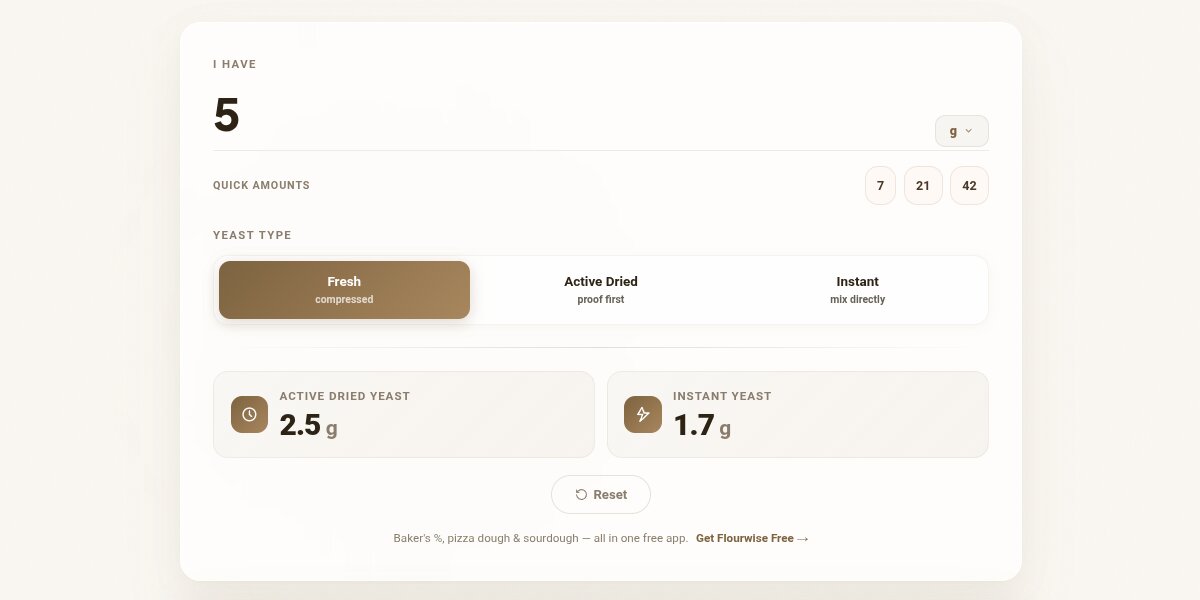
- Need exact grams? Use the fresh yeast to dry yeast converter for 5g, 10g, 15g, 25g, 42g, 50g, packets, teaspoons, and cubes.
- Key insight: All three make functionally identical bread. The difference is convenience, shelf life, and how forgiving each one is to your routine.
↓ Full 11-min guide with conversion chart, when to use each, substitution rules, and storage tips
All three types of yeast are the same organism: just packaged differently. The bread you bake with each will be virtually indistinguishable. The real differences are in how you handle them, how long they last on the shelf, and how forgiving they are when your timing slips. Pick the one that fits your kitchen, not the recipe.
I baked the same baguette recipe three times in one weekend using fresh yeast, active dry yeast, and instant yeast: converted by weight using the standard 3:1.2:1 ratio. Same flour, same hydration, same fermentation schedule.
The bread was almost identical. Slightly different aroma in the kitchen during proofing (fresh yeast smells more “yeasty”), maybe a 5% difference in oven spring, but the final loaves looked, tasted, and felt the same. The differences I’d read about online: that fresh yeast produces “better flavor” or that instant is “weaker”: didn’t show up in the actual bread.
The real differences turned out to be in handling. Fresh yeast has a 2-week shelf life and needs to be crumbled in. Active dry has a longer shelf life but traditionally needs proofing in warm water. Instant yeast goes straight into the flour, lasts 2 years sealed, and is the easiest to use. Once I understood that the choice is mostly about convenience, picking the right yeast became automatic.
The yeast types argument is mostly about workflow, not bread quality. If your bread is bad, the yeast type isn’t the problem. If your bread is good, switching yeast types won’t make it noticeably better.
All Three Are the Same Organism
Saccharomyces cerevisiae in different packages
The first thing to understand is that fresh, active dry, and instant yeast are all Saccharomyces cerevisiae: the same single-celled fungus that ferments bread, beer, and wine. The difference is in how the yeast is processed and preserved after it’s grown.
| Type | Water content | Yeast cells | Form |
|---|---|---|---|
| Fresh yeast (cake yeast) | ~68-70% | ~30-32% | Soft, crumbly block |
| Active dry yeast | ~7-8% | ~92-93% | Larger granules |
| Instant yeast | ~4-6% | ~94-96% | Fine granules |
The water content explains most of the conversion ratios. Fresh yeast is mostly water, so you need more of it by weight to get similar leavening power. Instant yeast is the driest and fastest-dispersing form, so you usually need the least.
The processing difference:
- Fresh yeast is just yeast cells suspended in water and a small amount of nutrients, pressed into blocks
- Active dry yeast is dried into larger granules; dead outer cells help protect living cells, and rehydration gives it the most predictable start
- Instant yeast is dried into smaller, porous granules that rehydrate rapidly when mixed directly into dough
The leavening result is functionally the same with all three types. The bread comes out the same. What changes is shelf life, handling, and how forgiving each one is to imperfect technique.
Fresh Yeast (Cake Yeast)
The traditional bakery yeast
Fresh yeast is the traditional bakery form, and it’s still used by some pizzerias and traditional bakeries today.
What it looks like:
Soft, crumbly blocks ranging from a small 42g cube (common in Europe) to a 1 lb (454g) block sold to professionals. Color is light tan to grayish-cream. Texture should crumble easily between fingers: if it’s hard or rubbery, it’s past its prime.
How to use it:
- Crumble directly into the dough or into the liquid
- Some bakers dissolve it in warm water first; not strictly necessary
- Keep direct contact with salt or sugar brief: mix them through the flour first so they do not sit concentrated on the yeast
- Standard amount: often 2-4% of flour weight for same-day bread, less for long fermentation
What it does well:
- Slightly fuller, more “yeasty” aroma during fermentation
- Some bakers report better flavor in pizza dough, especially Neapolitan
- Common in traditional bakery and pizzeria formulas, including cold-fermented doughs
- Traditional choice for old-school recipes
What it doesn’t do well:
- Very short shelf life: often 1-2 weeks for home bakers once purchased
- Hard to find in many regions (often only in European markets in the US)
- Awkward to measure for small batches without a precise scale
- Inconsistent quality if it sits on a store shelf too long
I used fresh yeast for 6 months when I could find it locally. The bread was good: but I went back to instant. The 2-week shelf life meant I either wasted half a block on every purchase or had to plan my baking around when I bought yeast. With instant in the pantry, I bake whenever I want with zero planning. The marginal flavor difference wasn’t worth the inconvenience for home baking.
Active Dry Yeast
The traditional grocery store yeast
Active dry yeast is what most American home bakers grew up with. Sold in those familiar 7g (1/4 oz) yellow packets and 4 oz jars, it’s been the home baking standard for decades.
What it looks like:
Coarse tan-colored granules, larger than instant yeast: closer to fine sand than fine powder. Sealed in vacuum packets or jars to preserve activity.
How to use it:
- Traditional method: dissolve in warm water (105-110°F / 40-43°C) with a pinch of sugar, wait 5-10 minutes for it to “proof” (foam up). This step verifies the yeast is alive and gets the cells active before adding to dough.
- Modern method: most modern active dry yeast can be added directly to flour without proofing. The instructions on the package usually still say to proof, but in practice it works fine direct.
- Standard amount: 1-2% of flour weight for bread
What it does well:
- Long shelf life: about 2 years sealed; about 4 months opened when stored airtight in the refrigerator or freezer
- Available everywhere: every grocery store carries it
- The proofing step is reassuring for new bakers (you literally see the yeast working)
- Cheap and reliable
What it doesn’t do well:
- Slightly less convenient than instant: the proofing step is technically optional but still advised on most packages
- Some cells are inactive after drying, so active dry usually needs slightly more by weight than instant in precision formulas
- Slower to start than instant yeast in cold doughs
Common brands:
- Fleischmann’s Active Dry Yeast (US standard)
- Red Star Active Dry
- SAF Active Dry (less common than their instant version)
Instant Yeast
The modern home baker’s default
Instant yeast is the most concentrated, most convenient, and most reliable form for home use. If you’re starting fresh today, this is what you should buy.
What it looks like:
Fine, evenly-sized granules: finer than active dry, about the texture of fine powder. Sold in vacuum-packed pouches (the European/professional standard) or jars.
Names you’ll see for instant-style dry yeast:
- Instant yeast
- Rapid-rise yeast
- Bread machine yeast
- Quick-rising yeast
- Fast-acting yeast
These are all instant-style dry yeasts. They can differ by strain, speed, and additives, but the handling is similar: they are designed to be mixed directly into the dough.
How to use it:
- Add directly to the flour: no proofing, no warm water
- Mix into dry ingredients before adding water
- Standard amount: 0.5-1.5% of flour weight for bread (less than active dry because it’s more concentrated)
- For long fermentation (overnight or longer): use as little as 0.2-0.5%: too much instant yeast in a long ferment causes overproofing
What it does well:
- No proofing required: saves 5-10 minutes per recipe
- Highest concentration of active cells: most reliable rise
- Long shelf life: about 2 years sealed; about 4 months opened when stored airtight in the refrigerator or freezer, often longer if frozen and kept dry
- Works in cold doughs that would slow active dry yeast down
- Forgiving: small dosage variations rarely affect the bread
What it doesn’t do well:
- Some recipe writers swear active dry produces better flavor: in practice the difference is undetectable in most home baking
- Very slightly less of a flavor “depth” in extremely short ferments (under 2 hours total)
Common brands:
- SAF Instant (red label): the professional gold standard, sold in 1 lb vacuum-packed bricks
- SAF-Instant Gold: for sweet doughs (osmotolerant for high sugar)
- Fleischmann’s Bread Machine Yeast (same thing, different label)
- Red Star Quick-Rise
If you’re picking yeast for general home baking, get SAF Instant Red. It’s the same yeast professional bakeries use, costs less per gram than supermarket packets, and lasts for 2 years sealed. A 1 lb (454g) brick is enough for hundreds of loaves.
Convert Yeast Types Without Math
Switching from fresh to instant or active dry to instant? The conversion is fast, but you don’t need to remember the ratios.
What Flourwise gives you for yeast handling:
- Built-in fresh yeast to dry yeast converter: convert any yeast type by weight in one tap
- Recipe calculator handles baker’s percentage automatically: yeast as % of flour weight
- Save your favorite recipes once and bake them with whichever yeast you have on hand
Yeast in your pantry doesn’t match what the recipe calls for? Convert in seconds, no math required.
Conversion Chart Between Types
A practical 3:1.2:1 baseline, with manufacturer caveats
The conversion ratio between fresh, active dry, and instant yeast is based on moisture, granule size, and live-cell concentration. King Arthur’s professional reference uses the same core multipliers in this chart: fresh yeast × 0.4 for active dry, and fresh yeast × 0.33 for instant.
Professional baseline: Fresh : Active Dry : Instant = 3 : 1.2 : 1
In practical terms:
| If recipe calls for | Substitute with |
|---|---|
| 30g fresh yeast | 12g active dry OR 10g instant |
| 21g fresh yeast | 8.4g active dry OR 7g instant |
| 12g fresh yeast | 5g active dry OR 4g instant |
| 14g active dry | 35g fresh OR 11g instant |
| 7g active dry (1 packet) | 17.5g fresh OR 5.5g instant |
| 10g instant | 30g fresh OR 12g active dry |
| 7g instant (1 packet) | 21g fresh OR 8.4g active dry |
Quick formulas:
- Fresh → Active dry: multiply by 0.4
- Fresh → Instant: multiply by 0.33
- Active dry → Fresh: multiply by 2.5
- Active dry → Instant: multiply by 0.75
- Instant → Fresh: multiply by 3
- Instant → Active dry: multiply by 1.33
Common conversions in tablespoons and teaspoons:
| Measurement | Fresh | Active dry | Instant |
|---|---|---|---|
| 1 packet | n/a (sold by weight) | 7g (2 1/4 tsp) | 7g (2 1/4 tsp) |
| 1 Tbsp | 17g | 9g | 9g |
| 1 tsp | 5.7g | 3g | 3g |
The “almost 1:1” reality:
In most home recipes, you can substitute instant for active dry (or vice versa) at a 1:1 ratio without noticing a difference. The 25% mathematical difference is real, but it falls within the natural variation of home baking: different yeast batch ages, different flour absorption, different room temperatures all matter more.
The 3:1 ratio between fresh and dry forms, however, is more important. Substituting fresh yeast 1:1 for instant in a recipe will severely under-yeast the dough.
Manufacturer caveat: consumer conversion charts are not perfectly uniform. Red Star and Fleischmann’s both treat one 7g packet of dry yeast as equivalent to a small fresh yeast cake of about 17g. King Arthur’s professional chart distinguishes active dry from instant and uses 30g fresh = 12g active dry = 10g instant. Both approaches work in real dough; the difference usually shows up as a faster or slower rise, not as a failed loaf.
If you just need the amount for a recipe, use the fresh yeast to dry yeast converter and choose whether you are converting from fresh, active dry, or instant yeast.
Which Yeast to Use When
Practical recommendations by use case
Default home baking (sandwich bread, pizza, simple loaves): Instant yeast. Get a 1 lb brick of SAF Instant Red, store it airtight in the freezer after opening, and test it if it has been open for more than a few months.
Long-fermentation breads (overnight cold ferment, no-knead, etc.): Instant yeast at very low percentages (0.2-0.5% of flour weight). Active dry works too at slightly higher amounts.
Sourdough recipes that call for “a little commercial yeast”: Instant. Use as little as 0.1-0.2%: just a pinch: to give wild yeast a backup.
Recipes from old cookbooks (pre-2000s): They usually mean active dry. Substitute instant at 0.75:1 or just use 1:1 for slightly faster proofing.
Pizzeria-style Neapolitan pizza: Either fresh yeast (traditional) or instant (modern). Both work well: fresh is the traditional choice.
Bread machines: Instant yeast (often labeled “bread machine yeast”). The auto-program assumes no proofing step.
Sweet doughs (brioche, panettone, hot cross buns): SAF Gold (osmotolerant instant yeast) or any instant yeast at slightly higher amounts (1.5-2% of flour). High sugar slows yeast, so you compensate with more.
Cold-environment baking (winter kitchens below 65°F): Instant yeast usually starts faster than active dry. Avoid letting instant yeast sit directly on ice or ice-cold water.
Backpacking or off-grid baking: Instant yeast in a vacuum-sealed packet. Long shelf life with no refrigeration needed.
For 95% of home bakers, instant yeast is the right answer. It’s more convenient, more shelf-stable, and produces functionally identical bread to fresh or active dry. Buy the bulk SAF Instant brick once and forget about yeast for two years.
Storage and Shelf Life
How long each type lasts
| Form | Sealed | Opened (refrigerated) | Frozen |
|---|---|---|---|
| Fresh yeast | Use by package date | Often 1-2 weeks once purchased | Possible, but not generally recommended |
| Active dry yeast | About 2 years | About 4 months | 6-12 months+ if airtight |
| Instant yeast | About 2 years | About 4 months | 6-12 months+ if airtight |
Storage rules:
- Sealed packets/bricks: Cool, dry pantry shelf is fine. Some bakers refrigerate sealed packages too: extends life slightly but isn’t necessary.
- Opened jars or partial bricks: Always refrigerate or freeze, ideally in an airtight container. Yeast loses leavening power faster when exposed to humidity, air, or heat.
- Freezing dry yeast: Active dry and instant yeast freeze well if kept dry and airtight.
- Freezing fresh yeast: Not generally recommended, because freezing can damage fresh yeast. If you freeze it anyway, portion it, wrap it airtight, thaw overnight in the refrigerator, and test activity before baking.
Testing if yeast is still alive:
Mix 2 1/4 tsp dry yeast (one 7g packet) with 1/4 to 1/2 cup warm water and 1 tsp sugar. For active dry yeast, 100-115°F is the usual range; for fresh yeast, use cooler water around 90°F. If the mixture foams significantly within 10 minutes, the yeast is alive. If nothing happens, discard and replace it.
This works for all three types but is most useful for active dry, where the proofing step is part of the normal workflow anyway.
Common Yeast Problems
When the dough doesn’t rise
Dough isn’t rising at all:
- Yeast is dead (most common cause): proof a sample to verify
- Water was too hot when proofing active dry yeast. Stay in the package’s recommended range, usually 100-115°F; much hotter water can damage or kill yeast.
- Yeast sat in direct contact with concentrated salt or sugar before mixing
- Room is too cold (below 65°F): yeast slows dramatically; warm the dough
Dough rising too slow:
- Used too little yeast for the recipe
- Cold kitchen (below 70°F): extend rise time or move to a warm spot
- Old or improperly stored yeast losing potency
- Used active dry without proofing in a recipe that needed quick activation
Dough rising too fast (overproofing):
- Used too much yeast
- Hot kitchen (above 80°F): reduce yeast or move dough to cooler spot
- Substituted instant for fresh at 1:1 instead of proper conversion
Bread tastes overly yeasty or “boozy”:
- Used too much yeast for the fermentation time
- Try reducing yeast and extending bulk fermentation: better flavor develops with less yeast and more time
- Standard rule: as fermentation time goes up, yeast amount goes down
Conclusion: Pick the Yeast That Fits Your Routine
The yeast aisle at the grocery store has multiple options, but the choice is simpler than it looks. All three types: fresh, active dry, and instant: produce essentially identical bread. The differences are in workflow, shelf life, and how easy each one is to keep on hand.
For most home bakers, instant yeast is the right default: shelf-stable for years, no proofing required, reliable results. Buy a 1 lb brick of SAF Instant Red, store it in the fridge after opening, and you have enough yeast for hundreds of loaves at a fraction of supermarket-packet pricing.
For your next bake: if you’re using active dry, try skipping the proofing step (just add it directly to the flour). If you’re using instant and you’ve never had access to fresh yeast, a one-time experiment will tell you whether the flavor difference matters to you. Most bakers find it doesn’t.
Quick Reference
- All three yeast types are baker’s yeast (Saccharomyces cerevisiae), but moisture, granule size, processing, and sometimes strain/formulation differ
- Conversion baseline: fresh : active dry : instant = 3 : 1.2 : 1 by weight
- 30g fresh = 12g active dry = 10g instant
- 1 packet (7g) instant = about 21g fresh by the professional ratio; 1 packet active dry = about 17.5g fresh. Some consumer brands round one dry packet to about 17-19g fresh.
- Instant yeast: most convenient, most concentrated, no proofing needed: best home default
- Active dry yeast: traditional, slightly less concentrated, often proofed in warm water (optional with modern brands)
- Fresh yeast: about 68-70% water, used in many traditional bakeries, often 1-2 week home shelf life once purchased
- Storage: dry yeast lasts about 2 years sealed and about 4 months opened when kept airtight in the refrigerator or freezer. Fresh yeast should stay refrigerated; freezing is possible but not generally recommended.
- Use 1-2% yeast (of flour weight) for standard bread, 0.2-0.5% for long-fermentation
- Best brand for serious home bakers: SAF Instant Red (1 lb bricks)
Frequently Asked Questions
What is the difference between active dry, instant, and fresh yeast?
All three are baker’s yeast (Saccharomyces cerevisiae) in different forms. Fresh yeast (cake yeast) is about 68-70% water and must be refrigerated. Active dry yeast is dehydrated to about 7-8% moisture and has larger granules; it traditionally performs best when rehydrated in warm water first, though many modern brands can be mixed directly into dough. Instant yeast is drier, about 4-6% moisture for SAF Instant Red, with finer granules that can be added directly to flour. Instant, rapid-rise, quick-rise, and bread machine yeast are all instant-style dry yeasts, though brands may use different strains or formulations.
What is the conversion ratio between fresh, active dry, and instant yeast?
A solid professional baseline is fresh : active dry : instant = 3 : 1.2 : 1 by weight. So 30g fresh yeast = 12g active dry = 10g instant. To convert fresh yeast to active dry, multiply by 0.4. To convert fresh yeast to instant, multiply by 0.33. To convert active dry to instant, multiply by 0.75. Manufacturer charts vary: some consumer brands treat one 7g packet of any dry yeast as equivalent to about 17-19g fresh yeast. Use the manufacturer’s chart when precision matters, and judge rise by dough volume rather than the clock.
Can I substitute instant yeast for active dry yeast?
Yes. For formula precision, use about 0.75g of instant yeast for every 1g of active dry yeast. For most home recipes, you can also substitute active dry and instant 1:1 and adjust rise time: instant usually starts faster, while active dry may take 15-20 minutes longer. Instant yeast can be added directly to flour. Active dry is traditionally dissolved in warm water first; many modern brands work when mixed directly into dough, but rehydrating is still the safest method when you need fast, predictable activation.
What is the best yeast for bread?
For most home bakers, instant yeast is the best default. It’s reliable, shelf-stable while sealed, works without proofing, and gives consistent results. SAF Red, Fleischmann’s Bread Machine Yeast, and Lesaffre Saf-Instant are excellent choices. Once opened, dry yeast should be sealed airtight and kept refrigerated or frozen; many consumer brands recommend using it within about 4 months, though freezer storage can keep it useful longer if it stays dry. For artisan bread with long fermentation, use small amounts of instant yeast, often around 0.2-0.5% of flour weight.
How long does fresh yeast last and can I freeze it?
Fresh yeast is highly perishable. In a home kitchen, plan on about 1-2 weeks once purchased, even though some packaged products have longer best-by dates when kept under a strict cold chain. Keep it refrigerated below 45°F (7°C), and discard it if it darkens, dries out, molds, or smells off. Freezing fresh yeast is possible but not generally recommended by Red Star because it can damage the yeast. If you freeze it, portion it, wrap it airtight, thaw overnight in the refrigerator, and test activity before baking. Active dry and instant yeast usually last about 2 years sealed; once opened, store airtight in the refrigerator or freezer and use within about 4 months for best reliability.