Pizza Calculator
Free pizza dough calculator & pizza size calculator with baker's percentage. Neapolitan, New York, Roman & Detroit styles — dial in hydration, cold fermentation, and dough ball weight for an easy pizza crust recipe every time.
Fine-tuning
Pizza Dough Hydration by Style
Every pizza style demands a different water percentage
TL;DR: Neapolitan pizza uses 55–65% hydration, New York style uses 60–68%, Roman tonda uses 65–80%, Roman al taglio goes up to 90%, and Detroit-style pan pizza uses 68–80%. Your flour type and oven temperature determine the sweet spot.
Hydration is the single most important variable in pizza dough. It controls the texture of the crust, how the dough handles during stretching, and the final bake. Too little water produces a tough, cracker-like crust. Too much water makes the dough impossible to shape and results in a soggy pizza in the middle. High hydration pizza dough (70%+) creates an airy, open crumb with crispy edges — perfect for Roman al taglio and Detroit-style pan pizza — but requires strong flour and confident handling. Use this pizza dough calculator to dial in the exact hydration for your style.
| Pizza Style | Hydration | Flour | Oven Temp | Bake Time |
|---|---|---|---|---|
| Neapolitan | 55–65% | Tipo 00 (11–13% protein) | 430–480°C / 800–900°F | 60–90 sec |
| New York | 60–68% | High-gluten bread flour (13–14.5%) | 290–315°C / 550–600°F | 8–12 min |
| Roman (tonda) | 65–80% | Strong bread flour (12–13%) | 280–320°C / 530–600°F | 3–5 min |
| Roman (al taglio) | 75–90% | Strong bread flour (13%+) | 280–320°C / 530–600°F | 8–15 min |
| Detroit | 68–80% | Bread flour (12–13%) | 230–260°C / 450–500°F | 12–15 min |
| Sicilian | 70–85% | Bread flour (12–13%) | 230–260°C / 450–500°F | 15–20 min |
| Home oven | 60–68% | Bread flour (12–13%) | 250°C / 500°F (max) | 8–12 min |
Key principle: Higher oven temperatures allow lower hydration because the intense heat rapidly gelatinizes starches and creates steam internally. Home ovens run cooler, so slightly higher hydration (62–68%) compensates and prevents a dry, tough crust. Use a pizza steel for the best results at home — it transfers heat 20× faster than a baking sheet.
Pizza Size Calculator: How Much Dough Per Pizza?
Dough ball weight guide — from personal pies to pizza for a party
TL;DR: A 12-inch Neapolitan pizza needs 250–280g of dough. A 14-inch New York slice needs 350–400g. Scale linearly by area: double the diameter = 4× the dough.
| Pizza Size | Diameter | Thin Crust | Medium Crust | Thick / Pan |
|---|---|---|---|---|
| Personal | 8″ / 20cm | 130–150g | 170–200g | 220–250g |
| Small | 10″ / 25cm | 180–210g | 230–260g | 300–340g |
| Medium | 12″ / 30cm | 250–280g | 300–350g | 400–450g |
| Large | 14″ / 35cm | 350–400g | 420–470g | 520–580g |
| Extra Large | 16″ / 40cm | 450–500g | 530–600g | 680–750g |
Quick formula: For a round pizza, the dough weight scales with the square of the diameter. If a 12″ pizza uses 270g, a 16″ pizza needs approximately 270 × (16/12)² = 270 × 1.78 ≈ 480g. This pizza dough calculator handles the math — set your flour weight based on total dough needed for all your pizzas.
Pizza calculator for party: Making 4 medium (12″) Neapolitan pizzas? You need 4 × 270g = 1080g total dough. Set the calculator to approximately 660g flour at 62% hydration with 2% salt, 1% yeast, and 3% olive oil. Hosting a bigger party? For 10 pizzas, multiply out to ~2700g dough — roughly 1650g flour. This pizza size calculator handles the math for any number of guests.
Pizza Dough Cold Fermentation Guide
How to make fermented pizza dough with maximum flavor
TL;DR: Cold fermentation (2–5°C / 36–41°F) for 24–72 hours develops complex flavors, improves digestibility, and makes the dough easier to stretch. Reduce yeast to 0.1–0.3% for long cold proofs.
The difference between good and great pizza is fermentation. A quick 2-hour room temperature rise produces a bland, bready crust. Cold fermentation slows yeast activity dramatically, allowing enzymes to break down starches into sugars and proteins into amino acids. The result: a crust with deeper flavor, better browning (Maillard reaction), and improved texture.
| Fermentation | Yeast % | Duration | Flavor | Best For |
|---|---|---|---|---|
| Same-day | 1–2% | 2–4 hrs (RT) | Mild, bready | Quick weeknight pizza |
| 24-hr cold | 0.3–0.5% | 1 hr RT + 24 hrs fridge | Good complexity | Everyday home pizza |
| 48-hr cold | 0.1–0.3% | 1 hr RT + 48 hrs fridge | Deep, complex | Neapolitan, NY style |
| 72-hr cold | 0.05–0.15% | 1 hr RT + 72 hrs fridge | Maximum depth | Competition-level pizza |
Sourdough pizza note: If using sourdough starter instead of commercial yeast, the fermentation timeline changes. Use 15–25% starter (at 100% hydration) and cold ferment for 24–48 hours. Beyond 48 hours, sourdough can overacidify the dough, making it too sour and weakening the gluten structure.
Pro tip: Ball your dough before the cold proof, not after. Cold dough is stiff and hard to portion evenly. Place individual dough balls in lightly oiled containers, seal, and refrigerate. Remove 1–2 hours before baking to let them reach room temperature.
Best Flour for Pizza Dough & Pizza Crust
00 flour vs bread flour vs all-purpose — protein content, gluten strength, and which Italian flour to buy
TL;DR: Use Tipo 00 flour (12–13% protein) for Neapolitan pizza, high-gluten bread flour (13–14.5%) for New York style, and standard bread flour (12–13%) for home oven pizza. Avoid all-purpose flour — it doesn't develop enough gluten.
| Flour Type | Protein | Best For | Popular Brands |
|---|---|---|---|
| Tipo 00 | 12–13% | Neapolitan, wood-fired | Caputo Pizzeria (12.5%), Le 5 Stagioni |
| Tipo 0 | 12.5–13.5% | Neapolitan, high-hydration | Caputo Nuvola (12.5%), Caputo Nuvola Super (13.5%) |
| High-gluten | 13–14.5% | New York, long ferment | King Arthur Sir Lancelot, All Trumps |
| Bread flour | 12–13% | Home oven, Detroit, pan | King Arthur Bread Flour, Bob's Red Mill |
| All-purpose | 10–11.5% | Not recommended for pizza | — |
00 Flour vs Bread Flour for Pizza
This is the most common flour question in pizza baking. Tipo 00 flour (also called double-zero or doppio zero) is finely milled Italian wheat flour with 12–13% protein. It produces a tender, extensible dough that stretches easily and bakes into a soft, slightly chewy crust — ideal for high-temperature Neapolitan ovens (450°C+). Bread flour is coarser with similar protein (12–13%) but creates a chewier, more structured crumb that browns better at lower temperatures. For home ovens maxing at 250°C, bread flour often outperforms 00 because it develops better color and crust. For wood-fired or Ooni ovens, 00 is the clear winner. Can you substitute? Yes — use the same weight, but expect a slightly different texture. All-purpose flour (10–11% protein) is not a good substitute for either — it doesn't develop enough gluten for proper pizza dough.
Why protein matters: Higher protein flour develops stronger gluten networks, which trap gas during fermentation and create the characteristic airy, chewy texture of good pizza crust. It also gives the dough more extensibility — the ability to stretch thin without tearing. When using the pizza dough calculator, remember that higher-protein flours can handle slightly higher hydration.
Learn more: Pizza Dough Hydration Explained
Salt & Olive Oil in Pizza Dough
Two ingredients that make or break your crust
Salt: the gluten builder you can't skip
Salt does three things in pizza dough: it tightens the gluten network (making the dough stronger and more elastic), it slows down yeast fermentation (giving you more control over timing), and it adds flavor. Without salt, the crust tastes flat and the dough ferments too fast, often collapsing before you can shape it.
Use 2–3% salt relative to flour weight. For Neapolitan pizza, the AVPN recommends roughly 3% (50–55g of salt per liter of water at ~60% hydration). New York style typically uses 2–2.5%. Fine sea salt or table salt dissolves fastest — coarse salt can leave undissolved pockets. Always add salt after autolyse (if you're doing one), never in direct contact with yeast before mixing.
| Pizza Style | Salt % | Per 1000g Flour | Notes |
|---|---|---|---|
| Neapolitan | 2.5–3% | 25–30g | AVPN standard; enhances leopard spotting |
| New York | 2–2.5% | 20–25g | Slightly less to balance sugar addition |
| Roman / Detroit | 2–2.5% | 20–25g | Standard range for pan styles |
| Long cold ferment (72h+) | 2.5–3% | 25–30g | Higher salt slows fermentation further |
Olive oil: when and how much
Not every pizza dough needs oil. Traditional Neapolitan dough uses zero oil — just flour, water, salt, and yeast. The intense oven heat (450°C+) creates the characteristic charred, puffy cornicione without any fat.
For home ovens and New York style, 2–5% olive oil (or vegetable oil) improves the crust by tenderizing the crumb, adding color in lower-temperature ovens, and extending shelf life. Add oil after the gluten is partially developed (5+ minutes into kneading) — adding it too early coats the flour proteins and slows gluten formation.
Detroit & pan pizza: Oil goes in the pan, not the dough. Generously oil the pan to create the signature crispy, fried bottom crust. The dough itself stays lean (0–2% oil).
Pizza Dough FAQ & Troubleshooting
What hydration should I use for Neapolitan pizza dough?
It depends on your oven. If you have a wood-fired or Ooni reaching 450°C+, stay at 55–60% — the extreme heat creates enough steam internally. For a home oven maxing at 250°C, go higher: 62–65% prevents a dry, cracker-like crust. A practical starting point: set the calculator to 60%, make one batch, and adjust by 2–3% up or down based on how the crust turns out. Also factor in your flour — Caputo Nuvola (Tipo 0, 12.5% protein) absorbs more water than standard Tipo 00.
How long should I cold ferment pizza dough?
For most home bakers, 48 hours is the sweet spot — noticeably better flavor without risk of overproofing. Here's how to time it: make your dough on Friday evening, ball it, put it in the fridge, and bake on Sunday. Use 0.1–0.2% instant yeast (just 1–2g per 1000g flour). The dough will rise slowly and develop a complex, slightly nutty flavor with beautiful brown spots when baked. If it smells too sour or feels slack after 72 hours, you've gone too far — reduce the time or lower fridge temperature.
What flour is best for pizza dough?
Match the flour to your oven. Wood-fired or Ooni (450°C+): Tipo 00 like Caputo Pizzeria — it browns without burning at extreme heat. Home oven (250°C): bread flour (12–13% protein) like King Arthur Bread Flour, which develops better color at lower temperatures. New York style in a deck oven: high-gluten flour (14%+ protein) like All Trumps for maximum chew. The one flour to avoid is all-purpose (10–11% protein) — it tears during stretching and produces a dense, crumbly crust.
How much dough do I need per pizza?
A practical rule: 0.9–1.1g of dough per cm² of pizza for thin to medium crust. A 30cm (12″) pizza has an area of ~707cm², so 250–280g works. For quick mental math: multiply the diameter in inches by 20 to get a ballpark weight in grams. So a 14″ pizza ≈ 280g (thin) to 400g (medium). Making pizza for a party? Set the calculator to your total flour and check the total dough weight — divide by your ball weight to see how many pizzas you'll get.
Can I use sourdough starter in pizza dough?
Yes, and it produces a crust with more depth than commercial yeast alone. The key is accounting for the starter's flour and water: 200g of starter at 100% hydration = 100g flour + 100g water. So if your recipe calls for 1000g flour at 62% hydration, and you add 200g starter, your actual flour is 1100g (1000 + 100) and you need 582g of additional water (1100 × 0.62 − 100). Add the preferment in the calculator — it does this math automatically. Cold ferment 24–48 hours; beyond that, sourdough tends to overacidify.
Why does my pizza dough keep shrinking back when I stretch it?
The fix is almost always more rest time. Gluten tightens during balling — it needs 1–2 hours at room temperature to relax before you can stretch it. A quick test: poke the dough with a floured finger. If it springs back immediately, it needs more time. If the indent stays, it's ready. Other culprits: hydration below 58% (add more water next time), or the dough was kneaded too aggressively in a stand mixer. Cover it, wait 15 minutes, and try again.
What temperature should I bake pizza at?
As hot as possible. For a home oven: crank it to maximum (usually 250°C / 500°F), place a pizza steel or stone on the top rack, and preheat for a full hour. Bake time: 7–10 minutes. For a portable pizza oven (Ooni, Roccbox): aim for 430–480°C on the stone surface, which bakes a Neapolitan pizza in 60–90 seconds. The biggest home oven mistake is not preheating long enough — a cold stone absorbs heat from the dough instead of crisping the bottom.
How do I stretch pizza dough without tearing it?
Three rules: room temperature, dry surface, gentle hands. Flour your work surface generously. Press from center to edge with your fingertips, rotating the dough 90° after each pass. Leave a 1–2cm rim untouched for the cornicione. Once it's about 20cm wide, drape it over your knuckles and let gravity stretch it — rotate slowly. If it resists, put it down and wait 5 minutes. Never use a rolling pin — it degases the dough completely and produces a flat, cracker-like crust with no airy edge.
Why is my pizza dough not rising?
First, check your yeast: dissolve it in warm water (35–38°C / 95–100°F) with a pinch of sugar. It should foam within 10 minutes — if it doesn't, the yeast is dead. The most common killer is water that's too hot: anything above 45°C (113°F) kills yeast instantly. Other causes: salt was mixed directly with yeast before adding flour (salt dehydrates yeast cells), or the dough is in a cold environment with very little yeast. For cold-fermented dough, don't expect a dramatic rise in the fridge — a 20–30% volume increase over 24 hours is completely normal.
How to fix sticky pizza dough?
Sticky dough is usually underdeveloped gluten, not too much water. High-hydration dough (above 65%) will feel sticky until the gluten network forms — keep kneading or do 3–4 sets of stretch-and-fold at 30-minute intervals. When handling, wet your hands instead of adding flour, which changes the hydration ratio and creates dry spots. If the dough was fine before cold ferment but is now a sticky mess, it overfermented: the gluten broke down. Next time, use less yeast or shorten the cold proof by 12–24 hours.
How much salt should I put in pizza dough?
Use 2–3% of flour weight. For a batch with 1000g flour, that's 20–30g of fine salt. Neapolitan tradition leans toward 3% (the AVPN standard), while New York style often uses 2–2.5%, especially when sugar is added. Salt does more than flavor — it tightens gluten and slows fermentation. Below 2%, the dough ferments too quickly and the crust tastes bland. Use fine sea salt or table salt for even distribution; coarse salt can leave salty pockets. Add salt after autolyse if you're using one.
What's the difference between 00 flour and bread flour for pizza?
00 flour (doppio zero / double-zero) is finely milled Italian wheat flour — the grind is ultra-fine, like talcum powder. It has 12–13% protein and produces a soft, extensible dough that stretches easily without snapping back. It's the standard for Neapolitan pizza baked in wood-fired ovens at 450°C+. Bread flour has similar protein (12–13%) but a coarser grind, creating a chewier, more structured crumb with better browning at lower temperatures. For home ovens (250°C max), bread flour usually outperforms 00 — the crust gets better color and crunch. For Ooni or wood-fired ovens, 00 is the way to go. All-purpose flour (10–11% protein) is not recommended for pizza — it tears during stretching and produces a dense, crumbly crust. Bottom line: match your flour to your oven temperature.
Why is my pizza soggy in the middle?
A soggy center usually comes from one of four causes: 1) Oven not hot enough — preheat your pizza steel or stone for a full 45–60 minutes at maximum temperature. A cold stone absorbs heat from the dough instead of crisping it. 2) Too many wet toppings — fresh mozzarella, tomatoes, and vegetables release water during baking. Pat mozzarella dry, pre-cook watery vegetables, and use a well-drained sauce. 3) Dough too thick in the center — when stretching, press firmly from the center outward so the middle is the thinnest part. 4) Hydration too high for your oven — home ovens can't evaporate as much water as a 450°C pizza oven. If your crust is soggy at 68% hydration, drop to 62–65% and try again. A pizza steel (not stone) also helps — steel transfers heat 20× faster.
Baking Guides & Tools
 Hydration
 Pizza Dough Hydration Explained
How water percentage affects your pizza crust — from Neapolitan to Detroit, with visual crumb comparisons.
Read article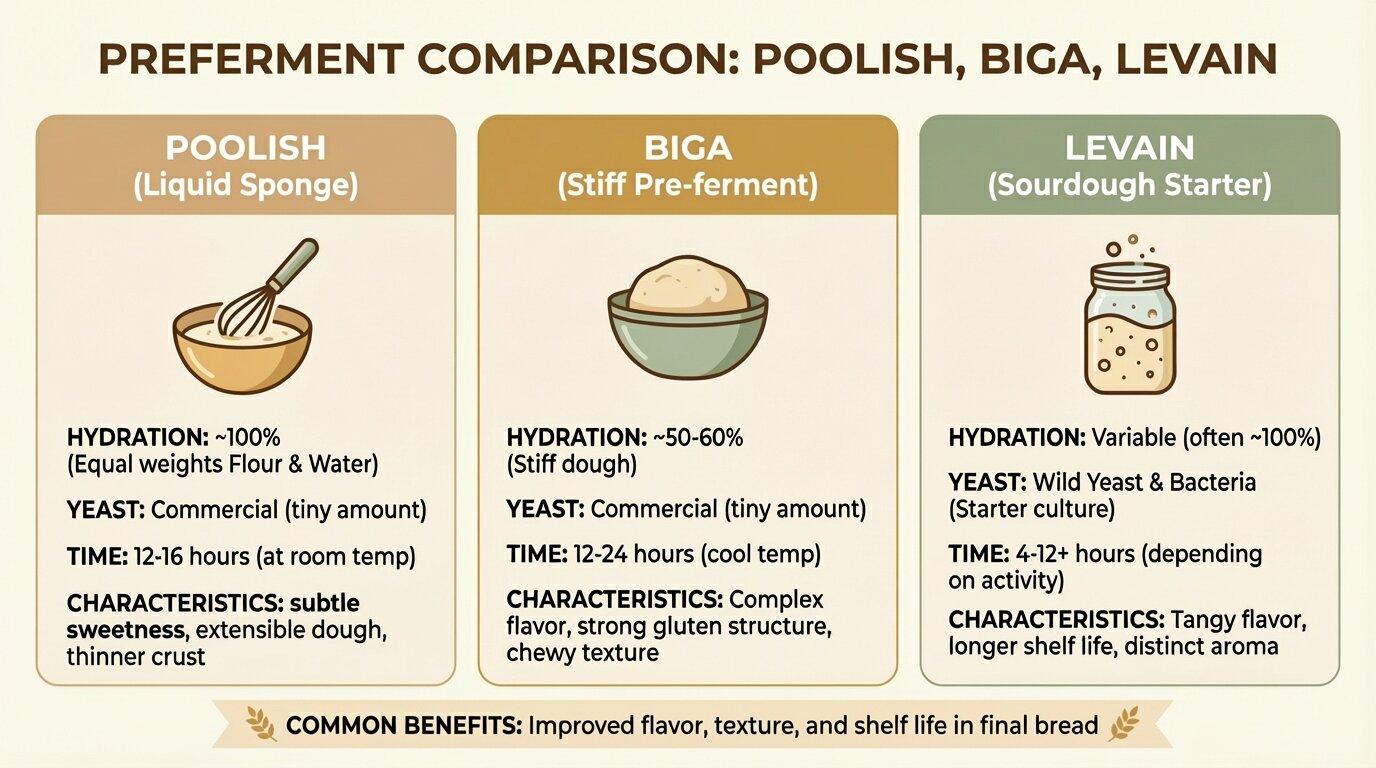 Hydration
 Poolish vs Biga vs Levain
The three major preferments compared — which one to use for your pizza dough and why.
Read article Calculator
 Baker's Percentage Calculator
Full baker's calculator with presets for sourdough, ciabatta, brioche, bagels and more.
Open calculator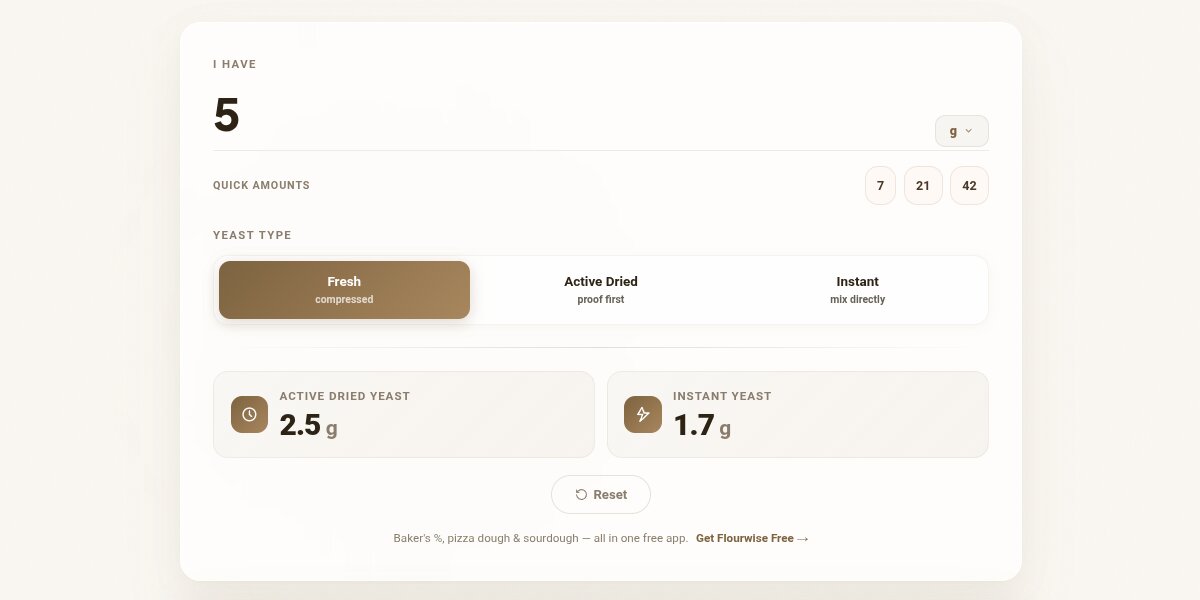 Tool
Tool Yeast Converter
Convert between fresh, active dry and instant yeast — get the right amount for your pizza dough.
Open converterFull Pizza Dough Calculator in the App
Dedicated pizza mode with style presets, dough ball divider, cold fermentation planner, and baking mode with step-by-step timers. Set your number of pizzas and ball weight — get exact ingredient amounts per ball.
Get Flourwise Free