Sourdough Discard: What It Is & What to Do With It
⚡ What You’ll Learn in 60 Seconds
- What it is: The portion removed before feeding an established starter.
- Storage: For predictable quality, use within about 1-2 weeks; keep it lidded at 40°F (4°C) or colder.
- Freezing: Up to about 3 months for best quality. Weigh each portion because tray sizes vary.
- 5 useful recipe categories: Pancakes/quick breads, crackers, pizza/focaccia, cakes, savory applications
- Key insight: Saving discard is optional; keep only clean discard from an established starter that you expect to use.
↓ Full 11-min guide with storage, freezing, recipe categories, and how to substitute discard for flour-water in recipes
Discard from a healthy, established starter can become a useful baking ingredient instead of waste. This guide covers when it is worth saving, how to store it, and the categories of cooked or baked recipes where it works best.
Saving discard is optional, not a requirement of good starter maintenance. If you bake with it, a small dated jar in the refrigerator prevents the accumulation from getting out of control. Pancakes, crackers, quick breads, and doughs with another dependable leavener are practical uses.
The important distinction is between established-starter discard and the material removed while building a new starter. During the early days, the culture is still changing and may smell unpleasant or show unusual microbial activity. Do not save that early discard for food; wait until the starter is established and behaving normally.
Discard from an established starter is fermented flour and water. Save only what you can store cleanly and use in a cooked or baked recipe.

What Sourdough Discard Actually Is
A simple definition
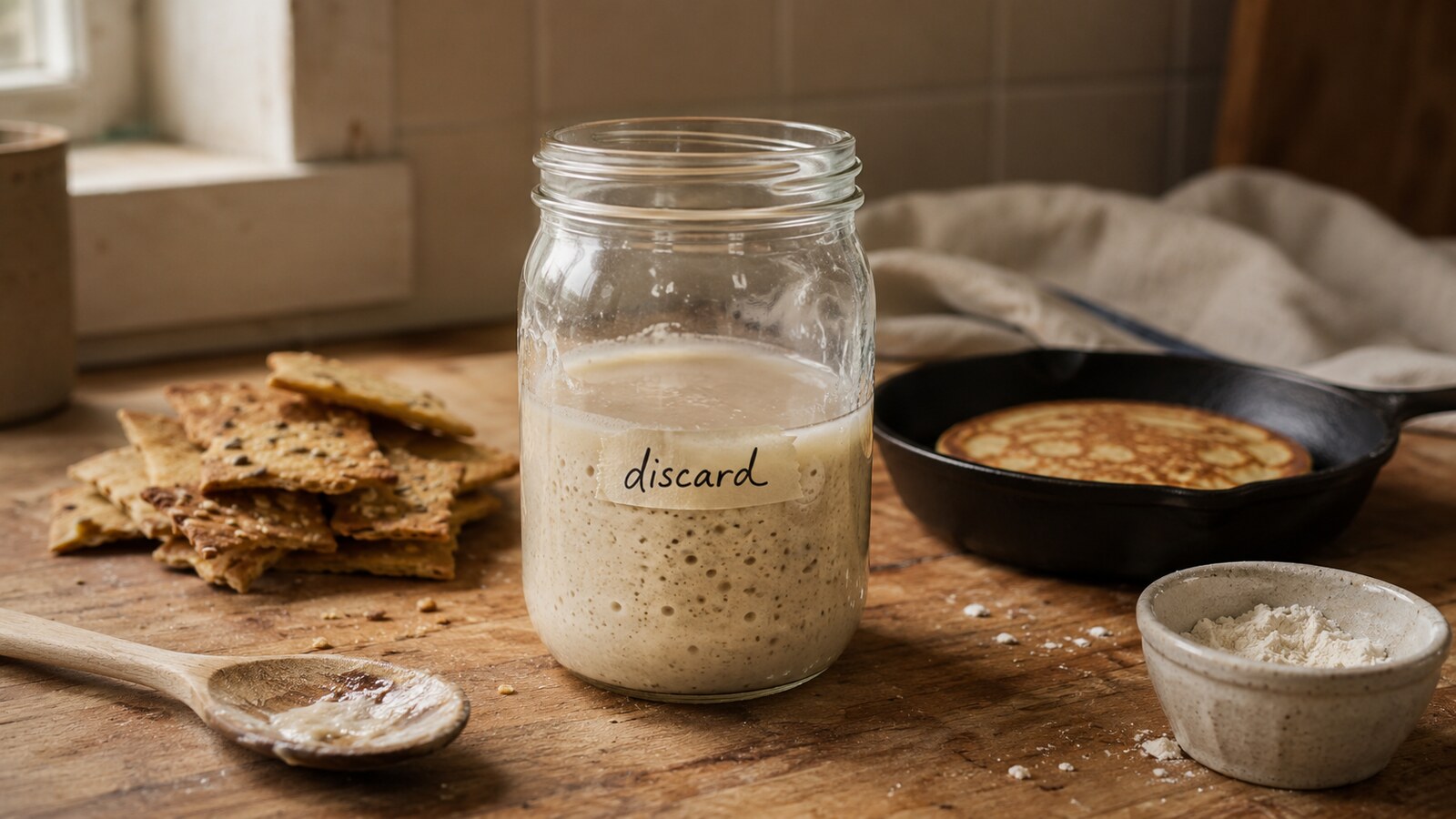
Sourdough discard is the portion of starter you remove during feedings. When you maintain a starter, you can’t keep adding flour and water indefinitely: the volume would grow exponentially. So during each feeding, you remove most of the existing starter (the discard) and feed what remains with fresh flour and water.
What’s left in the discard jar is still real starter:
- Fermented flour and water at 100% hydration (typical maintenance)
- A community of yeasts that may be less active than in a starter at peak
- Lactic acid bacteria that contribute acidity and aroma
- Fermentation byproducts that create tangy flavor
- Flour enzymes that continue acting while the mixture rests
Discard comes from starter, but its condition varies. It may be freshly removed and still active, or it may have spent days in the refrigerator with much less predictable leavening power. Treat it as a flavor and flour-water component unless a tested recipe specifically depends on its activity.
Discard is starter removed during maintenance, but its activity depends on when it was removed and how it was stored. For reliable bread leavening, use starter at the stage required by the recipe.
Why Bakers Usually Discard
The math of starter maintenance
The simplest reason for discard: math. If you feed your starter without removing any first, the volume doubles or triples with every feeding.
Starting with 50g starter:
- After feeding 1 (1:1:1 ratio): 50g + 50g flour + 50g water = 150g
- After feeding 2 (without discard): 150g + 150g flour + 150g water = 450g
- After feeding 3: 1350g
- After feeding 4: 4050g
- After 10 feedings: 2.95 million grams (almost 3 metric tons)
Obviously impossible. So before each feeding, you typically discard most of the starter, leaving just enough to feed and grow back to a manageable size.
Why discard makes feeding practical:
Removing starter is mainly a size-management step. It lets you provide a meaningful proportion of fresh flour and water without creating an ever-growing batch. The refreshment supplies food and dilutes accumulated acids and fermentation byproducts. You could technically retain everything and add a proportionally enormous feed, but discarding or using part of the culture is the practical way to keep the quantity manageable.
One common maintenance approach:
- Keep a small measured amount of starter
- Feed it at the ratio and hydration used by your maintenance routine
- Refrigerate only the discard from a healthy, established starter that you expect to use
For more on the feeding process, see the feeding guide.
How to Store Discard
Keeping it usable for as long as possible
Storage is straightforward, but clean handling and refrigeration still matter.
Container:
- A clean glass or food-safe plastic container with a lid
- 16-32 oz (500ml-1L) is a good size for most home bakers
- Wide mouth makes scooping easier
- Leave headroom and do not fill the jar to the top; cold discard may still expand
Temperature:
- Refrigerator at 38-40°F (3-4°C)
- Refrigerate promptly if you are saving it for later
Adding to existing discard:
- Each time you feed your starter, add the new discard to the same jar
- Stir only with a clean utensil
- Label the jar with the oldest date and empty and wash it regularly
Hooch (the liquid layer):
Refrigerated discard may separate and develop a grayish or brownish liquid layer, often called hooch. If there are no spoilage signs, you can:
- Stir it back in (slightly more alcoholic flavor in the discard)
- Pour it off (milder flavor, but this changes the mixture’s hydration and makes substitution math less exact)
Either option can work when the discard otherwise looks and smells normal. Liquid separation does not override mold, colored streaks, or a rotten smell.
A 1-2 week window is a conservative quality target. Some established-starter discard can remain usable for several weeks under clean refrigeration, but flavor becomes more acidic and condition matters more than the calendar. When in doubt, discard it.
Freezing Discard for Longer Storage
For when you have more discard than you can use
If you accumulate more established-starter discard than you can use promptly, freezing measured portions is convenient.
The ice cube method:
- Weigh discard into a silicone tray and note how much each cavity holds
- Freeze until solid (4-6 hours)
- Transfer frozen cubes to a labeled freezer bag
- Label with the date and use within about 3 months for best quality
Using frozen discard:
| Recipe type | How to use frozen discard |
|---|---|
| Pancakes, waffles, banana bread | Thaw in the refrigerator so it mixes evenly |
| Crackers, crispbread | Thaw in fridge overnight, then use at room temp |
| Pizza dough, focaccia | Thaw in fridge overnight, warm to room temp 1-2 hours before using |
| Cookies, cakes | Thaw in the refrigerator, then mix according to the recipe |
Why freezing works:
Freezing preserves a useful flour-water ingredient and much of its fermented flavor, but microbial survival and activity are not predictable enough to promise the same leavening as fresh active starter. In pizza or focaccia, use active starter or commercial yeast unless a tested formula explicitly uses thawed discard as its leavener.
5 Useful Recipe Categories for Discard
Where discard adds the most value
Discard works in different recipes for different reasons. Use a tested discard recipe when possible, because its flour, water, and acidity can change texture and chemical leavening.
1. Quick breads and pastries (no active fermentation needed)
- Pancakes and waffles
- Banana bread, zucchini bread
- Biscuits, scones
- Muffins, quick breads
- Crepes, blini
Why discard works: these recipes usually rely on baking soda, baking powder, eggs, or a combination rather than starter activity. Discard adds fermented flavor and contributes flour and water. Follow a tested formula so the acidity and leavener remain balanced.
2. Crispy applications (high acidity helps)
- Crackers and crispbread
- Tortillas and flatbreads
- Pita
- Lavash
- Pretzels (savory)
Why discard works: the fermented mixture contributes tang and can change dough extensibility and browning. The final texture still depends on fat, thickness, bake time, and the recipe’s overall hydration.
3. Pizza and focaccia (flavor enhancer)
- Same-day pizza dough (with commercial yeast as primary leavener)
- Focaccia
- Pizza al taglio
Why discard works: discard contributes fermented flavor even when commercial yeast or active starter provides dependable leavening. Use the amount and yeast rate specified by a tested pizza or focaccia formula.
4. Cakes and sweet baked goods (subtle complexity)
- Chocolate cake
- Brownies
- Coffee cake
- Pound cake
- Carrot cake
Why discard works: a tested amount can add subtle fermented flavor. Because discard changes acidity and hydration, do not adjust baking soda or baking powder casually; use a formula developed for discard.
5. Savory applications
- Sourdough crackers with cheese, herbs, seeds
- Sourdough croutons
- Sourdough pretzels
- Sourdough flatbreads with toppings
- Sourdough biscuits with savory mix-ins
Why discard works: the tang pairs well with cheese, garlic, rosemary, black pepper, and olives. The usable amount depends on the recipe.
A tested discard recipe is the safest starting point. Once you understand the ingredient math, you can experiment with replacing part of the flour and liquid, but texture, milk solids, eggs, sugar, fat, acidity, and chemical leaveners may still need adjustment.
Track Discard Recipes With Photos
Save the recipes that work and note the amount and hydration of discard you used. Repeated records make comparisons easier.
What Flourwise gives you for sourdough management:
- Built-in journal: log every bake including discard recipes
- Recipe manager and baker’s-percentage calculator for saving adjusted formulas in grams
- Step-by-step baking mode with active timers for pizza, focaccia, and other saved recipes
Discard isn’t waste. It’s an ingredient. The right tool helps you treat it that way.
How to Substitute Discard for Flour and Water
The math behind discard recipes
Most discard recipes work by replacing some of the recipe’s flour and water with an equivalent amount of discard. The math depends on the discard’s hydration.
Standard 100% hydration discard:
Many home starters are maintained at 100% hydration, meaning equal flour and water by weight. Confirm your own starter’s hydration before calculating a substitution.
If your discard is 100g, it’s effectively:
- 50g flour
- 50g water
As a starting calculation, 100g of this discard contributes 50g flour and 50g water. Whether both can be subtracted directly depends on the recipe.
Example: estimating a discard substitution in pancakes
Original recipe:
- 200g all-purpose flour
- 240g milk
- 1 egg
- 30g sugar
- 6g baking powder
Adding 200g of discard:
- 200g − 100g (the flour from discard) = 100g flour
- 240g − 100g (the water from discard) = 140g milk
-
- 200g discard
- 1 egg, 30g sugar, 6g baking powder (unchanged)
This accounts for ingredient weight, but it does not guarantee the same batter. Milk contains solids as well as water, and discard changes acidity. Treat the calculation as a test batch and keep the original leaveners unchanged unless you are following a tested conversion.
Different hydration discard:
If your starter is at 50% hydration (stiff starter), 100g of discard contains 67g flour and 33g water. Calculate the substitutions accordingly.
For 75% hydration discard: 100g contains 57g flour and 43g water.
General rule:
For 100% hydration discard, 1g contributes 0.5g flour and 0.5g water. That solves the ingredient math, not every recipe adjustment.
Flour is a raw food. Do not taste discard, raw batter, or raw dough; use discard only in recipes that will be thoroughly cooked or baked.
When Discard Is Past Its Prime
The signs of actual spoilage
Refrigeration slows change, but discard can still spoil. Inspect the jar every time and discard the entire batch when the signs are questionable.
Signs your discard is still fine:
- Sour smell (more sour than fresh starter, but not putrid)
- Layer of liquid on top (hooch: normal)
- Slightly grayish color
- Slight separation
- Tang, vinegar, or alcohol smell
Signs your discard is past its prime:
- Mold: any fuzzy or clearly growing colony. Throw away the entire jar.
- Pink or orange discoloration: throw away the entire jar.
- Putrid, rotten, or garbage smell: different from normal sour, fruity, yeasty, or alcoholic aromas.
- Unexplained severe discoloration: especially when combined with an abnormal smell or growth.
When in doubt, toss it. Discard is cheap to replace. Do not taste it to decide whether it is safe.
Feeding old discard does not make spoiled material safe. If you want to rebuild starter from refrigerated discard that looks and smells normal, feed a small portion in a separate clean container and wait for repeated healthy rise and aroma before relying on it as leavening. If anything looks questionable, throw it away.
How to Reduce Discard Production
If you can’t keep up with your discard
If you generate more discard than you can use, even with freezing, the simplest fix is to maintain less starter.
Smaller starter:
- Keep 20-30g of starter instead of 100g
- Feed at the same ratios: less starter = less discard
- A small starter can build up to a usable amount with 1-2 feedings before baking
Refrigerator maintenance:
- Keep starter in the fridge between bakes
- Feed once a week instead of daily
- This can reduce discard substantially compared with daily room-temperature feeding
- Give it the feedings and time it needs to regain the activity required by your recipe
Higher feeding ratios with a smaller seed:
- If those ratios fit your starter and schedule, use a small seed amount so the total quantity stays manageable
- A higher ratio by itself does not reduce waste if you retain a large amount of starter
- Higher ratios usually take longer to peak at the same temperature, but your starter determines the actual schedule
No-discard maintenance (advanced):
Low-discard methods keep only a tiny seed amount and build exactly what the next bake needs. To be truly no-discard, you must use the remainder in a recipe before feeding the retained seed again; merely adding flour and water repeatedly still makes the quantity grow.
A practical approach is to maintain a small refrigerated starter and build a larger levain only before baking. Choose the feeding ratio and schedule according to your flour, temperature, starter activity, and recipe.
Conclusion: Discard Is an Ingredient
Discard from an established starter can be treated as an ingredient instead of automatic waste. It works well in pancakes, crackers, focaccia made with dependable leavening, banana bread, and other thoroughly baked recipes.
The storage routine is simple: use a clean dated container, refrigerate promptly, inspect each batch, and freeze measured portions for longer quality. With 100% hydration discard, 1g contributes 0.5g flour and 0.5g water, but a tested recipe still gives the most reliable result.
For your next maintenance feeding, save only discard from an established, healthy starter and only if you expect to use it. Label the jar with the oldest date and choose a fully cooked or baked recipe.
Quick Reference
- Sourdough discard = starter removed before feeding; save it for food only after the starter is established.
- Storage: use about 1-2 weeks as a quality-first target in a clean, lidded container at 40°F (4°C) or colder.
- A gray liquid layer can be normal if there are no other spoilage signs.
- Freezing: use within about 3 months for best quality and weigh portions because trays vary.
- 5 useful categories: pancakes/quick breads, crackers, pizza/focaccia, cakes, savory applications
- Substitution rule: 1g discard at 100% hydration = 0.5g flour + 0.5g water
- Toss if you see mold, pink or orange discoloration, or smell putrid decay.
- Never taste raw discard, dough, or batter; flour is a raw food.
- Reduce discard with a smaller starter and build only the amount your next bake needs.
Frequently Asked Questions
What is sourdough discard?
Sourdough discard is the portion of starter you remove before a feeding so the culture stays at a manageable size and receives enough fresh flour and water. Discard from a healthy, established starter can be refrigerated and used in cooked or baked recipes. Throw away discard from the early starter-building stage or any batch with mold, pink or orange discoloration, or a putrid smell.
How long does sourdough discard last in the fridge?
For predictable flavor and quality, use refrigerated discard within about 1-2 weeks. Established-starter discard can sometimes remain usable for several weeks in a clean, lidded container at 40°F (4°C) or colder, but inspect it every time. A gray liquid layer and a sharper sour or alcoholic aroma can be normal. Mold, pink or orange discoloration, or a putrid smell means the whole batch should be discarded.
Can you freeze sourdough discard?
Yes. Freeze discard in measured portions, transfer the solid portions to a labeled freezer bag, and use them within about 3 months for best quality. Tray cavities vary, so weigh how much yours holds instead of assuming each cube is 30g. Thaw discard in the refrigerator before mixing for even distribution. Do not rely on frozen discard as the only leavener unless a tested recipe specifically says to do so.
What can I make with sourdough discard?
Sourdough discard works well in quick breads, pancakes, waffles, crackers, flatbreads, cakes, and savory bakes. It can also add fermented flavor to pizza and focaccia when active starter or commercial yeast provides dependable leavening. Because discard contributes flour, water, and acidity, a tested discard recipe is more reliable than a blind one-for-one substitution.
Is sourdough discard the same as starter?
Discard comes from starter, but the names describe different intended uses. ‘Active starter’ usually means a recently fed culture at the activity level a bread formula requires. ‘Discard’ means the portion removed during maintenance, and its leavening power may be unpredictable. Use discard in recipes that do not rely on it as the only leavener unless the formula specifically calls for it.