Poolish vs Biga vs Levain: Which Preferment to Use for Your Bread?
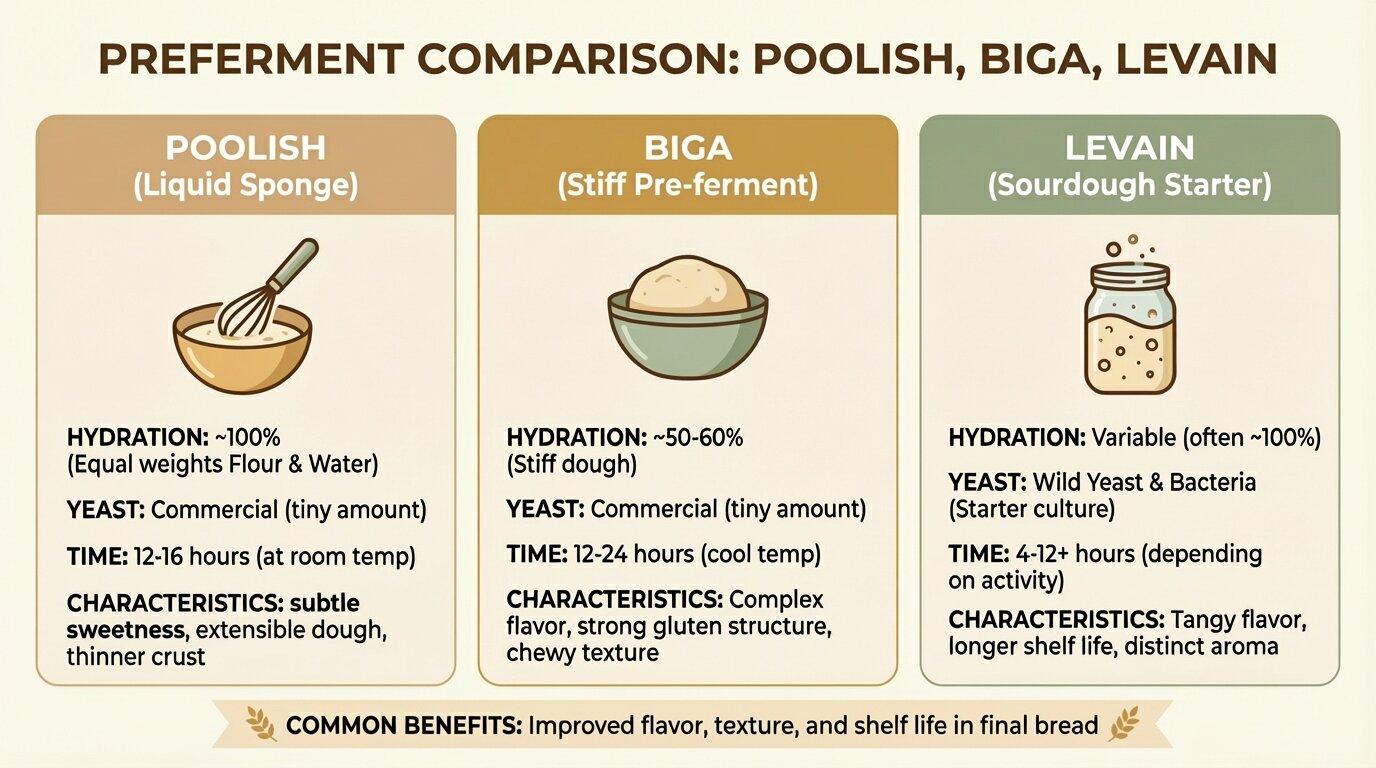
⚡ What You’ll Learn in 60 Seconds
- Poolish: 100% hydration (equal flour & water), 8–12 hours, light airy crumb – best for baguettes & pizza
- Biga: 50–60% hydration (stiff), 12–16 hours, chewy complex flavor – best for ciabatta & rustic bread
- Levain: Sourdough-based, wild yeast, tangy flavor – best for sourdough & artisan loaves
- Key difference: Poolish and biga use commercial yeast (predictable timing). Levain uses wild yeast (more flavor, less predictable).
- Quick rule: Want light & airy? Poolish. Want chewy & complex? Biga. Want tangy & artisan? Levain.
↓ Full 10-min guide with tested results, recipes, troubleshooting, and when to use each preferment
I spent my first six months making bread with commercial yeast straight into the dough. The results were fine – decent texture, reasonable flavor, consistent rise. Then I tried poolish for a pizza dough recipe.
The difference caught me off guard. The dough stretched easier, felt more alive during handling, and the baked crust had this subtle sweetness and complex aroma I’d never achieved before. I was using the same flour, same hydration, same technique. The only variable was the 12-hour poolish.
That’s when I started testing preferments systematically. Poolish for light, airy breads. Biga for chewier, more structured dough. Levain when I wanted that distinctive sourdough character. Each one produces noticeably different results even when everything else stays the same.
Preferments aren’t about making bread possible – they’re about making it better. More flavor, better texture, improved keeping quality, and easier handling. The question isn’t whether to use them, but which one to choose.
What Are Preferments and Why Use Them?
The foundation of better bread
A preferment is a portion of your dough’s flour and water mixed with yeast (or wild yeast in sourdough) and fermented ahead of the final mix. You prepare it 8-16 hours before baking, then incorporate it into your main dough along with the remaining ingredients.
The fermentation time allows yeast to break down complex carbohydrates and develop flavor compounds that straight dough (where all ingredients mix at once) doesn’t have time to create.
Benefits of Using Preferments
- Enhanced flavor: Long fermentation creates complex taste – nutty, slightly sweet, more developed than straight dough
- Improved texture: Better crumb structure, more open holes, lighter feel
- Easier handling: Dough is more extensible and less likely to tear during shaping
- Better keeping quality: Bread stays fresh longer due to enzymatic activity during fermentation
- Stronger gluten network: Extended fermentation helps develop gluten naturally with less kneading
- Increased digestibility: Longer fermentation breaks down some of the harder-to-digest compounds in flour
Preferments require planning ahead (8-16 hours before baking) but minimal active work. You mix flour, water, and yeast, then let time do the work. The payoff is bread that tastes and feels noticeably better than straight dough.
The Three Main Types
The baking world uses dozens of preferment types, but three dominate home and professional baking:
- Poolish (Polish): Wet preferment, 100% hydration, 12-16 hour fermentation, French/Italian origin
- Biga: Stiff preferment, 50-60% hydration, 12-24 hour fermentation, Italian origin
- Levain (Sourdough starter): Wild yeast preferment, variable hydration, ongoing maintenance, ancient origin
Each creates different flavors, textures, and handling characteristics. I’ll break down the specifics so you know which one fits your bread.
Poolish: Wet, Fast, Light
The beginner-friendly preferment
Wet Preferment (100% Hydration)
Formula: Equal parts flour and water by weight, tiny amount of yeast
Fermentation time: 12-16 hours at room temperature
Characteristics:
- Liquid consistency – pours like thick pancake batter
- Subtle sweetness and mild complexity
- Creates light, open crumb structure
- Excellent extensibility for pizza and focaccia
- Minimal yeast needed (0.05-0.2% instant yeast for 12-16h fermentation)
- Bubbles vigorously when ready
My Testing Results with Poolish
I tested poolish with Neapolitan pizza dough (65% total hydration) using 20% poolish by baker’s percentage. For 1000g total flour, this meant 200g flour + 200g water + 0.15g instant yeast for the poolish, fermented 12 hours at 70°F.
| Aspect | Observations |
|---|---|
| Mixing | Poolish incorporated smoothly into final dough. Wet consistency made it easy to blend. |
| Handling | Dough was noticeably more extensible than straight dough. Stretched easily for pizza without tearing. |
| Flavor | Subtle sweetness and mild complexity. Not sour, but more interesting than plain yeast bread. |
| Texture | Light, airy crumb with irregular holes. Crust was crisp but not tough. |
| Shelf Life | Stayed fresh 24 hours longer than straight dough version. Less staling. |
Poolish was the first preferment I mastered. The liquid consistency means you can’t mess up mixing – just stir flour, water, and a pinch of yeast until combined. I make it before bed, and by morning it’s bubbled up beautifully. The dough made with poolish stretches without resistance, which is perfect for pizza. I use poolish for about 70% of my baking now.
Best Uses for Poolish
- Neapolitan pizza: Creates the light, airy crust with great leoparding
- Baguettes: Classic French application – open crumb and thin crust
- Focaccia: High hydration works perfectly with poolish
- Ciabatta: Needs the extensibility poolish provides
- Light sandwich bread: When you want soft, fluffy texture
Biga: Stiff, Slow, Chewy
For structure and complexity
Stiff Preferment (50-60% Hydration)
Formula: Flour with 50-60% of its weight in water, small amount of yeast
Fermentation time: 12-24 hours at cool temperature (or longer cold ferment)
Characteristics:
- Firm, dough-like consistency
- More complex, nutty flavor than poolish
- Creates chewy, structured crumb
- Better for hearty breads that need strength
- Slightly more yeast than poolish (0.1-0.3% instant yeast for 12-24h fermentation)
- Cracks and develops rough surface when ready
My Testing Results with Biga
I tested biga with the same pizza recipe at 65% total hydration, using 20% biga. For 1000g total flour: 200g flour + 120g water + 0.3g instant yeast, fermented 14 hours at 68°F.
| Aspect | Observations |
|---|---|
| Mixing | Required tearing biga into small pieces first. More work than poolish but still straightforward. |
| Handling | Dough had more strength and resistance than poolish version. Less extensible but held shape better. |
| Flavor | Noticeably more complex than poolish. Nutty, slightly wheaty character. Still no sourness. |
| Texture | Chewier crumb, more uniform holes than poolish. Better structure for NY-style pizza. |
| Shelf Life | Even better than poolish – stayed fresh 48 hours with minimal staling. |
I switched to biga when I started making NY-style pizza. Poolish made the dough too extensible – it wouldn’t hold its shape when I stretched it large and thin. Biga gave me the chew and structure I needed. The flavor is more developed too. Mixing is slightly harder (you have to break up the stiff preferment), but that’s the only downside. For breads that need structure, biga wins.
Best Uses for Biga
- NY-style pizza: Provides the chew and structure characteristic of this style
- Rustic Italian bread: Traditional application in Italian baking
- Sandwich loaves: When you want soft but structured crumb
- Hearty country bread: Dense crumb with complex flavor
- Bread that needs strength: Any recipe where dough must hold shape
Levain: Wild, Complex, Tangy
The sourdough option
Wild Yeast Preferment (Variable Hydration)
Formula: Sourdough starter (flour + water + wild yeast/bacteria), variable hydration
Fermentation time: 4-12+ hours for build (depending on activity), ongoing starter maintenance
Characteristics:
- Contains wild yeast and lactic acid bacteria
- Distinctive tangy, complex flavor
- Variable texture depending on hydration
- Requires maintaining active starter
- Fermentation timing less predictable than commercial yeast
- Most complex flavor of all preferments
My Testing Results with Levain
I tested levain (100% hydration starter) with the same pizza recipe, using 20% levain. For 1000g total flour: 200g active starter (100g flour + 100g water from starter), fermented 5 hours after feeding.
| Aspect | Observations |
|---|---|
| Mixing | Mixed in easily like poolish. Starter was bubbly and active at peak. |
| Handling | Extensible like poolish. Fermentation timing was less predictable than commercial yeast – had to watch for doubling rather than relying on clock. |
| Flavor | Unmistakable sourdough tang. Complex, slightly acidic, much more character than poolish or biga. |
| Texture | Open, irregular crumb. Similar to poolish but with more character in the taste. |
| Shelf Life | Excellent – stayed fresh 3+ days. Acidity acts as natural preservative. |
Levain transformed bread from technique into craft for me. The flavor complexity is in a different league – it’s not just “better bread,” it’s an entirely different experience. The challenge is maintaining the starter (weekly feedings minimum) and adjusting fermentation times since wild yeast is more active than commercial. I use levain when I want bread to be the star of the meal, not just an accompaniment. The effort is worth it.
Best Uses for Levain
- Sourdough bread: The classic application
- Sourdough pizza: When you want that distinctive tang
- Artisan loaves: Any bread where complex flavor is the goal
- Long-keeping bread: Natural preservation from acidity
- Special occasion baking: When bread is the centerpiece
Levain requires ongoing starter maintenance but offers flavor complexity poolish and biga can’t match. If you’re willing to feed a starter weekly, levain elevates bread from good to exceptional.
Side-by-Side Comparison
Quick reference for choosing
| Characteristic | Poolish | Biga | Levain |
|---|---|---|---|
| Hydration | 100% (liquid) | 50-60% (stiff) | Variable (usually 100%) |
| Fermentation Time | 12-16 hours | 12-24 hours | 4-12+ hours (plus starter maintenance) |
| Yeast Type | Commercial | Commercial | Wild yeast + bacteria |
| Flavor Profile | Subtle sweetness, mild | Nutty, complex, wheaty | Tangy, complex, acidic |
| Texture Result | Light, airy, open crumb | Chewy, structured, uniform | Open crumb, complex character |
| Extensibility | High | Moderate | High |
| Shelf Life | Good (24+ hours fresh) | Better (48+ hours fresh) | Excellent (3+ days fresh) |
| Ease of Use | Easiest | Easy | Moderate (requires starter) |
| Best For | Pizza, baguettes, focaccia | NY pizza, Italian bread, hearty loaves | Sourdough bread, artisan loaves |
Quick Decision Guide:
- Want easy, light bread with minimal complexity? → Poolish
- Need structure, chew, and nutty flavor? → Biga
- Want distinctive tang and maximum flavor? → Levain
- Making Neapolitan pizza? → Poolish
- Making NY-style pizza? → Biga
- Making sourdough bread? → Levain
Calculate Preferments Automatically
Flourwise handles poolish, biga, and levain calculations automatically. No more manual baker’s percentage math.
The calculator does everything:
- Select preferment type → instant weight calculation
- Set preferment percentage (10%, 20%, 30%…) → auto-adjusts
- Accounts for flour and water in preferment
- True hydration calculated automatically
- Change recipe size → all ratios stay perfect
Stop doing math. Start baking better bread.
When to Use Each Preferment
Matching preferment to bread type
Use Poolish When…
- You want light, airy texture with open crumb
- Making high-hydration doughs (focaccia, ciabatta)
- Baking Neapolitan or Roman-style pizza
- You need maximum extensibility for stretching
- You’re new to preferments (easiest to work with)
- Timing is flexible (8-12 hour window)
- You want subtle flavor improvement without tang
Use Biga When…
- You want chewy, structured texture
- Making NY-style pizza or thick-crust pizza
- Baking hearty sandwich bread or Italian bread
- You need dough that holds its shape
- You want complex flavor without sourness
- Shelf life is important (biga improves keeping quality)
- Making rustic, country-style loaves
Use Levain When…
- You want maximum flavor complexity
- Making traditional sourdough bread
- You enjoy the distinctive tang of sourdough
- Shelf life is critical (natural preservation from acidity)
- You’re willing to maintain an active starter
- Making special occasion or artisan bread
- You want bread with character and personality
I keep all three going in rotation. Poolish for weeknight pizza (easy, consistent). Biga when I’m making sandwich bread for the week (better keeping quality). Levain for weekend sourdough when I have time to appreciate the process. Each has its place. You don’t need to commit to just one – use whatever fits the bread you’re making.
How to Make and Maintain Each Type
Practical guidance for each preferment
Making Poolish
Basic formula for 20% poolish:
- Flour: 20% of total recipe flour
- Water: Equal to poolish flour (100% hydration)
- Instant yeast: 0.05-0.2% of poolish flour weight (depending on time and temperature)
Example for 1000g total flour recipe (12h fermentation at 70°F/21°C):
- 200g bread flour
- 200g water
- 0.1-0.3g instant yeast (tiny pinch) - use less for warmer temps or longer fermentation
Process:
- Mix flour, water, and yeast until combined (30 seconds)
- Cover loosely (allow gas to escape)
- Ferment 8-12 hours at room temperature (68-72°F)
- Ready when bubbly and slightly domed on surface
- Use immediately or refrigerate up to 24 hours
Making Biga
Basic formula for 20% biga:
- Flour: 20% of total recipe flour
- Water: 50-60% of biga flour weight
- Instant yeast: 0.1-0.3% of biga flour weight (depending on time and temperature)
Example for 1000g total flour recipe (14h fermentation at 68°F/20°C):
- 200g bread flour
- 110g water (55% hydration)
- 0.2-0.6g instant yeast - use less for longer fermentation or cooler temps
Process:
- Mix flour, water, and yeast until shaggy dough forms
- Knead briefly until cohesive (1-2 minutes)
- Cover tightly (prevents drying)
- Ferment 12-16 hours at room temperature
- Ready when surface is cracked and rough
- Tear into small pieces before adding to final dough
Building Levain (from Active Starter)
Basic formula for 20% levain:
- Active starter: 20% of total recipe flour
- Built from starter feed 4-8 hours before use
Example for 1000g total flour recipe:
- Take 50g active starter
- Add 75g flour + 75g water
- Ferment 4-6 hours until doubled and bubbly
- Use 200g for recipe (discard excess or save for next bake)
Starter Maintenance:
- Feed weekly minimum (daily if kept at room temp)
- Standard feed ratio: 1:1:1 (starter:flour:water)
- Can refrigerate between feedings
- Bring to room temp and feed 8-12 hours before building levain
All preferments improve with time but have limits. Poolish peaks at 12 hours, biga at 16 hours, levain when doubled. Beyond that, they over-ferment and develop off flavors. Use when ready or refrigerate to slow fermentation.
Troubleshooting Common Problems
Fixing preferment issues
Poolish Didn’t Bubble or Rise
Possible causes:
- Too little yeast (needs at least 0.1% of flour weight)
- Water too hot (killed yeast) – use cool or room temp water
- Kitchen too cold (below 65°F slows fermentation dramatically)
- Old or inactive yeast
Solutions:
- Use 0.2% yeast instead of 0.1% for faster, more reliable rise
- Place poolish in warmer spot (70-75°F is ideal)
- Test yeast in warm water with sugar before using
- Extend fermentation time by 2-4 hours if kitchen is cool
Biga Is Too Dry or Crumbly
Possible causes:
- Hydration too low (below 50%)
- Not covered properly – dried out during fermentation
- Flour absorbed more water than expected
Solutions:
- Increase hydration to 55-60%
- Cover with plastic wrap or damp towel
- Add water 1 tablespoon at a time until dough comes together
Levain Smells Bad or Has Liquid on Top
Possible causes:
- Liquid (hooch) on top: starter is hungry and needs feeding
- Nail polish/acetone smell: over-fermented, too much acetic acid
- Foul or rotten smell: contamination or very neglected starter
Solutions:
- For hooch: pour off liquid, feed starter with fresh flour and water
- For acetone smell: feed more frequently or use more starter in each feed
- For contamination: discard and start fresh starter
- Maintain regular feeding schedule (weekly minimum)
Final Dough Too Sticky After Adding Preferment
Possible causes:
- Didn’t account for water in preferment when calculating hydration
- Preferment over-fermented and broke down gluten
- Added too much preferment (exceeded recipe percentage)
Solutions:
- Use calculator that accounts for preferment water content automatically
- Don’t let preferment ferment beyond recommended time
- Reduce fresh water in final dough to compensate
- Add flour gradually to reach proper consistency (affects hydration %)
Conclusion: Start with Poolish, Expand from There
After testing all three preferments across multiple bread types, I’ve found that each has clear strengths. Poolish delivers the best balance of ease and improvement for beginners. Biga adds structure and complexity when you need it. Levain creates bread with personality that poolish and biga can’t match.
You don’t need to pick one and stick with it forever. I use poolish for weekly pizza, biga for sandwich bread that needs to last, and levain for weekend sourdough when I want something special. The preferment serves the bread, not the other way around.
My recommended approach:
- Start with poolish for 8-10 bakes to understand preferments
- Try biga when you want more structure or longer shelf life
- Build and maintain levain if you’re ready for sourdough commitment
- Use calculator to handle the math automatically
Each preferment requires planning ahead but minimal active work. Mix it, forget it, use it when ready. The flavor and texture improvements are worth the overnight wait.
Quick Reference
- Poolish: 100% hydration, 8-12 hours, light/airy texture, easiest to use
- Biga: 50-60% hydration, 12-16 hours, chewy texture, more complex flavor
- Levain: Variable hydration, 4-8 hours + maintenance, tangy/complex
- All three improve flavor, texture, and shelf life vs. straight dough
- Poolish best for pizza, baguettes, light breads
- Biga best for hearty breads, NY pizza, sandwich loaves
- Levain best for sourdough bread, artisan loaves, maximum flavor
- Account for water in preferment when calculating dough hydration
Frequently Asked Questions
What’s the difference between poolish and biga?
Poolish is a wet preferment (100% hydration – equal parts flour and water by weight) that ferments 8-12 hours and creates light, airy crumb with subtle sweetness. Biga is a stiff preferment (50-60% hydration) that ferments 12-16 hours and produces chewier texture with more complex, nutty flavor. Poolish is easier to mix and incorporate, while biga requires tearing into pieces first.
Which preferment is best for pizza?
Poolish is excellent for Neapolitan pizza – it creates light, airy crust with great extensibility and subtle flavor. Biga works better for NY-style or Roman pizza where you want more chew and structure. Levain (sourdough) produces unique tangy flavor and works for both styles, but requires maintaining an active starter. For beginners, start with poolish.
Can I use levain instead of poolish?
Yes, but the results will differ. Levain adds distinctive tangy sourdough flavor that poolish doesn’t have. Levain timing is less predictable than poolish since wild yeast varies more than commercial yeast – watch for visual cues like doubling rather than relying strictly on time. Final dough fermentation may be similar or slightly slower depending on your starter’s strength. For neutral flavor and predictable timing, stick with poolish. For complexity and tang, use levain. Both create similar texture at 100% hydration.