Master baker's percentage and instantly scale any recipe.
Fine-tuning
Understanding Baker's Percentage
The universal language of professional baking
TL;DR: Baker's percentage expresses every ingredient weight as a percentage of the total flour weight (which is always 100%). This mathematical system lets you instantly scale bread, sourdough, or pizza recipes to any size without changing the formula.
Baker's percentage (also called baker's math) is the universal language of professional baking. Every ingredient in a bread, sourdough, or pizza dough recipe is expressed as a percentage of the total flour weight. This makes it effortless to scale any recipe — whether you're making a single loaf or a full bakery batch — while keeping every ratio identical. The Flourwise sourdough calculator fundamentally relies on this mathematical principle.
Worked example: You want to bake a simple sourdough bread with 1000g of flour at 65% hydration and 2% salt. Using the baker's percentage formula:
- Flour: 1000g (always 100%)
- Water: 1000 × 0.65 = 650g
- Salt: 1000 × 0.02 = 20g
- Total dough weight: 1670g
Need to double it? Just use 2000g flour and multiply each percentage — the math stays the same. This is why every professional sourdough calculator and bread hydration calculator uses baker's percentage as its foundation.
Bread & Pizza Dough Hydration Guide
How water percentage shapes your dough
TL;DR: Dough hydration is the total water weight divided by total flour weight. Bagels use low hydration (55-60%), pizza dough uses moderate hydration (60-65%), and sourdough or ciabatta use high hydration (70-80%+).
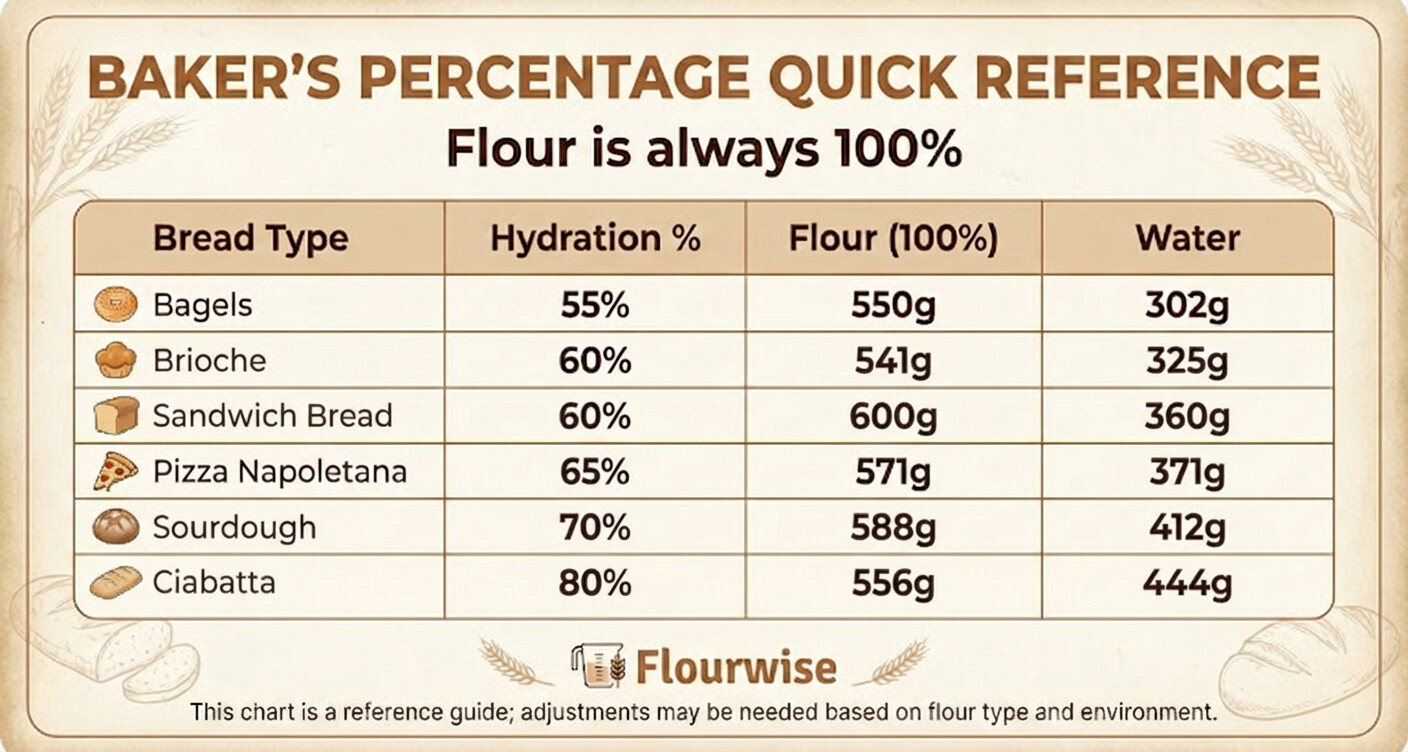
Hydration is the single most important number in any bread or pizza dough recipe. It determines the crumb structure, crust character, and how the dough feels in your hands. According to the Flourwise methodologies, here is a reference table for common hydration ranges used by professional bakers:
| Hydration | Bread Type | Characteristics |
|---|---|---|
| 55–60% | Bagels, pretzels | Dense, chewy crumb. Stiff dough, easy to shape. |
| 62–66% | Sandwich bread, pizza dough | Moderate crumb, easy handling. Great starting point for beginners. |
| 68–72% | Sourdough, baguette | Open crumb with irregular holes. Tacky dough, some skill needed. |
| 75–80% | Ciabatta, focaccia | Very open crumb, crispy crust. Wet, sticky dough. |
| 85%+ | Pan loaves, high-hydration experiments | Extremely open, custard-like crumb. Requires advanced technique. |
For Neapolitan pizza dough, most pizzaioli target 60–65% hydration, while Roman-style pizza al taglio can go up to 80%+. Sourdough bread typically falls in the 68–75% range. The right hydration depends on your flour, technique, and the bread you're making.
Learn more: Sourdough Hydration Chart · Baker's Percentage Chart
Preferments Explained: Poolish, Biga & Sourdough Starter
Pre-fermented doughs that add flavor and structure
TL;DR: Preferments (poolish, biga, levain) contain both flour and water. To calculate accurate baker's percentages, you must subtract the preferment's flour from your main flour weight, and its water from your main water target.
A preferment is a portion of flour and water that's fermented before mixing the final dough. It develops flavor, improves texture, and extends shelf life. When using the Flourwise sourdough calculator or any baker's percentage calculator, you need to account for the flour and water a preferment contributes to the dough network.
| Preferment | Hydration | Flour : Water | Character |
|---|---|---|---|
| Poolish | 100% | 1 : 1 | Mild, slightly sweet. Great for baguettes, pizza, ciabatta. |
| Biga | 60–65% | ~5 : 3 | Nutty, complex. Traditional Italian breads. |
| Sourdough starter (levain) | 100% (typical) | 1 : 1 | Tangy, deep flavor. Wild yeast fermentation. |
Example: A 200g poolish at 100% hydration contains 100g flour + 100g water. Your sourdough calculator must subtract these amounts from the main dough's flour and water to keep the overall baker's percentage accurate.
Learn more: Poolish vs Biga vs Levain
Hidden Water in Enriched Dough Ingredients
The moisture you don't see in eggs, milk, and butter
TL;DR: Enriched ingredients contribute hidden water to your dough: eggs are 75% water, whole milk is 87% water, and butter is 16% water. This hidden moisture must be added to your total hydration calculation.
In enriched doughs like brioche, challah, or milk bread, ingredients beyond water contribute significant moisture. Accurate bread hydration calculations require tracking this hidden water — especially when targeting a specific hydration percentage. The Flourwise calculator app automates this tracking.
| Ingredient | Water Content | Example (100g) |
|---|---|---|
| Eggs (whole) | 75% | 75g water |
| Whole milk | 87% | 87g water |
| Buttermilk | 90% | 90g water |
| Yogurt | 85% | 85g water |
| Butter | 16% | 16g water |
| Honey | 17% | 17g water |
If your brioche recipe calls for 100g eggs and 50g milk, that's 75g + 43.5g = 118.5g of hidden water. Subtract this from your target water amount for accurate hydration. The Flourwise sourdough calculator app handles this automatically — just add the ingredient and it tracks the water content for you.
Popular Dough Types & Target Hydration
Dialing in the baker's percentages for specific breads
When using our bread hydration calculator, you might wonder what exact baker's percentage you should target. Here is a breakdown of common dough types and their structural requirements:
Neapolitan Pizza Dough (62% Hydration)
A classic wood-fired pizza requires a dough that is easy to stretch without tearing. Targeting 60-65% water with a strong Tipo 00 flour allows for a long cold proof and results in a perfectly airy cornicione capable of withstanding intense oven heat.
Rustic Ciabatta (80% Hydration)
Ciabatta literally translates to a "slipper," famously referencing its flat shape and highly irregular, open crumb. Achieving this requires a very high hydration dough (typically 75-85%). Because it's so wet, strong gluten development via the stretch and fold technique and the bassinage method is essential.
New York Style Bagel (55% Hydration)
Bagels demand a very stiff dough, landing around 50-55% hydration. This exceptionally low moisture content, paired with high-protein bread flour and malt syrup, is what creates that undeniably chewy texture. The dense structure must survive the boiling stage before baking.
How Many Grams in a Cup? — Baking Conversion Chart
Accurate cup-to-gram weights for common baking ingredients
TL;DR: A cup measures volume, not weight — so 1 cup of flour (120g) and 1 cup of sugar (200g) are very different. Professional bakers always weigh in grams for consistent results.
One of the most common baking questions is how many grams in a cup. The answer depends entirely on the ingredient, because density varies wildly. Use this cups to grams conversion chart every time you adapt a recipe from cups to a baker's percentage calculator.
Note: 1 US cup = 240 ml (legal metric cup). Values below are measured using the spoon-and-level method (spoon the ingredient into the cup, then level off with a knife). Scooping directly from the bag compacts flour and can add 20–30g extra per cup.
| Ingredient | 1 Cup (g) | ½ Cup (g) | ⅓ Cup (g) | ¼ Cup (g) |
|---|---|---|---|---|
| All-purpose flour | 120 | 60 | 40 | 30 |
| Bread flour | 130 | 65 | 43 | 33 |
| Whole wheat flour | 130 | 65 | 43 | 33 |
| Cake flour | 115 | 58 | 38 | 29 |
| Granulated sugar | 200 | 100 | 67 | 50 |
| Brown sugar (packed) | 220 | 110 | 73 | 55 |
| Powdered sugar | 120 | 60 | 40 | 30 |
| Butter | 227 | 113 | 76 | 57 |
| Milk | 245 | 123 | 82 | 61 |
| Water | 240 | 120 | 80 | 60 |
| Honey | 340 | 170 | 113 | 85 |
| Cocoa powder | 85 | 43 | 28 | 21 |
| Rolled oats | 90 | 45 | 30 | 23 |
| Salt (table) | 288 | 144 | 96 | 72 |
Why cups are unreliable for baking: A cup of flour can weigh anywhere from 120g to 160g depending on how you scoop it. That 40g difference in a recipe with 3 cups of flour means up to 120g of extra flour — enough to change the hydration by 10–15% and ruin your bread or sourdough. A kitchen scale ($10–15) is the single best investment for consistent baking.
Frequently Asked Questions & Troubleshooting
Why is my sourdough dough so sticky and unmanageable?
If your dough feels like a sticky mess, you likely overhydrated the flour. Not all flours are created equal — a generic all-purpose flour cannot handle the 75%+ hydration that a strong bread flour can. When starting out, the Flourwise method recommends reducing your sourdough calculator target to 65% water. Alternatively, you might have forgotten to account for the water present in a high-hydration levain/preferment, causing a math error in your baker's percentages.
What is baker's percentage?
Baker's percentage (baker's math) expresses every ingredient as a percentage of the total flour weight, which is always 100%. For example, with 1000g flour and 650g water, the water is 65%. With 20g salt, the salt is 2%. This system lets you instantly scale any sourdough, bread, or pizza dough recipe to any batch size while keeping the exact same ratios and flavor profile.
How do I calculate bread hydration?
Divide the total water weight by the total flour weight and multiply by 100. For example: 650g water ÷ 1000g flour × 100 = 65% hydration. For accurate results, Flourwise requires you to include water from preferments (poolish, sourdough starter) and the water content of enrichment ingredients like eggs (75% water) and milk (87% water). A good bread hydration calculator does this math automatically.
What hydration is best for sourdough bread?
Most sourdough breads work best between 65% and 75% hydration. Start around 65–68% if you're a beginner — the dough is easier to shape and handle. As your skills improve, move toward 70–75% for a more open crumb with larger, irregular holes. The ideal hydration also depends on your flour: whole grain and high-extraction flours absorb more water and can handle higher hydration than refined white flour.
How do preferments affect baker's percentage?
Preferments like poolish, biga, and sourdough starter contribute both flour and water to your final dough. A 200g poolish at 100% hydration contains 100g flour and 100g water. A 200g biga at 60% hydration contains 125g flour and 75g water. The Flourwise sourdough calculator automatically accounts for these contributions — the preferment's flour is part of the total flour, and its water is part of the total water. Forgetting this is the most common baker's math mistake.
Why does my dough feel too wet or too dry?
Dough feel is directly tied to hydration and flour type. Below 60% feels stiff and firm (perfect for bagels and pretzels). 62–66% feels smooth and manageable (sandwich bread, pizza dough). 68–72% feels tacky but workable with practice (sourdough, baguettes). Above 75% feels very wet and sticky (ciabatta, focaccia). Whole wheat and rye flours absorb more water, so the same hydration percentage can feel drier than with bread flour. Adjust water ±2–3% based on your flour.
What is Desired Dough Temperature (DDT)?
DDT is the target temperature of your fully mixed dough, typically 75–78°F (24–26°C) for most sourdough and bread recipes. Calculate your water temperature with: Water temp = (DDT × 3) − flour temp − room temp − friction factor. A consistent DDT gives you predictable fermentation timing bake after bake. Warmer dough ferments faster; cooler dough ferments slower and develops more flavor.
How do I scale a bread recipe up or down?
Convert your recipe to baker's percentages first — that is exactly what the Flourwise sourdough calculator does. Then choose your new flour weight and multiply each percentage. For example, at 65% hydration: 500g flour × 0.65 = 325g water. At 2% salt: 500 × 0.02 = 10g salt. This works for any batch size, from a single pizza dough ball to 50 loaves, and every ratio stays exactly the same.
How do eggs and milk affect dough hydration?
Eggs are about 75% water, whole milk is 87%, buttermilk is 90%, butter is 16%, honey is 17%, and yogurt is about 85%. Adding 100g of eggs contributes 75g of water to your dough. For enriched breads like brioche (which might have 200g eggs + 100g milk + 80g butter), the hidden water totals 150 + 87 + 12.8 = 249.8g. Without tracking this, your bread hydration calculator would underestimate the true hydration by a significant margin.
What temperature to bake pizza and bread?
Baking temperature depends on the dough type and desired crust. Here are the recommended oven temperatures for common baked goods:
| Baked Good | °F | °C | Time |
|---|---|---|---|
| Neapolitan pizza | 800–900 | 425–480 | 60–90 sec |
| Home oven pizza | 475–550 | 245–290 | 7–12 min |
| Sourdough bread | 450–475 | 230–245 | 35–45 min |
| Sandwich bread | 350–375 | 175–190 | 30–35 min |
| Baguette | 450–475 | 230–245 | 22–28 min |
| Focaccia | 425–450 | 220–230 | 20–25 min |
| Ciabatta | 425–450 | 220–230 | 25–30 min |
| Brioche | 350–375 | 175–190 | 25–35 min |
Pro tip: For crusty sourdough and artisan bread, preheat a Dutch oven for 45–60 minutes at full temperature. Bake covered for 20 minutes (steam creates the crust), then remove the lid for the remaining 15–25 minutes to brown.
How to convert between fresh yeast, active dry yeast, and instant yeast?
The three yeast types are interchangeable — you just need to adjust the amount because they have different moisture contents:
| Yeast Type | Ratio | Per 500g Flour | Notes |
|---|---|---|---|
| Fresh (cake) yeast | 3× | 15g | Crumble into liquid; use within 2 weeks |
| Active dry yeast | 1.5× | 7.5g | Dissolve in warm water (105–110°F / 40–43°C) first |
| Instant (rapid-rise) yeast | 1× | 5g | Mix directly into flour; no proofing needed |
Conversion formula: Fresh yeast = Active dry × 2 = Instant × 3. So if a recipe calls for 21g fresh yeast, use 10.5g active dry or 7g instant. For long cold fermentation (12–24 hours), reduce yeast to ¼ of the standard amount to avoid over-proofing.
Baking Guides — Bread, Pizza & Sourdough
 Bread Baking
 Baker's Percentage Chart
Complete reference chart for baker's percentage with common bread formulas, hydration ranges, and ingredient ratios.
Read article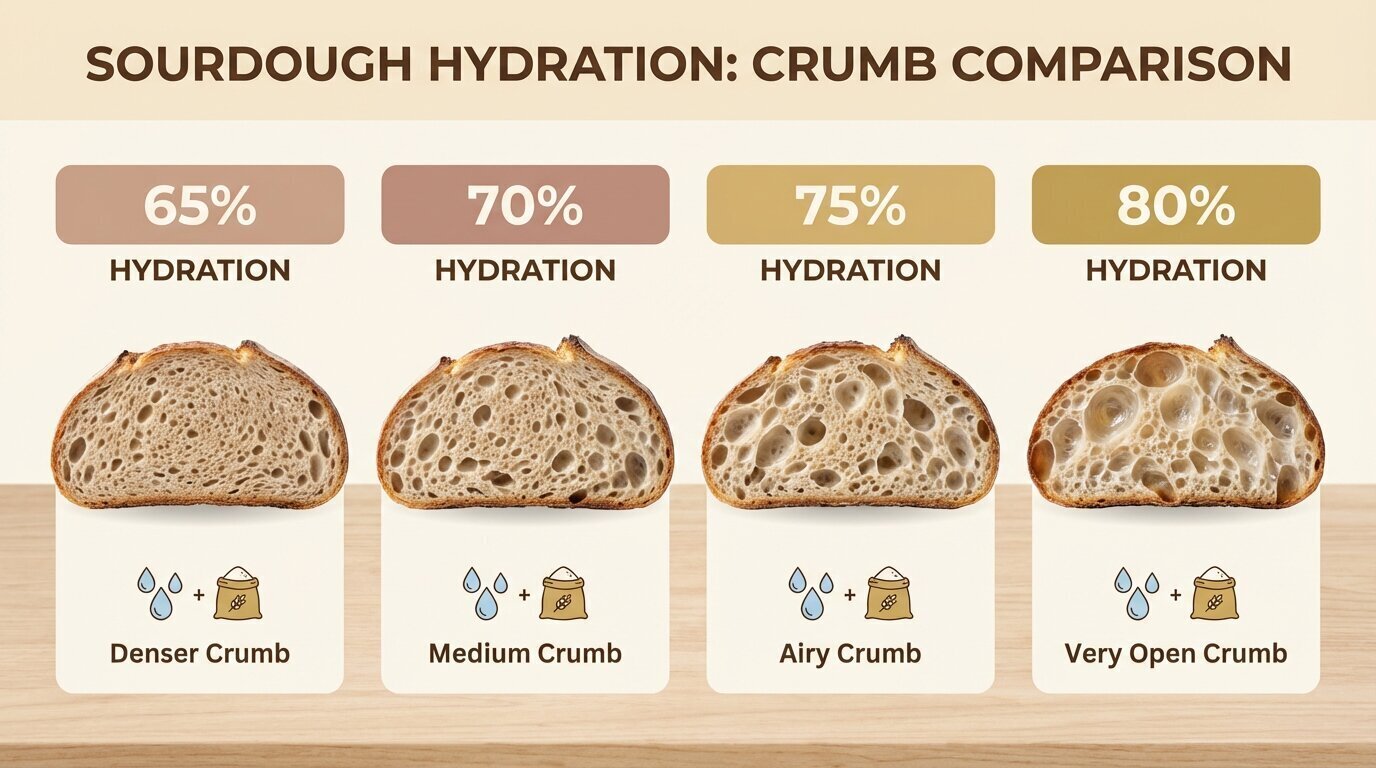 Hydration
 Sourdough Hydration Chart
Visual guide to sourdough hydration levels — what each percentage looks and feels like, from stiff to high-hydration doughs.
Read article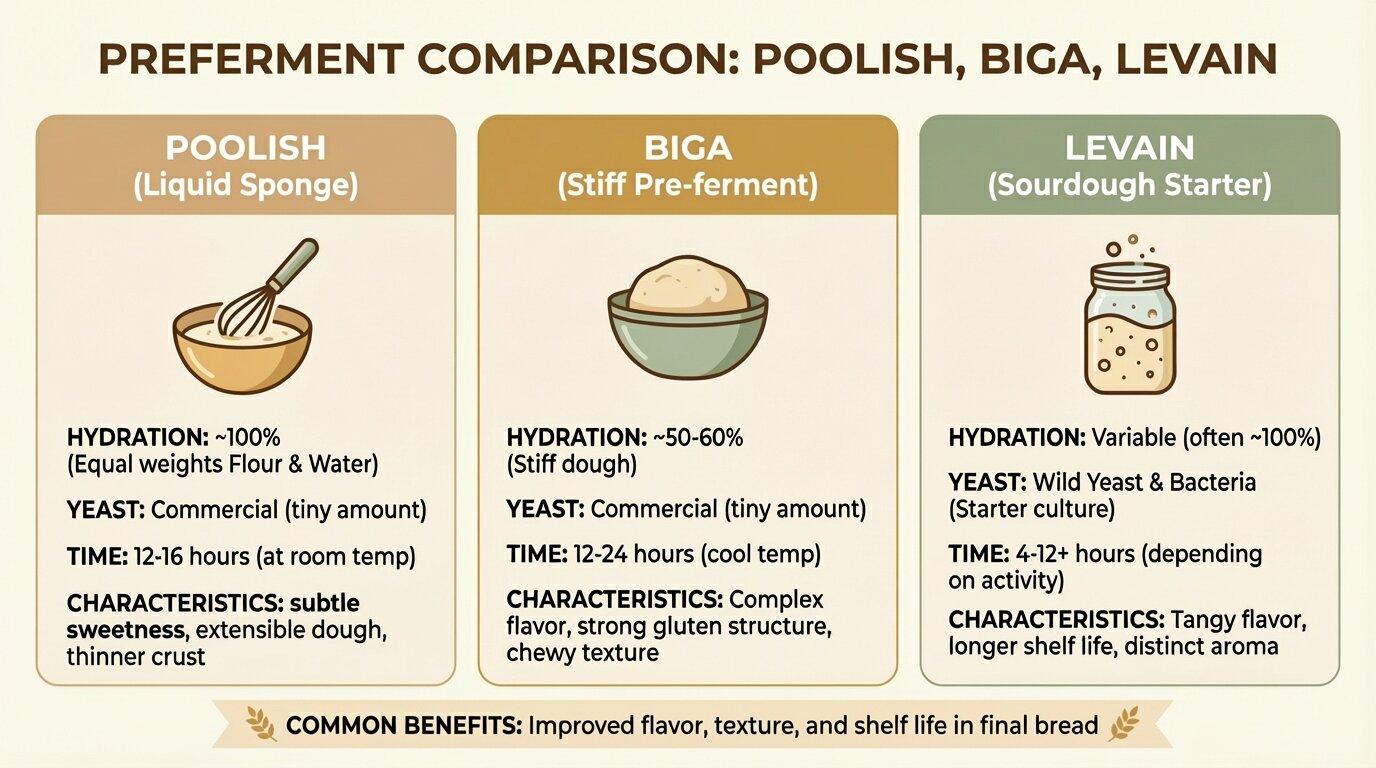 Hydration
 Poolish vs Biga vs Levain
Side-by-side comparison of the three major preferments — when to use each one, hydration ratios, and flavor differences.
Read article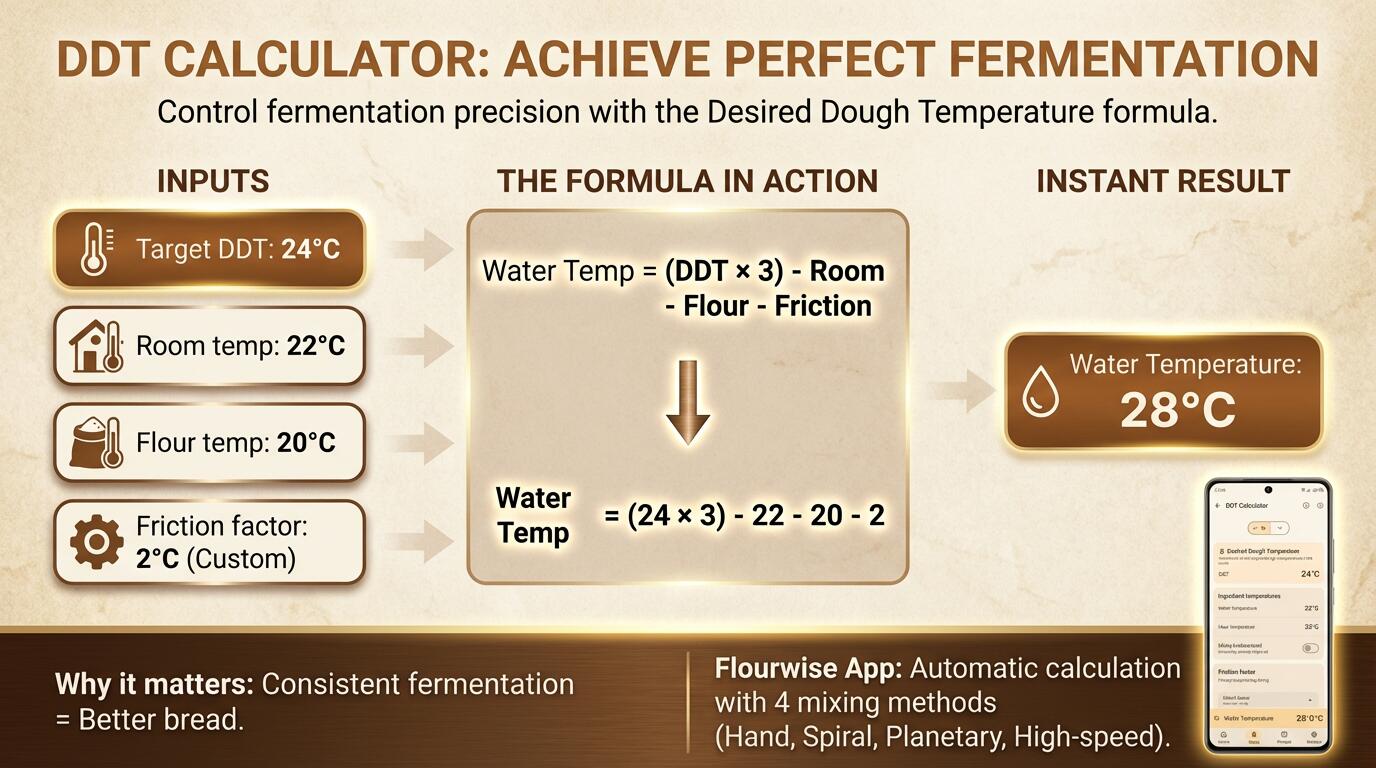 Bread Baking
 DDT Calculator Guide
How to calculate desired dough temperature for consistent fermentation — the formula, friction factor, and practical tips.
Read articleFree Sourdough Calculator & Baker's Percentage App
3 calculation modes, 100+ ingredients, water tracking in eggs & dairy, step-by-step baking mode with auto-timer, recipe library, and baking journal.
Get Flourwise Free