What is Sourdough Starter? Complete Beginner's Guide (2026)
⚡ What You’ll Learn in 60 Seconds
- What it is: Wild yeast + bacteria living in flour-water mixture that ferments and leavens bread
- Build time: 5-10 days from scratch, feeding daily until consistently active
- vs Commercial yeast: Slower rise (4-12 hrs), complex tangy flavor, bread stays fresh 5-7 days
- Maintenance: Weekly feeding minimum (refrigerated) or daily (room temp) – surprisingly low-effort
- Resilience: Rarely goes bad – recovers from neglect, only mold requires discarding
↓ Full 11-min guide explaining how it works, what to expect, and why it’s worth the initial setup
Sourdough starter isn’t mysterious – it’s just flour, water, and time. Wild yeast and bacteria naturally present in flour colonize the mixture, creating a living culture that leavens bread. The “complicated” reputation comes from overthinking what’s actually a straightforward process: mix flour and water, feed regularly, use when bubbly. Once established, it maintains itself with minimal effort.
I avoided sourdough for months because the starter seemed mysterious and complicated. Everyone talked about “feeding” it like a pet, watching for “peak activity,” and maintaining it forever. I didn’t want another responsibility.
Then I finally built one. It took 7 days from flour and water to active starter. The process was simpler than I expected – mix flour and water, wait, discard some, add fresh flour and water, repeat. By day 7, I had a bubbly culture that made bread taste completely different from anything I’d baked with commercial yeast.
Sourdough starter isn’t complicated. It’s just wild yeast and bacteria living in a flour-water mixture. You maintain it by feeding (adding fresh flour and water). It leavens bread while creating distinctive flavor and texture that commercial yeast can’t replicate.
Sourdough starter is a living culture, but it’s not fragile. It survives neglect, recovers from mistakes, and keeps working for years with minimal effort once established. The “difficult” reputation comes from people overthinking what’s actually a straightforward process.
What Is Sourdough Starter?
The simple definition
Sourdough starter is a live culture of wild yeast and lactic acid bacteria that naturally occur in flour and your environment. It’s made by mixing flour and water, then letting it ferment. Over several days, the mixture becomes colonized by microorganisms that feed on the flour’s starches and sugars.
This culture serves three purposes:
- Leavening agent: The yeast produces carbon dioxide that makes bread rise
- Flavor developer: Bacteria create lactic and acetic acids that give sourdough its distinctive tang
- Dough conditioner: Fermentation breaks down proteins and starches, improving texture and digestibility
The Basic Components
Physical composition:
- Flour (typically 50% by weight)
- Water (typically 50% by weight)
- Wild yeast (various strains, primarily Saccharomyces and Candida species)
- Lactic acid bacteria (primarily Lactobacillus species)
When you feed starter, you’re adding fresh flour and water. The microorganisms consume the flour’s nutrients, multiply, produce gases (CO2) that create bubbles, and generate acids that create sour flavor.
Sourdough starter is not a specific ingredient you buy. It’s something you create and maintain. Every starter is unique because it contains microorganisms from your local environment, flour, and kitchen.
What It’s Called Around the World
Different baking traditions use different terms for essentially the same thing:
- Levain (French): Often refers to a portion of starter built specifically for a recipe
- Mother dough (Italian: “madre”): The maintained culture you keep and feed
- Sourdough culture: Scientific/technical term
- Starter: Common English term (what I’ll use throughout this guide)
How Sourdough Starter Works
The science made simple
Understanding what happens inside the jar helps demystify the process and explains why you do what you do.
The Fermentation Cycle
Phase 1: Feeding (0-2 hours after feeding)
You add fresh flour and water. The mixture is thick or liquid depending on your ratio. Yeast and bacteria start waking up and consuming fresh nutrients. Minimal gas production yet. Starter looks calm, possibly a few small bubbles.
Phase 2: Active Fermentation (2-6 hours after feeding)
Microorganisms are highly active. Yeast produces CO2 rapidly – starter rises and becomes full of bubbles. This is “peak” activity. The mixture can double or triple in volume. This is when you use starter for baking – it’s strongest and most active.
Phase 3: Maturation (6-12+ hours after feeding)
Yeast slows down as food depletes. Bacteria continue producing acids. Starter may begin falling from its peak height. Flavor becomes more acidic and complex. If left too long without feeding, it becomes overly sour and less active.
Phase 4: Starvation (12-24+ hours after feeding)
Food is depleted. Starter falls flat. A layer of liquid (hooch) may form on top – this is alcohol produced by yeast. The culture survives but becomes sluggish. Needs feeding to restore activity.
I learned these phases by watching my starter throughout the day. At 2 hours post-feed, barely any change. At 4-5 hours, explosive activity with bubbles everywhere. At 8 hours, starting to fall. By 12 hours, completely collapsed with hooch on top. Once I understood this cycle, feeding schedules made sense – you’re trying to catch the starter at peak and use it or refresh it before it starves.
What the Microorganisms Do
Wild Yeast:
- Consumes sugars and starches
- Produces carbon dioxide (makes bread rise)
- Produces ethanol (alcohol – contributes to flavor)
- Doubles approximately every 4-8 hours when well-fed
Lactic Acid Bacteria:
- Also consume sugars
- Produce lactic acid (mild, yogurt-like sourness)
- Produce acetic acid (sharper, vinegar-like sourness)
- Create environment that inhibits bad bacteria (natural preservation)
The ratio of lactic to acetic acid changes based on temperature, hydration, and feeding schedule. Warmer temperatures and wetter starters favor lactic acid (milder). Cooler temperatures and stiffer starters favor acetic acid (sharper).
What Healthy Starter Looks Like
Visual signs of a good culture
Healthy starter has specific visual characteristics that tell you it’s working properly.
At Peak Activity (Ready to Use)
- Height: Doubled or tripled in volume from feeding
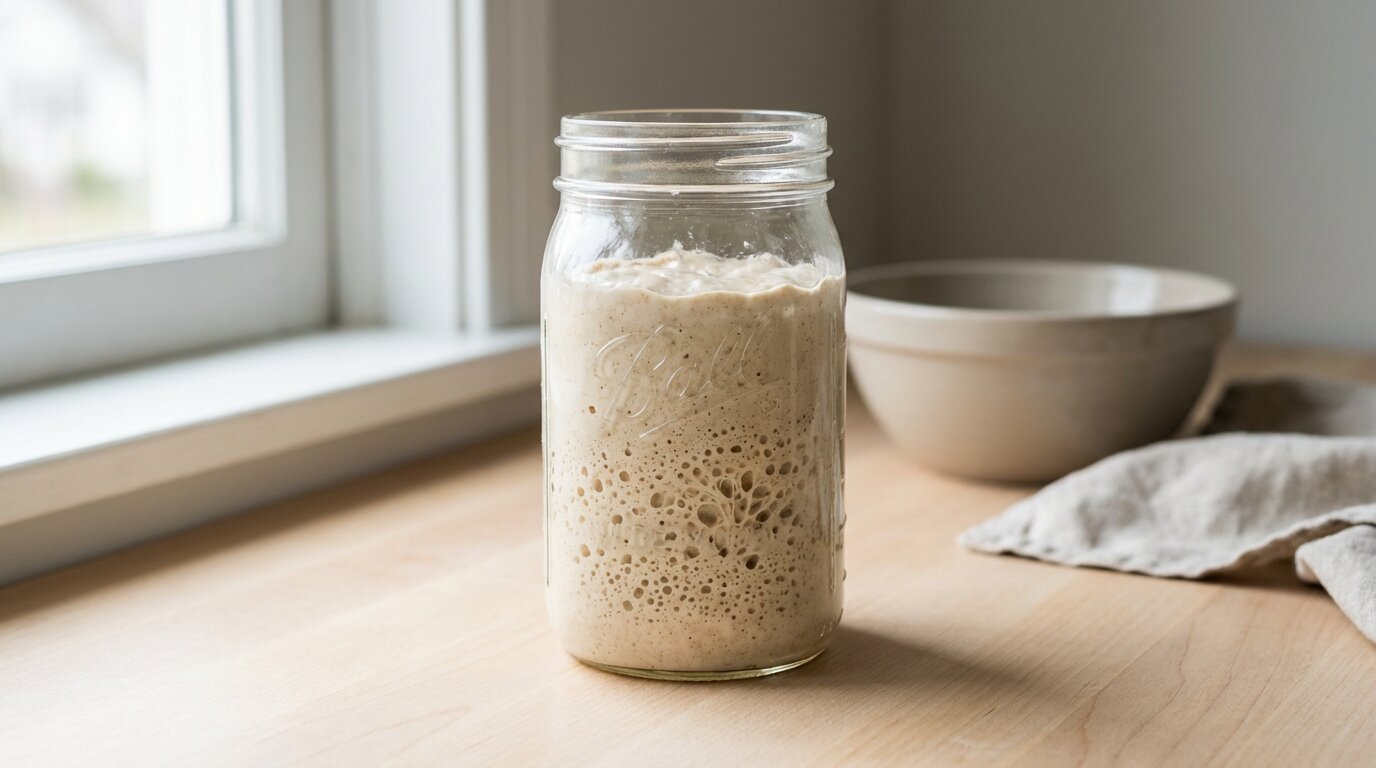
- Bubbles: Many bubbles throughout – small, medium, and large. Surface is domed and bubbly
- Texture: Light, airy, almost mousse-like. Holds air pockets
- Smell: Pleasant sour aroma – like yogurt, beer, or ripe fruit. Not offensive or putrid
- Consistency: Thick but pourable if 100% hydration. Stretchy, extensible
- Color: Creamy white or slightly tan (depends on flour type)
Just After Feeding
- Thick mixture, uniform consistency
- Few or no bubbles yet
- Smells like raw flour with slight sourness
- Level in jar is at baseline before rise
Past Peak (Needs Feeding Soon)
- Fallen from peak height, deflated appearance
- Surface may have collapsed inward
- Still has bubbles but less active
- Smells more intensely sour or boozy
- May have clear liquid (hooch) on top or bottom
- Still usable but less reliable for baking
My starter at peak looks like it’s alive – bubbles popping on the surface, the whole mass expanded and light. If I tilt the jar, it slowly flows down. When I scoop some out, I can see the open, airy structure inside. This is when I know it’s ready for bread. Any earlier, and it hasn’t developed enough strength. Any later, and it’s starting to weaken.
Signs of Problems
Mold: Fuzzy growth (white, green, pink, black) on surface. This is bad – throw it out and start over.
Orange or pink streaks: Bacterial contamination. Discard.
Foul smell: Rotten, putrid, or nail polish remover odor (very strong acetone). Usually fixable with more frequent feeding, but if extreme, start over.
No activity after 2+ weeks: Culture didn’t establish. Start over with fresh flour and possibly different water.
Sourdough Starter vs Commercial Yeast
Understanding the differences
Commercial yeast and sourdough starter both leaven bread, but they’re fundamentally different.
| Aspect | Commercial Yeast | Sourdough Starter |
|---|---|---|
| Organisms | Single strain (Saccharomyces cerevisiae) | Dozens of wild yeast strains + bacteria |
| Activity Speed | Fast (1-2 hours for rise) | Slower (4-12+ hours for rise) |
| Flavor Profile | Neutral, slightly sweet | Complex, tangy, sour |
| Shelf Life of Bread | Good (2-3 days fresh) | Excellent (5-7 days fresh, natural preservative from acids) |
| Maintenance | None (single use) | Regular feeding (weekly minimum) |
| Predictability | Very consistent | Variable (affected by temperature, flour, feeding schedule) |
| Cost | ~$0.50 per packet | Ongoing (flour for feeding) but minimal |
| Digestibility | Standard | Better (long fermentation breaks down hard-to-digest compounds) |
| Texture | Good, standard crumb | Excellent, complex crumb with better crust |
Commercial yeast is faster and more predictable. Sourdough starter produces better flavor, texture, and keeping quality, but requires maintenance and patience. Neither is “better” – they serve different purposes.
Timeline: Building Starter from Scratch
What to expect each day
Creating a starter from nothing takes 5-10 days. Here’s what typically happens. Your experience may vary by 2-3 days depending on flour type, water quality, and temperature.
Day-by-Day Development
Day 1: Mix equal parts flour and water (e.g., 50g flour + 50g water). Cover loosely. Leave at room temperature. No activity expected – you’re establishing the mixture.
Day 2: May see a few bubbles. This is often “false activity” from random bacteria, not established yeast yet. Discard half, feed with fresh flour and water (e.g., keep 50g, add 50g flour + 50g water).
Day 3-4: Activity may slow down or stop. This is normal. Bad bacteria died off, good yeast hasn’t taken over yet. The mixture might smell unpleasant. Keep feeding daily (discard half, feed fresh).
Day 5-6: Real activity begins. Bubbles appear and persist. Starter rises noticeably after feeding. Smell becomes pleasantly sour (like yogurt). This is when wild yeast establishes dominance.
Day 7-9: Consistent activity. Starter doubles in 4-8 hours after feeding. Passes the “float test” (small spoonful dropped in water floats). Ready for baking test loaf.
Day 10+: Fully mature. Predictable rising pattern. Strong enough for regular baking. Flavor continues developing over weeks/months.
My first starter took 8 days to become reliably active. Days 3-4 were frustrating because nothing happened – the mixture just sat there. I almost gave up. Then on day 5, suddenly bubbles everywhere. By day 7, it was doubling consistently. The lesson: trust the process and keep feeding. The yeast is there, it just takes time to establish.
Factors that affect development time:
- Flour type: Whole wheat/rye develop faster than white flour (more nutrients, more microorganisms)
- Temperature: 75-80°F is ideal. Cooler = slower. Warmer = faster but potentially off-flavors
- Water: Chlorinated tap water can slow development. Filtered or spring water helps
- Environment: Homes with active baking/fermentation have more wild yeast in air
Basic Maintenance Overview
Keeping your starter alive
Once established, starter maintenance is straightforward. You’re replicating the natural cycle: feed, let ferment, use or refresh before it starves.
The Standard Feeding Routine
Basic process:
- Discard portion of old starter (or use for baking/discard recipes)
- Add fresh flour
- Add water
- Mix thoroughly
- Cover loosely
- Wait for activity (4-12 hours depending on temperature)
Common ratio: 1:1:1 (starter:flour:water by weight)
Example: Keep 50g starter, add 50g flour + 50g water = 150g total after feeding
Storage Options
Room Temperature (Active Maintenance):
- Feed once or twice daily
- Best for frequent baking (3+ times per week)
- Starter stays very active and predictable
- Requires daily attention
Refrigerated (Low Maintenance):
- Feed once weekly (or every 2 weeks if strong)
- Best for occasional baking
- Take out, bring to room temp, feed 1-2 times before baking
- Most home bakers use this method
Dried (Long-Term Storage):
- Spread thin layer of starter on parchment, let dry completely
- Store dried flakes in airtight container
- Rehydrate with water and feed to reactivate
- Backup method or for sharing starter with others
Starter is resilient. If you forget to feed it for a week or two, it’s usually recoverable. Just discard most, feed with fresh flour and water, and give it 2-3 feedings to bounce back. I’ve revived starters left unfed in the fridge for a month.
Common Concerns and Myths
Separating fact from fear
Myth: “Starter is fragile and easy to kill”
Reality: Starter is remarkably resilient. It survives neglect, temperature swings, and irregular feeding. The microorganisms are tough. I’ve forgotten starters in the fridge for 3 weeks – they recovered after 2-3 feedings.
Myth: “You need a 100-year-old starter to make good bread”
Reality: Starter age doesn’t matter much beyond the first few weeks. A 2-week-old starter and a 20-year-old starter contain similar microorganisms determined by your environment and flour. Older starters may be more stable, but new starters work fine.
Myth: “Hooch means your starter is dying”
Reality: Hooch (liquid on top) just means the starter is hungry. It’s alcohol produced by yeast. Stir it back in or pour it off, then feed. The starter is fine.
Myth: “Metal utensils kill starter”
Reality: Brief contact with metal (stirring with metal spoon) doesn’t harm starter. Prolonged storage in reactive metal (aluminum, copper) can affect flavor, but stainless steel is fine. I use a metal spoon regularly with no issues.
Concern: “What if I go on vacation?”
Solution: Feed well, refrigerate. Starter survives 2-3 weeks refrigerated without feeding. For longer trips, dry some as backup or give to a friend. It’s harder to kill starter than you think.
Concern: “My starter smells weird”
Assessment: Sourdough starters smell sour, tangy, yeasty, boozy, or like ripe fruit. All normal. Foul, putrid, or very strong nail polish remover smells indicate problems – usually fixable with more frequent feeding. If mold appears, discard and start over.
Why Use Sourdough Starter?
The practical benefits
Starter requires more effort than buying commercial yeast. So why bother?
Flavor and Aroma
Sourdough bread has complex, layered flavor that commercial yeast bread can’t match. The long fermentation and acid production create taste depth – tangy, slightly sweet, nutty, with better crust caramelization. Once you taste real sourdough, yeasted bread feels one-dimensional.
Texture and Crumb
The extended fermentation develops gluten differently and breaks down starches, creating chewy-yet-tender texture. The crust is thicker and crunchier. The crumb has better structure and stays moist longer.
Keeping Quality
Acids act as natural preservatives. Sourdough bread stays fresh 5-7 days without preservatives, while yeasted bread goes stale in 2-3 days. Less food waste, better value.
Digestibility
Long fermentation breaks down phytic acid (which inhibits mineral absorption) and partially breaks down gluten. Many people who struggle with regular bread tolerate sourdough better. This isn’t medical advice – just a commonly reported observation.
Self-Sufficiency
Once you have starter, you can bake bread indefinitely without buying yeast. Flour and water create more starter, which creates more bread. There’s satisfaction in maintaining a living culture and using it weekly.
Baking Depth
Sourdough baking involves more variables and skill development than yeasted bread. It’s more engaging. Temperature management, fermentation timing, starter strength assessment – these create depth that keeps baking interesting.
I use sourdough starter for about 80% of my baking now. Commercial yeast still has its place for quick breads or when I need predictable timing, but for weekend baking or bread I want to savor, sourdough wins. The flavor difference is obvious, and I enjoy the rhythm of maintaining the starter and watching fermentation.
Never Miss a Feeding Again
Flourwise calculates exact feeding amounts and sends you reminders on schedule.
Everything you need for starter care:
- Set any ratio (1:1:1, 1:5:5, custom) → instant weight calculations
- “I have X grams” or “I need X grams” → auto-calculates everything
- Scheduled feeding reminders with push notifications
- Track feeding history and starter activity over time
Never forget to feed. Never guess proportions. Stay consistent.
Conclusion: Starter Is Simpler Than Its Reputation
Sourdough starter intimidated me until I actually made one. The process is straightforward – mix flour and water, feed regularly, watch for activity. The culture establishes itself in about a week, then maintains itself with minimal effort.
It’s not fragile. It’s not complicated. It’s a living fermentation that’s been working for thousands of years before commercial yeast existed. If you can follow a basic schedule and observe changes in your mixture, you can maintain a starter.
The payoff is bread that tastes better, lasts longer, and gives you more control over the baking process. Once you experience what real sourdough tastes like, the weekly feeding becomes a small price for consistently excellent bread.
Quick Reference
- Sourdough starter = wild yeast + bacteria living in flour + water mixture
- Takes 5-10 days to build from scratch (day 7-9 typically ready)
- Maintain by feeding: discard portion, add fresh flour and water
- Store at room temp (feed daily) or fridge (feed weekly)
- At peak: doubled in height, full of bubbles, pleasant sour smell
- Creates complex flavor, better texture, longer shelf life than commercial yeast
- More resilient than its reputation – survives neglect and recovers
- Hooch (liquid on top) = hungry starter, not dying starter
- Mold (fuzzy growth) = throw out and start over
Frequently Asked Questions
What is sourdough starter?
Sourdough starter is a live culture of wild yeast and lactic acid bacteria that naturally occur in flour and the environment. It’s a mixture of flour and water that ferments over time, creating a bubbly, active culture used to leaven bread. Unlike commercial yeast, starter contains complex microorganisms that produce distinctive sour flavor and better texture.
How long does it take to make sourdough starter?
A new sourdough starter takes 5-10 days to become active enough for baking. You feed it daily (flour + water) and watch for consistent rising and falling. By day 5-7, most starters show reliable activity – doubling in 4-8 hours after feeding. Some take up to 10-14 days depending on temperature, flour type, and environment. Whole wheat or rye flour starters develop faster than white flour starters.
What’s the difference between sourdough starter and yeast?
Commercial yeast is a single strain (Saccharomyces cerevisiae) that produces fast, predictable rise with neutral flavor. Sourdough starter contains dozens of wild yeast strains plus lactic acid bacteria, creating slower fermentation (4-12+ hours), distinctive tangy flavor, better keeping quality (bread stays fresh 5-7 days), and more complex texture. Starter requires ongoing maintenance (weekly feeding minimum) while commercial yeast is single-use.
Can sourdough starter go bad?
Starter is resilient and rarely goes completely bad. Signs of actual problems: visible mold (fuzzy white, green, pink, or black growth on surface) or extremely foul putrid smell. These require discarding and starting over. Hooch (liquid on top), sour smell, or temporary inactivity are normal and fixable with feeding. Even neglected starters left in the fridge for weeks usually recover after 2-3 feedings.