Sourdough Starter Smells Weird: Is It Bad or Normal? (Complete Guide)
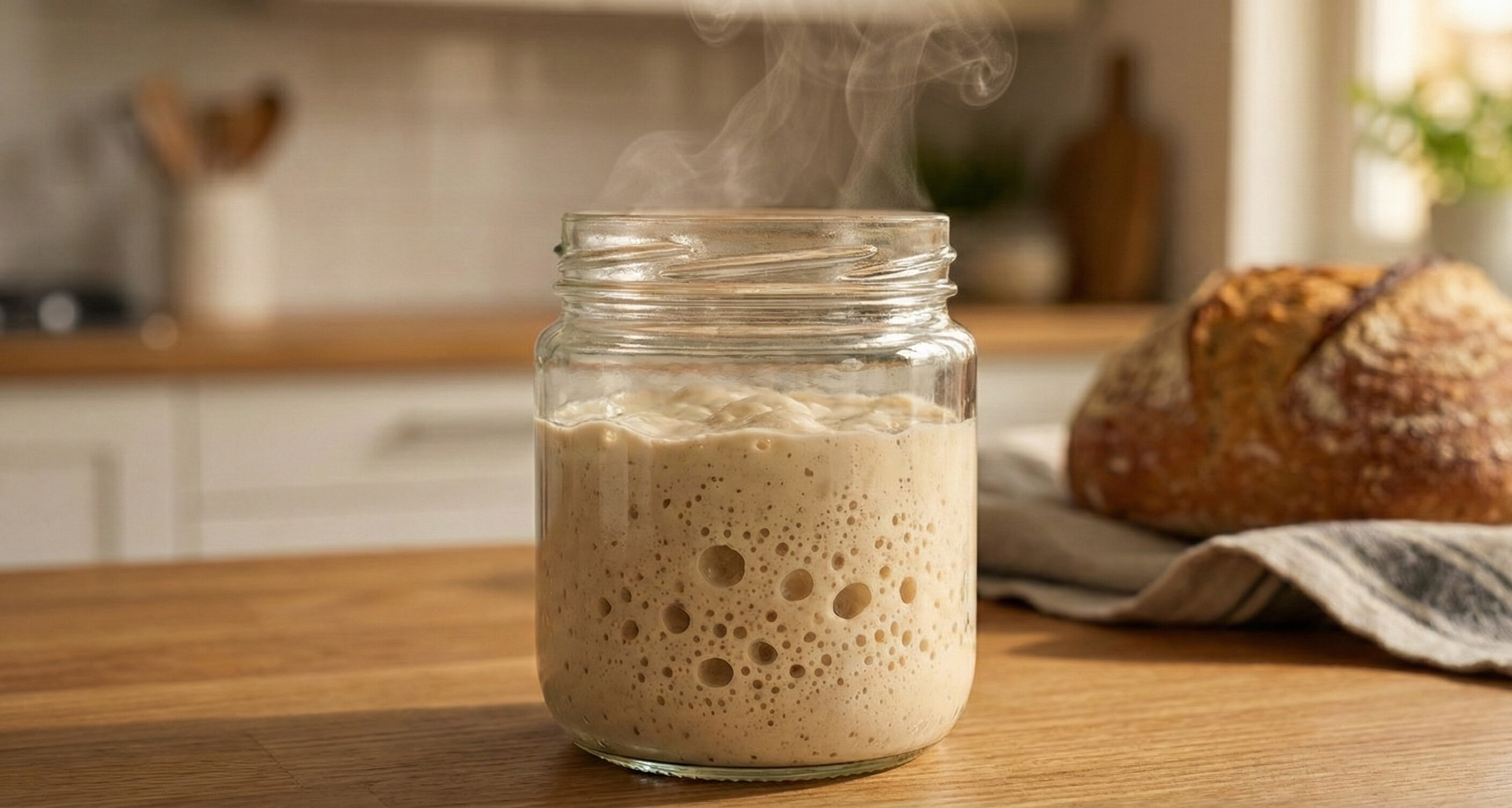
⚡ What You’ll Learn in 60 Seconds
- Normal smells: Yogurt, vinegar, yeasty/beer-like, mild sour = healthy fermentation ✓
- Concerning but fixable: Acetone/nail polish, strong alcohol = very hungry, feed ASAP ⚠
- Bad (discard): Rotten, putrid, ammonia, or visible mold = contaminated ✗
- Hooch (liquid on top): Safe hunger signal, not spoilage – stir in or pour off
- Key insight: Strong smells usually mean hungry starter, not bad starter – most “weird” smells are fixable with feeding
↓ Full 15-min guide with visual smell chart, hooch vs mold comparison, and exact fixes
Most “weird” smells are normal. Sourdough starter is a living culture of yeast and bacteria fermenting flour. Fermentation produces smells – some pleasant (yogurt, tangy), some alarming (acetone, alcohol). The difference between normal and bad comes down to recognizing fermentation byproducts versus actual spoilage. Once you learn what healthy starter smells like at different stages, you’ll stop panicking.
The first time my starter smelled like nail polish remover, I thought I’d killed it. Sharp, chemical smell. Nothing like the mild yogurt-like aroma I expected. I nearly threw it out.
Then I fed it. Eight hours later, it smelled normal again – tangy, slightly sour, active. What I’d interpreted as “dead starter” was actually “very hungry starter producing excess alcohol.” The smell was a signal, not a death sentence.
After maintaining starters for over 3 years, I’ve encountered nearly every smell variation. Vinegar, acetone, beer, cheese, even faint alcohol. Most were normal fermentation. A few required immediate feeding. Only twice did I have actual spoilage – both times, the smell was unmistakably rotten, and visible mold confirmed contamination.
This guide covers every smell you’re likely to encounter: what’s normal, what’s concerning but fixable, and what actually requires discarding your starter. You’ll learn to identify fermentation byproducts, recognize hunger signals, differentiate hooch from mold, and know exactly when to feed versus when to start over.
Sourdough starter should smell alive – sour, tangy, active. If it smells like fermentation (even strong fermentation), it’s probably fine. If it smells like death, then worry. Your nose knows the difference between intense fermentation and actual rot.
Why Sourdough Starter Smells
The science behind fermentation aromas
Sourdough starter is a symbiotic culture of yeast and lactic acid bacteria (LAB) fermenting flour. As these microorganisms consume carbohydrates, they produce various compounds that create characteristic smells.
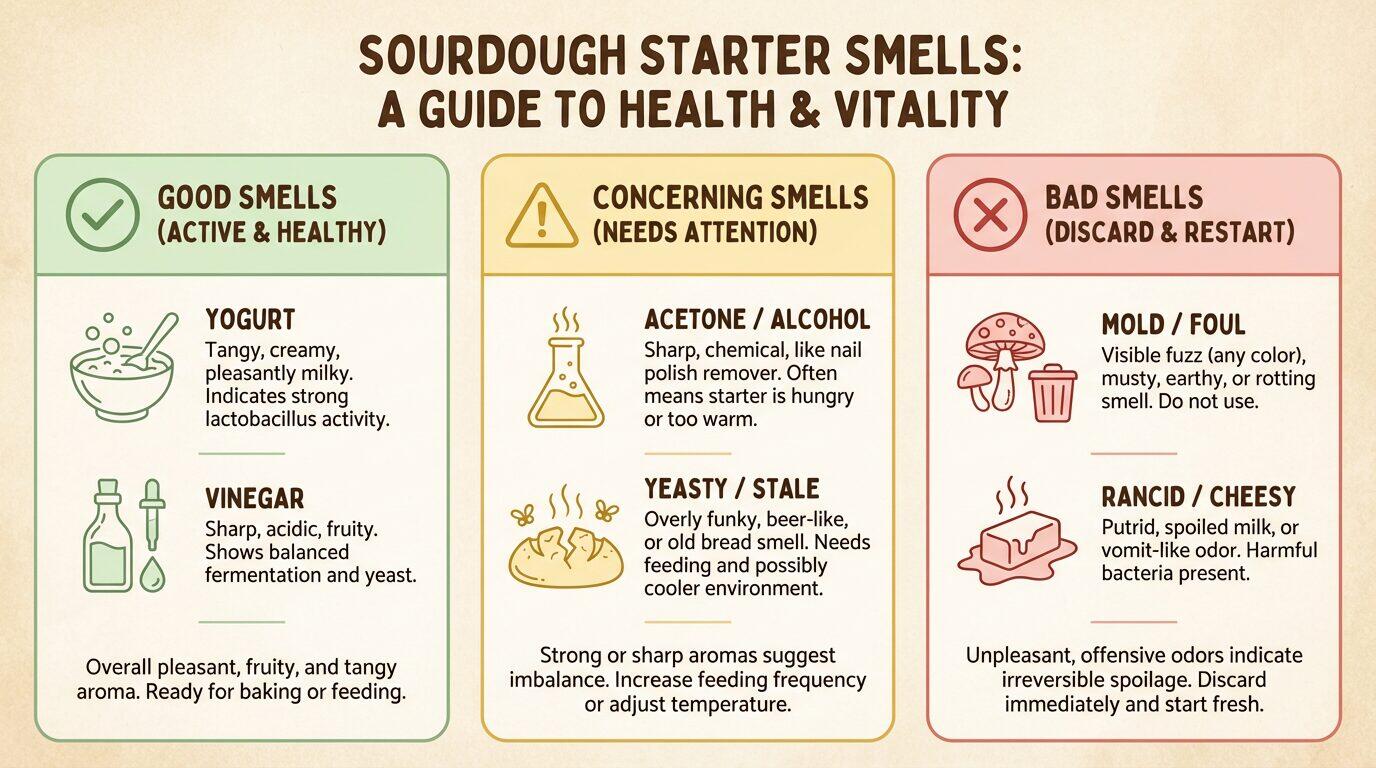
Primary Smell Sources
Lactic Acid Bacteria (LAB):
- Produce lactic acid → sour, yogurt-like smell
- Produce acetic acid → vinegar, tangy smell
- Create the characteristic “sourdough” tang
- Dominant when starter is well-fed and active
Yeast (Saccharomyces cerevisiae and wild yeasts):
- Produce ethanol (alcohol) → boozy, beer-like smell
- Produce CO2 (gas) → contributes to active, bubbly appearance
- Produce esters → fruity or sweet undertones
- More prominent during vigorous fermentation
Metabolic Byproducts:
- Acetone (from stressed yeast) → nail polish remover smell
- Various organic acids → sharp, sour aromas
- Volatile compounds → complex fermentation smells
Factors Affecting Smell Intensity
- Time since feeding: Fresh feeding = mild, neutral. Peak activity = tangy, pleasant. Past peak = strong, sharp, alcoholic.
- Temperature: Warmer (75-80°F) = faster fermentation = stronger smells develop quicker. Cooler (65-70°F) = slower, milder progression.
- Hydration: Thicker starter (lower hydration) = slower fermentation, milder smells. Thinner starter (higher hydration) = faster, more intense aromas.
- Flour type: Whole grain (rye, whole wheat) = stronger, earthier smells due to more nutrients. White flour = cleaner, milder aromas.
I maintain two starters – one 100% white flour, one 50% white/50% rye. The white flour starter smells clean and yogurt-like at peak. The rye blend smells significantly more intense – earthy, tangy, almost funky. Both are healthy, just different microbial profiles creating different aromatic signatures.
Normal Smells (Healthy & Active)
What healthy fermentation smells like
These smells indicate normal, healthy fermentation. Your starter is active, the microbial culture is thriving, and it’s safe to use.
1. Yogurt / Tangy / Creamy
Smell profile: Mild, pleasant tang like plain yogurt or buttermilk. Slightly milky, creamy aroma.
What it indicates: Strong lactic acid bacteria (LAB) activity. This is the classic “sourdough” smell and indicates healthy lactofermentation.
When you’ll smell it: At peak activity (4-8 hours after feeding), when starter is fully active and ready to use.
Action: This is ideal. Use for baking or refrigerate if not baking immediately.
2. Vinegar / Sharp / Acidic
Smell profile: Sharp, acidic, like apple cider vinegar or white vinegar. More intense than yogurt smell.
What it indicates: Acetic acid production from LAB. Shows active fermentation and yeast consuming flour sugars.
When you’ll smell it: When starter is getting hungry (8-12 hours after feeding) or approaching time to feed again.
Action: Feed within the next few hours. Still usable but will produce more sour bread. If you prefer less sour bread, feed sooner after peak.
My starter develops a vinegar smell about 12 hours after feeding at room temperature. This is my signal that it’s time to either use it or feed it again. If I catch it at 8-10 hours (before strong vinegar smell), the bread tastes milder. At 14+ hours with strong vinegar smell, bread is noticeably more sour – which I actually prefer for certain loaves.
3. Yeasty / Beer-Like / Bready
Smell profile: Reminiscent of beer, bread dough, or fresh baked bread. Slightly sweet, malty undertones.
What it indicates: Active yeast fermentation producing ethanol and CO2. Strong yeast population.
When you’ll smell it: During peak rise (when starter is most active and bubbly) and shortly after feeding.
Action: Normal and healthy. This is when starter has maximum leavening power.
4. Mildly Sour / Pleasant Tang
Smell profile: Subtle sourness, not overpowering. Pleasant, clean fermentation smell.
What it indicates: Balanced LAB and yeast activity. Well-maintained starter.
When you’ll smell it: Anytime between feeding and peak, when culture is active but not hungry.
Action: Ideal state. Continue normal feeding schedule.
All normal smells share one characteristic: they smell like fermentation, not decay. Even strong vinegar or yeasty smells indicate active microbial metabolism, not spoilage. If the smell makes you think “fermentation” rather than “rot,” your starter is probably fine.
Concerning Smells (Needs Attention)
Warning signals that require immediate feeding
These smells indicate your starter is stressed, very hungry, or producing excess metabolic byproducts. They’re fixable with proper feeding but shouldn’t be ignored.
1. Acetone / Nail Polish Remover / Chemical
Smell profile: Sharp, chemical smell like nail polish remover or paint thinner. Harsh, almost solvent-like.
What it indicates: Yeast under extreme stress producing acetone and other ketones. Happens when starter has consumed all available food and enters starvation metabolism.
When you’ll smell it: When starter hasn’t been fed in too long (24+ hours at room temp, 2+ weeks refrigerated). Often accompanied by hooch (liquid layer on top).
Action:
- Feed immediately with 1:1:1 ratio
- Check for hooch – pour off if present
- Feed again in 12 hours
- After 2-3 feedings, smell should normalize
- Going forward: feed more frequently or use higher ratios (more flour/water)
Acetone smell is alarming but doesn’t mean your starter is dead. It’s the yeast equivalent of “I’m starving, please feed me now.” I’ve recovered starters from acetone smell dozens of times – it always works with consistent feeding.
2. Strong Alcohol / Boozy / Ethanol
Smell profile: Strong alcohol smell like vodka, whisky, or rubbing alcohol. Very sharp and pungent.
What it indicates: Excess ethanol production from yeast. Happens when yeast runs out of oxygen and switches to anaerobic fermentation, producing more alcohol.
When you’ll smell it: Starter past peak, often with hooch visible. Frequently occurs in thick, underfed starters or those stored too long between feedings.
Action:
- Stir to reincorporate oxygen
- Feed with 1:2:2 or 1:5:5 ratio (more food)
- Increase feeding frequency
- For refrigerated starter: feed weekly instead of every 2 weeks
3. Overly Yeasty / Stale Bread / Old Dough
Smell profile: Stale, musty bread smell. Overly funky, almost unpleasant yeastiness.
What it indicates: Yeast dominating LAB. Can happen when starter is too warm, overfed at low ratios, or flour is low in nutrients for LAB.
When you’ll smell it: After several days of feeding at very warm temperatures (80°F+) or when using only white flour with no whole grain.
Action:
- Move to cooler location (70-75°F ideal)
- Add 10-20% whole wheat or rye flour in next feeding (feeds LAB)
- Feed at longer intervals to allow LAB to catch up
- Continue regular feeding – balance will restore
I once kept a starter on a shelf above my oven during winter (trying to keep it warm). Temperature hit 85°F regularly. After a week, it smelled overly yeasty, almost musty. I moved it to a cooler spot and added 20% whole wheat flour to the next three feedings. Within 5 days, the balanced yogurt-like smell returned.
4. Cheese-Like / Funky / Musty (but not moldy)
Smell profile: Funky, cheese-like, reminiscent of aged cheese or musty basement. Unpleasant but not rotten.
What it indicates: Possible off-balance in microbial community or specific LAB strains producing unusual compounds. Can also indicate protein breakdown.
When you’ll smell it: After prolonged neglect (weeks without feeding) or when using hard water with high mineral content.
Action:
- Check for visible mold (fuzzy = discard)
- If no mold, feed with 1:10:10 ratio (dilutes off-flavors)
- Discard most, feed daily for 3-5 days to refresh culture
- Switch to filtered or spring water
- If smell persists after 5 feedings, consider starting fresh
Bad Smells (Discard & Restart)
When to throw out your starter
These smells indicate harmful bacteria, mold contamination, or spoilage. Unlike fermentation smells (which indicate active yeast/LAB), these indicate decay and dangerous microorganisms.
1. Rotten / Putrid / Foul
Smell profile: Unmistakably rotten. Like spoiled food, garbage, or decay. Not sour – actually putrid.
What it indicates: Harmful bacteria contamination. Pathogenic or spoilage bacteria have overtaken the culture.
When you’ll see it: Usually accompanied by visible signs – discoloration (pink, orange, black streaks), separation, or unusual texture.
Action: Discard immediately. Do not attempt to save.
2. Ammonia / Urine-Like / Chemical Decay
Smell profile: Strong ammonia smell like cleaning products or urine. Harsh chemical smell distinct from acetone.
What it indicates: Protein breakdown by putrefactive bacteria. Indicates serious contamination.
Action: Discard. Sanitize jar with bleach solution or boiling water before starting new culture.
3. Moldy / Musty / Earthy (with visible mold)
Smell profile: Musty, earthy, damp basement smell. Always accompanied by visible mold.
What it indicates: Mold contamination. Fuzzy growth (white, green, blue, pink, orange, black) visible on surface or sides of jar.
Action:
- Discard entire starter – do NOT scrape off mold and save the rest
- Mold has invisible mycelia throughout the culture
- Sanitize jar thoroughly
- Start fresh culture
Never try to save moldy starter by removing the mold. Mold produces mycotoxins and has thread-like structures (mycelia) throughout the entire culture, not just the visible surface growth. It’s not worth the health risk. Start fresh – it only takes 5-7 days to build a new active starter.
4. Vomit / Bile / Spoiled Milk
Smell profile: Smell of vomit, bile, or severely spoiled dairy. Nauseating, distinct from sour.
What it indicates: Butyric acid production from Clostridium or other spoilage bacteria. Serious contamination.
Action: Discard immediately. This smell is a clear sign of spoilage, not fermentation.
How to Tell Fermentation from Spoilage
| Characteristic | Fermentation (OK) | Spoilage (Discard) |
|---|---|---|
| Smell | Sour, tangy, vinegar, yeasty, even alcohol/acetone | Rotten, putrid, ammonia, vomit, foul decay |
| Appearance | Bubbly, may have hooch (liquid), consistent color | Mold (fuzzy), pink/orange/black streaks, slimy texture |
| Texture | Smooth, bubbly, may separate (normal) | Slimy, chunky, curdled, abnormal separation |
| Your reaction | ”This smells strong but like fermentation" | "This smells dead/rotten/dangerous” |
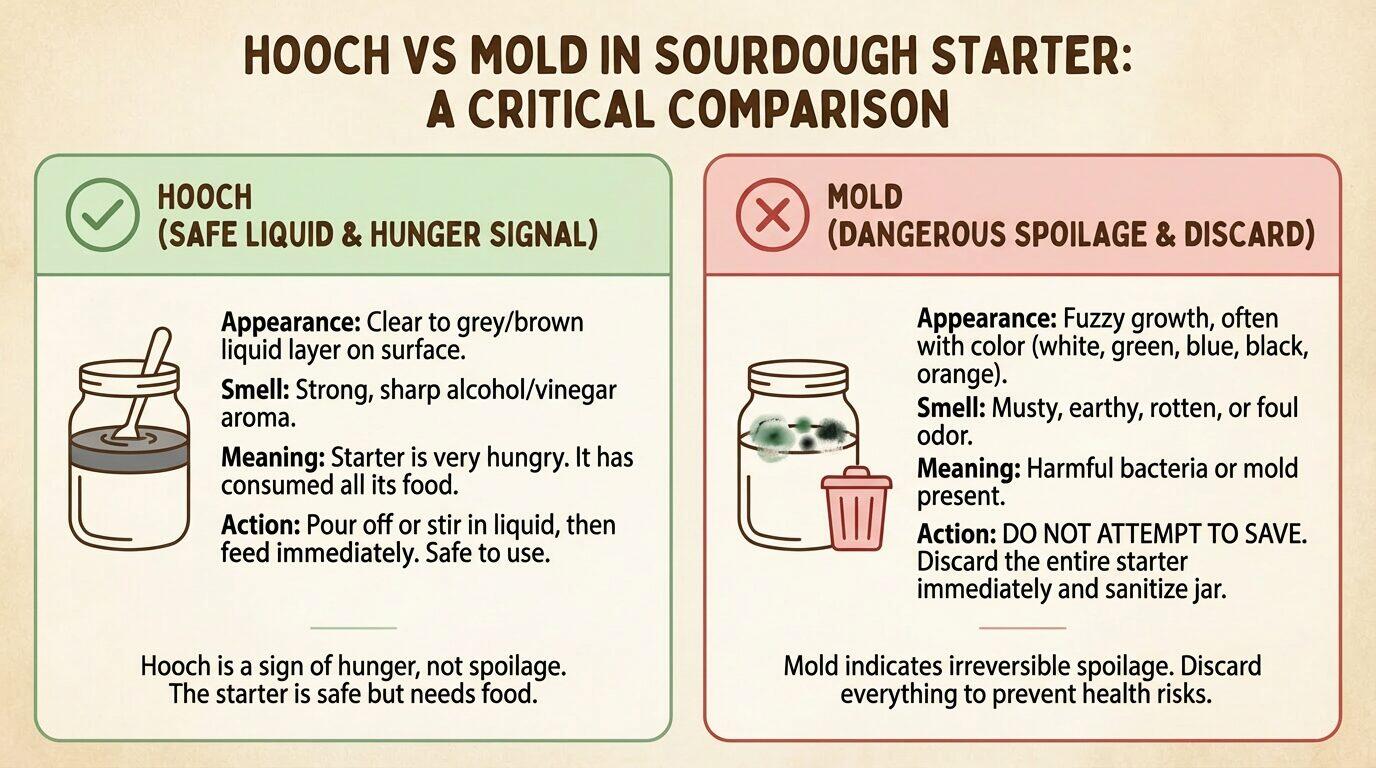
Hooch vs Mold: Critical Comparison
The most commonly confused starter issue
This is the #1 source of confusion. New bakers see dark liquid on their starter and panic, thinking it’s mold. It’s almost always hooch – which is completely harmless.
What is Hooch?
Hooch is alcohol (ethanol) produced by yeast when starter runs out of food. It separates and rises to the surface as a liquid layer.
Visual characteristics:
- Appearance: Clear to gray/brown liquid layer on surface
- Texture: Liquid, watery, flows when jar is tilted
- Location: On top of starter, clear separation line
- Smell: Sharp alcohol, vinegar, or acetone smell
- Color: Clear, gray, brown, sometimes dark – color doesn’t indicate badness
What it means: Your starter is very hungry. It consumed all available food and is now producing alcohol as a byproduct of starvation metabolism.
What to do:
- Pour off the liquid OR stir it back in (both are safe)
- Pouring off = milder flavor in final bread
- Stirring in = slightly more sour bread
- Feed starter immediately with 1:1:1 or 1:2:2 ratio
- Going forward: feed more frequently or use higher ratios
I get hooch on my refrigerated starter if I forget to feed it for 10-12 days. It’s always grayish-brown liquid on top. I pour it off (I prefer less sour bread), feed 1:2:2, let it ferment 2 hours at room temp, then back in the fridge. Starter returns to normal activity within one feeding cycle.
What is Mold?
Mold is fungal contamination – a different organism from the yeast and bacteria in your starter. It’s dangerous and means your starter is spoiled.
Visual characteristics:
- Appearance: Fuzzy, spotted, or hairy growth with visible texture
- Texture: Fuzzy, raised, three-dimensional (not flat liquid)
- Location: On surface, sides of jar, or throughout culture
- Smell: Musty, earthy, moldy, rotten – distinct from fermentation
- Color: White, green, blue, pink, orange, or black fuzzy spots
What it means: Harmful mold contamination. The entire culture is compromised, including invisible spores and mycelia throughout.
What to do:
- DO NOT try to scrape off mold and save the rest
- Discard entire starter
- Sanitize jar with bleach solution (1 tbsp bleach per gallon water) or boil for 10 minutes
- Start fresh culture
- Identify source of contamination (dirty utensils, dusty environment, contaminated flour)
Quick Decision Chart
| Visual Observation | What It Is | Action |
|---|---|---|
| Dark liquid layer on top, smooth | Hooch (safe) | Pour off or stir in, feed immediately |
| White/pink/green/blue fuzzy spots | Mold (discard) | Throw out entire starter, sanitize jar |
| Clear liquid with strong alcohol smell | Hooch (safe) | Feed starter, increase feeding frequency |
| Fuzzy growth on jar sides | Mold (discard) | Do not save, start fresh |
| Gray/brown liquid, vinegar smell | Hooch (safe) | Stir in, feed normally |
Simple test: If you can pour it like water, it’s hooch (safe). If it’s fuzzy, spotted, or has texture, it’s mold (discard). Hooch is liquid alcohol. Mold is solid fungal growth. They look completely different once you’ve seen both.
How Smell Changes Over Time
The fermentation timeline after feeding
Understanding how your starter’s smell evolves through its fermentation cycle helps you identify what stage it’s in and when to feed or use it.
Timeline: Room Temperature (70-75°F)
0-2 hours after feeding:
- Smell: Neutral, slightly floury, mild
- Activity: Minimal bubbles, mixture just beginning fermentation
- Status: Too early to use – microorganisms just waking up
2-4 hours after feeding:
- Smell: Faint tangy aroma developing, clean
- Activity: Small bubbles forming, starter beginning to rise
- Status: Active but not peak yet
4-8 hours after feeding (PEAK):
- Smell: Pleasant yogurt-like tang, slightly yeasty, mild sour
- Activity: Doubled or tripled in height, full of bubbles, domed surface
- Status: ✅ IDEAL TIME TO USE – maximum leavening power
8-12 hours after feeding:
- Smell: Stronger vinegar, sharper tang, beginning alcohol notes
- Activity: Starting to fall from peak, still bubbly but deflating
- Status: Past peak – usable but will produce more sour bread
12-24 hours after feeding:
- Smell: Strong vinegar, alcohol, possibly acetone if very warm
- Activity: Fallen significantly, may have hooch forming
- Status: Hungry – feed soon or refrigerate immediately
24+ hours after feeding:
- Smell: Acetone, strong alcohol, very sharp and pungent
- Activity: Flat, hooch visible on top, starving metabolism
- Status: ⚠ Very hungry – feed immediately
I mark my jar with tape when I feed my starter and note the time. At 5-6 hours, I check for peak (doubled height, domed top). That’s when I use it. If I miss the window and check at 10-12 hours, it smells strongly of vinegar and has fallen – I’ll feed it again before using to restore full activity.
Temperature Impact
Timeline shifts with temperature:
- 65-68°F (cool): Peak at 10-14 hours, smells develop slowly
- 70-75°F (ideal): Peak at 6-8 hours, standard timeline
- 76-80°F (warm): Peak at 3-5 hours, rapid smell intensification
- 80°F+ (hot): Peak at 2-3 hours, acetone smell can develop quickly
How to Fix a Smelly Starter
Solutions for each smell issue
For Acetone / Nail Polish Smell
Problem: Very hungry starter producing excess ketones
Solution:
- Pour off any hooch present
- Feed immediately at 1:1:1 ratio
- Wait 8-12 hours at room temperature
- Feed again at 1:1:1 ratio
- After 2-3 feeding cycles, smell normalizes
- Going forward: increase feeding frequency
For Strong Alcohol Smell
Problem: Excess ethanol from neglected starter
Solution:
- Stir starter to reincorporate oxygen
- Pour off hooch if present
- Feed at higher ratio (1:5:5 or 1:10:10) to dilute alcohol
- Let ferment at room temp for 8-12 hours
- Feed again at 1:2:2
- Normal activity and smell return after 2 feedings
For Overly Sour / Vinegar Smell
Problem: Excess acetic acid production
Solution:
- Feed more frequently (don’t let it go 24+ hours between feedings)
- Use lower temperatures (move to cooler spot, 70°F instead of 75°F+)
- Increase hydration slightly (use 60g water instead of 50g with 50g flour)
- Higher hydration and cooler temp favor lactic acid over acetic acid
For Weak / No Smell
Problem: Underactive starter, weak microbial population
Solution:
- Move to warmer location (75°F ideal)
- Feed daily at 1:1:1 ratio for 5-7 days
- Add 10-20% whole wheat or rye flour (more nutrients for microbes)
- Ensure you’re using filtered water (not heavily chlorinated)
- Be patient – young starters (under 2 weeks) are naturally mild
General Refresh Protocol (For Any Off-Smell)
If your starter smells wrong but doesn’t have mold:
- Day 1: Discard all but 10g starter, feed with 100g flour + 100g water (1:10:10 ratio). This heavily dilutes any off-flavors.
- Day 2: Discard all but 50g, feed with 50g flour + 50g water (1:1:1 ratio).
- Days 3-5: Continue daily 1:1:1 feedings at room temperature.
- By Day 5: Starter should smell normal (yogurt-like, tangy).
- If still off after 5 days: Consider starting fresh.
I’ve used this refresh protocol to rescue starters that sat neglected in my fridge for 6-8 weeks. The acetone smell was overwhelming. After the 1:10:10 dilution feeding followed by 3-4 days of 1:1:1 feedings, they returned to normal activity and smell. I’ve never had to discard a starter that didn’t have visible mold.
Track Starter Health & Never Miss a Feeding
Flourwise logs feedings, tracks activity patterns, and sends you reminders so your starter stays healthy.
Everything for consistent starter care:
- Log feedings and note observations → track smell/activity over time
- Scheduled feeding reminders with push notifications
- Calculate exact feeding amounts for any ratio (1:1:1, 1:5:5, custom)
- Plan bake day timeline based on your starter’s peak time
Build confidence in starter management. Never panic about weird smells again.
When to Actually Discard
The only times you should throw out your starter
Good news: you rarely need to discard starter. Most issues are fixable. Here are the only legitimate reasons to start over:
1. Visible Mold
Signs:
- Fuzzy growth (any color: white, green, blue, pink, orange, black)
- Raised, textured spots on surface or jar sides
- Musty, moldy smell
Action: Discard entire starter. Do not try to save any portion.
2. Truly Rotten Smell
Signs:
- Smell of decay, not fermentation
- Putrid, like spoiled meat or garbage
- Ammonia or vomit smell
- Makes you gag (fermentation smells might be strong, but not nauseating)
Action: Discard. This indicates harmful bacteria contamination.
3. Pink or Orange Discoloration
Signs:
- Pink, orange, or red streaks or patches
- Serratia marcescens bacteria (produces pink pigment)
- Usually appears after contamination from dirty utensils or hands
Action: Discard. This bacteria can be harmful and indicates poor sanitation.
4. No Recovery After 7+ Days of Daily Feeding
Signs:
- You’ve fed daily at 1:1:1 ratio for a full week
- Starter still shows no rise, no bubbles, no activity
- Smell remains off or doesn’t develop
Action: Culture may be dead or contaminated with organisms outcompeting yeast/LAB. Start fresh.
When NOT to Discard (Common False Alarms)
Don’t panic over these:
- Hooch on top → Just feed it
- Acetone smell → Feed 2-3 times, it recovers
- Strong vinegar smell → Normal hunger signal
- Starter hasn’t risen in 24 hours → May be too cold, move to warmer spot
- Gray or brown liquid → That’s hooch (alcohol), not mold
- Slightly discolored from whole wheat flour → Flour color, not contamination
- Smells weird after being refrigerated 3 weeks → Feed 2-3 times at room temp
Rule of thumb: If you’re uncertain whether to discard, try 3-5 daily feedings first. If the starter doesn’t respond (no rise, no bubbles, smell doesn’t improve), then discard. But 95% of “weird smell” problems resolve with consistent feeding.
Conclusion: Trust Your Nose (But Educate It First)
The first time you smell acetone from your starter, it’s alarming. The smell is harsh, chemical, wrong. Your instinct says “throw this out.”
But now you know: that’s not spoilage. That’s stress metabolism from a very hungry culture. Feed it twice, and it returns to normal. The smell that seemed like death was actually a communication signal – “I need food, please.”
After you’ve smelled normal yogurt-like starter, vinegar-sharp hungry starter, and acetone-stressed starter a few times, you develop intuition. You’ll smell your starter and immediately know: “This is 8 hours past feeding” or “This needs emergency feeding” or “This is at perfect peak.”
The only time your nose should trigger alarm is when the smell shifts from fermentation (any intensity) to actual decay – rotten, putrid, ammonia, decomposition. That smell is unmistakable and rare. Everything else is fermentation at different stages of hunger.
Your starter is resilient. Most “bad” smells are fixable. Actual contamination is obvious. Trust the process, feed consistently, and you’ll develop the confidence to distinguish normal from concerning from dangerous.
Quick Reference
- Normal smells: yogurt, vinegar, yeasty, mildly sour = healthy fermentation ✓
- Concerning smells: acetone, strong alcohol, overly yeasty = very hungry, feed ASAP ⚠
- Bad smells: rotten, ammonia, putrid, moldy = contaminated, discard ✗
- Hooch (liquid on top) = safe alcohol, not mold → pour off or stir in, then feed
- Mold (fuzzy growth) = dangerous contamination → discard entire starter, sanitize jar
- Timeline: Fresh feeding = neutral. Peak (4-8h) = tangy/yogurt. Past peak (12h+) = vinegar/alcohol
- Acetone smell = extreme hunger signal, not death sentence → feed 2-3 times to recover
- 95% of “weird” smells are fixable with proper feeding
- Only discard for: visible mold, truly rotten smell, pink/orange discoloration, or no response after 7 days of feeding
- When uncertain: feed daily for 3-5 days and observe – most starters recover
Frequently Asked Questions
Should my sourdough starter smell sour?
Yes, sourdough starter should smell pleasantly sour – like yogurt, buttermilk, or mild vinegar. This tangy aroma comes from lactic acid bacteria (LAB) fermenting flour. A mild sour smell is normal and healthy. Very strong or sharp vinegar smell indicates a very hungry starter that needs feeding soon. Sweet-sour smell is ideal at peak activity.
Why does my sourdough starter smell like acetone or nail polish remover?
Acetone smell indicates a very hungry starter producing excess alcohol. When starter runs out of food, yeast produces more ethanol and other volatile compounds including acetone. This is fixable – feed your starter immediately. For refrigerated starters, feed weekly instead of every 2 weeks. For room temperature starters, increase feeding frequency or use higher ratios (more flour/water). The starter is still usable after feeding.
What does a bad sourdough starter smell like?
Bad starter smells rotten, putrid, like spoiled milk, or has strong ammonia odor. These smells indicate harmful bacteria contamination, not normal fermentation. If you see visible mold (fuzzy growth in white, pink, orange, blue, or black), the starter is contaminated and should be discarded. Normal fermentation smells sour, tangy, yeasty, or alcoholic – not rotten or foul.
Is the liquid on top of my sourdough starter bad?
No, the liquid (called hooch) is not bad – it’s alcohol produced by hungry yeast. Hooch appears as a clear, gray, or brownish liquid layer on top of starter. It means your starter consumed all its food and needs feeding. You can pour it off or stir it back in (stirring makes starter slightly more sour). Hooch is a hunger signal, not spoilage. Feed your starter and it will be fine.
How can I tell the difference between hooch and mold?
Hooch is liquid (clear, gray, or brown) that separates on top – it’s safe. Mold is fuzzy growth with texture, often colored (white, green, blue, pink, orange, black) – it’s dangerous. Hooch: stir in or pour off, then feed. Mold: discard entire starter and sanitize jar. Hooch smells alcoholic or vinegary. Mold smells musty, earthy, or rotten. Visual test: liquid = hooch (OK), fuzzy/spotted = mold (discard).
Can I use sourdough starter that smells like vinegar?
Yes, starter that smells like vinegar is still usable but is past peak and very hungry. Vinegar smell indicates acetic acid production from lactic acid bacteria. The bread will be more sour than if you’d used starter at peak. For best results: feed the starter, wait for it to reach peak activity (4-8 hours, when it smells mildly tangy like yogurt), then use it. Or use the vinegar-smelling starter for extra sour bread – it’s not harmful, just strong-flavored.
My starter doesn’t smell like anything. Is that bad?
Very mild smell is normal for: 1) Young starters (under 2 weeks old) that haven’t developed strong microbial populations yet, 2) Freshly fed starter (0-2 hours after feeding), 3) Refrigerated starter that’s been cold. To develop stronger smell: maintain at room temperature with daily feedings for 5-7 days, add 10-20% whole wheat or rye flour (more nutrients), ensure temperature is 70-75°F, and wait for peak activity (4-8 hours after feeding). Mature, active starters have distinct tangy smell.