No Knead Bread: 4 Ingredients, Without Dutch Oven, 10 Min
⚡ What You’ll Learn in 60 Seconds
- Just 4 ingredients: 100% flour, 65% water, 1.9% salt, 1% yeast — zero kneading required
- Beginner friendly: No stand mixer, no banneton, no Dutch oven, no special equipment — just a bowl, an oven, and a fridge
- Total active time: Under 10 minutes of actual work spread across two days
- Overnight in the fridge: 12-20 hours of cold fermentation develops flavor and structure without any hands-on work
- Key insight: 65% hydration is deliberately low — the dough holds its shape during final proof on a simple cutting board without a banneton. Higher hydration would spread flat.
Full 10-min guide with baker’s percentages, fermentation timing chart, step-by-step process, and scaling instructions
I mixed 470g of flour, 305g of water, 9g of salt, and 5g of yeast in a bowl. No kneading, no stand mixer, no special equipment. I covered it, put it in the fridge overnight, and went to sleep.
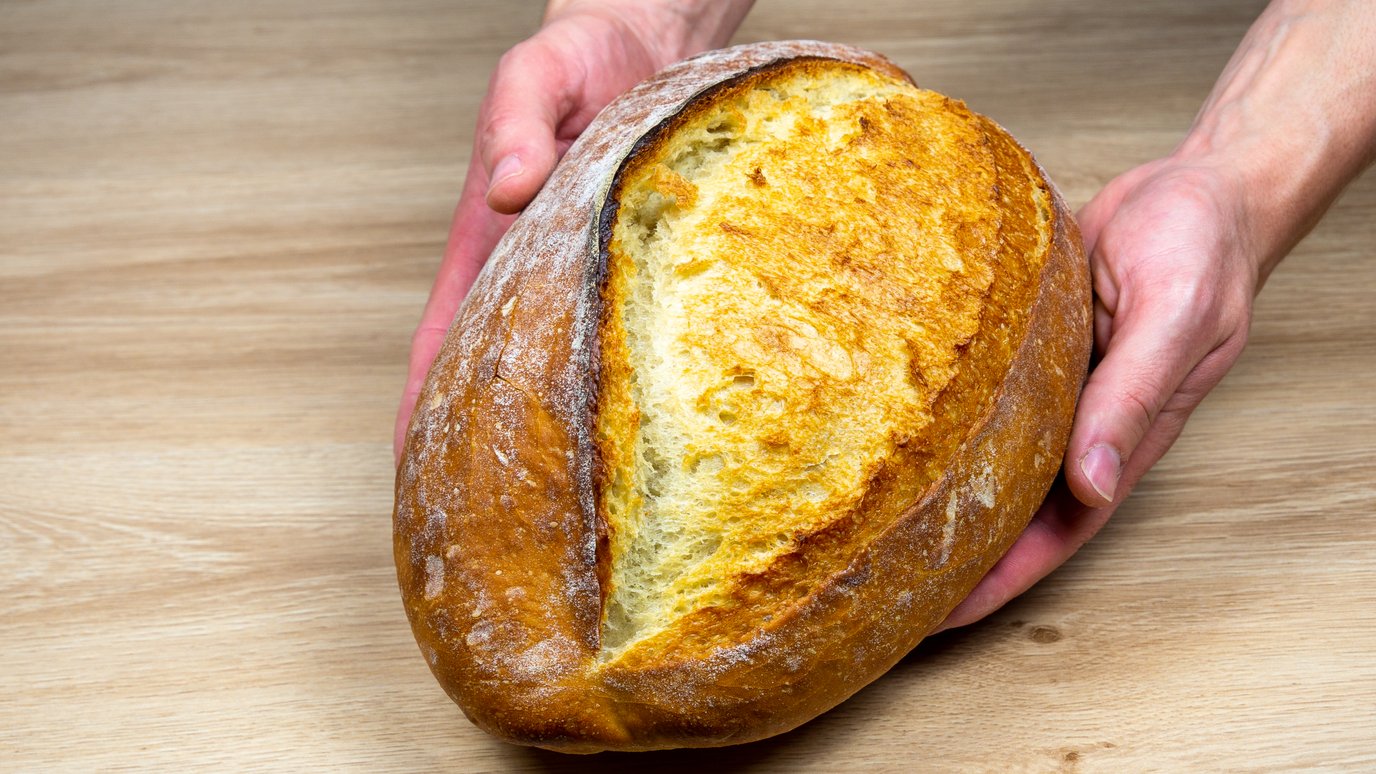
Sixteen hours later, I pulled the dough out, gave it a quick pre-shape into a ball, let it rest for 20 minutes, and shaped it into a batard with good surface tension. Three hours of final proofing, 27 minutes in the oven, and the result was a crusty artisan bread with soft crumb and the kind of flavor you only get from long, slow fermentation.
That’s no knead overnight bread — an easy artisan bread recipe without kneading, and you don’t need any special equipment to make it. No stand mixer, no banneton, no Dutch oven. A bowl, parchment paper, and a regular oven with a steam tray. Once you understand the formula behind it, you can scale it, adjust it, and bake it on your own schedule.
No knead bread isn’t a shortcut. It’s a technique that uses time and water overnight to do the work that kneading does by force. The result isn’t “almost as good” — it’s often better.

Why No Knead Bread Works
Time and water replace mechanical force
Kneading has one job: developing gluten. You stretch and fold the dough repeatedly to align gluten proteins into a strong, elastic network that traps gas and gives bread its structure.
No knead bread achieves the same result through two mechanisms:
1. Autolyse (hydration): When flour and water mix, gluten proteins (glutenin and gliadin) begin absorbing water and linking together on their own. At 65% hydration, this process is slower but steady. Given enough time — 12 to 20 hours — the gluten network develops without any mechanical input.
2. Cold fermentation: The fridge slows yeast activity to a crawl, which does two critical things. First, it gives gluten more time to develop passively. Second, it allows enzymes (amylase) to break down starches into sugars, creating complex flavors that a 2-hour room temperature rise can’t produce. That slightly tangy, deep flavor in cold-fermented bread? That’s enzymatic activity, and it requires time.
The combination means you get strong gluten structure AND superior flavor with almost zero effort. The tradeoff is patience — you need 12-20 hours of fridge time. But those are hours where you’re sleeping or at work, not standing in the kitchen.
No knead bread uses autolyse (passive gluten development from hydration) and cold fermentation (slow enzymatic flavor development) to replace mechanical kneading. The result is artisan bread with better flavor and comparable structure — under 10 minutes of hands-on work for a loaf that rivals any bakery.
The No Knead Bread Formula in Baker’s Percentages
Scale this easy overnight dough recipe to any size
This is a 4 ingredient no knead bread — flour, water, salt, yeast. Here’s the formula broken down into baker’s percentages — the universal language for scaling bread recipes:
| Ingredient | Baker’s % | Weight (1 loaf) | Role |
|---|---|---|---|
| Wheat flour (AP or bread flour) | 100% | 470g | Structure, gluten |
| Water | 64.9% | 305g | Hydration, autolyse |
| Salt | 1.9% | 9g | Flavor, gluten strength |
| Dry yeast | 1.06% | 5g | Leavening |
| TOTAL | 167.9% | 789g |
65% hydration is deliberately on the lower side, and that’s the point. I designed this recipe to be beginner-friendly — most people starting out don’t know their flour’s protein content or absorption rate, and 65% works reliably regardless of whether you’re using all-purpose or bread flour. But there’s a second, equally important reason: this bread proofs without a banneton. After final shaping, it sits on a cutting board or pizza peel covered with parchment paper. At 70%+ hydration, the dough would spread flat without a banneton to hold its shape. At 65%, it holds tension and structure on its own, giving you good oven spring from a flat surface. For context, standard artisan sourdough runs at 70-75% hydration — but those recipes typically use a banneton for final proof.
1.9% salt is just under the standard 2% — enough for good flavor without slowing fermentation during the long cold rise.
1% yeast is moderate. This amount works well for the 12-20 hour cold fermentation window. More yeast means shorter fermentation but less flavor development.
I settled on these exact percentages after testing 8-10 variations over a few weeks. At 60% hydration, the autolyse was too slow and the crumb came out tight. At 70%, the dough spread flat during the final proof on the cutting board — without a banneton to support it, the wetter dough couldn’t hold its shape. 65% is the sweet spot: enough water for proper gluten development, but firm enough to proof free-standing on parchment paper with good oven spring. This recipe works equally well with all-purpose or bread flour at 65% hydration — I’ve tested both with no change in water amount needed.
Want to scale this recipe to a bigger or smaller loaf? Multiply each percentage by your desired flour weight — or use a baker’s percentage calculator that does it automatically. For two loaves, double the flour to 940g: water becomes 610g, salt 18g, yeast 10g. The ratios stay perfect at any scale.
Step-by-Step Process
Under 10 minutes of actual work, spread across two days
Day 1 — Evening (5 minutes active)
Mix the dough
Dissolve 5g dry yeast in 305g room temperature water. Add 470g wheat flour (all-purpose or bread flour — both work at this hydration) and 9g salt. Stir with a spoon or dough whisk until no dry flour remains. The dough will look rough and shaggy — that’s exactly right. Don’t overwork it.
Finish by hand
Wet your hands and press any remaining dry patches into the dough. You’re not kneading — just making sure everything is incorporated. This takes 30 seconds.
First rest
Cover the bowl tightly with plastic wrap and place it in the fridge for 30-60 minutes. This short initial rest lets the flour fully hydrate before the long cold fermentation. I recommend the full 60 minutes.
Shape in the air
After the initial rest, wet your hands and pull the dough out of the bowl. Here’s the technique: hold the dough in both hands and fold the edges underneath repeatedly, rotating as you go. You’re forming a smooth ball in mid-air — no counter, no flour, no mess. The dough transforms from rough and sticky to smooth and taut in about 30-60 seconds.
Overnight cold fermentation
Place the dough back in the bowl, cover tightly with plastic wrap, and refrigerate overnight for 12-20 hours.
The air-shaping technique is the most satisfying part of this recipe. The first time I tried it, I was skeptical — shaping without a counter seemed wrong. But the wet hands prevent sticking, and the dough’s weight helps create surface tension as you fold. After two or three loaves, it becomes second nature. The whole shaping step takes under a minute.
Day 2 — Morning/Afternoon (5 minutes active + waiting)
Check the dough
After 12-20 hours, the dough may look like it barely rose. Don’t panic — this is completely normal. Cold fermentation slows gas expansion, but fermentation has absolutely occurred. You’ll see small bubbles on the surface and the dough will feel softer and more airy than when you put it in.
Turn out and pre-shape
Turn the dough onto a lightly floured surface. It shouldn’t be very sticky since it’s cold. Gently degas by pressing with your fingertips — don’t punch it. Fold all edges to the center and form a rough ball. This step equalizes the dough temperature, which matters after 12+ hours in the fridge. Cover and rest 20 minutes.
Final shaping
Dust with flour, flip the dough over, and shape it into a tight boule or batard. Build surface tension by tucking the dough underneath with your thumbs, pulling it toward you on the counter. The dough should feel taut on top. Roll it gently to seal the seam on the bottom.
Final proof
Place the shaped dough seam-down on parchment paper on a cutting board or pizza peel (lightly dusted with semolina or cornmeal for insurance against sticking). No banneton needed — at 65% hydration, the dough holds its shape on a flat surface. Cover and proof at room temperature for 2-3.5 hours until the dough has visibly expanded and feels pillowy when gently poked.
Never Guess Your Baking Timeline Again
Planning when to start, when to shape, and when to bake is the hardest part of bread with long fermentation. Flourwise has a built-in baking mode with step-by-step timers for every stage.
What it does for no knead bread:
- Set your schedule backwards from when you want fresh bread
- Automatic timers for cold fermentation, proofing, and baking
- Save this recipe and bake it step-by-step with one tap
- Log your result in the baking journal — track what worked and what to tweak next time
You handle the mixing and shaping. The app handles the timing.
Cold Fermentation Timing Chart
How fridge temperature affects your timeline
The biggest variable in no knead bread is fermentation time, and it depends almost entirely on your fridge temperature. Here’s what I’ve observed:
| Fridge Temp | Min Time | Optimal Time | Max Time | Notes |
|---|---|---|---|---|
| 2-3°C (36-37°F) | 16h | 18-20h | 24h | Very slow. Best flavor development. Dough may look underproofed. |
| 4-5°C (39-41°F) | 12h | 14-16h | 20h | Standard home fridge. Good balance of convenience and flavor. |
| 6-7°C (43-45°F) | 10h | 12-14h | 16h | Warmer fridge. Faster rise, slightly less complex flavor. |
If you want to shorten cold fermentation, don’t add more yeast — increase your fridge temperature by 1-2°C instead. Going from 3°C to 5°C cuts 2-4 hours off your timeline while preserving most of the flavor complexity. Adding more yeast speeds things up but reduces the enzymatic flavor development that makes cold-fermented bread special.

Planning Your Bake
The beauty of this recipe is scheduling flexibility. Here are two realistic timelines:
Evening Baker (bread ready for dinner)
10:00 PM — Mix dough, initial rest, shape in the air, into fridge
Next day 2:00 PM (16h later) — Take out, pre-shape into ball, rest 20 min, final shape
2:30 - 5:30 PM — Final proof (~3 hours)
5:00 PM — Preheat oven to 250°C (482°F) with steam tray inside
5:30 PM — Score and bake (15 min steam + 12-15 min dry)
6:00 PM — Fresh bread for dinner
Morning Baker (bread ready for lunch)
9:00 PM — Mix dough, initial rest, shape, into fridge
Next day 7:00 AM (10h later, warmer fridge at 5°C) — Take out, pre-shape, rest, final shape
7:30 - 10:30 AM — Final proof (~3 hours)
10:00 AM — Preheat oven
10:30 AM — Score and bake
11:00 AM — Fresh bread
I typically mix the dough about an hour before going to bed. The initial 60-minute rest and air-shaping add barely any effort to my evening routine. The next afternoon, I take it out around 2 PM, and we have fresh bread by 6 PM. Once you’ve done it three or four times, the whole process fits into your life rather than the other way around.
Shaping Without a Counter
The cleanest bread technique you’ll ever learn
Traditional bread shaping means flour everywhere — on the counter, on your hands, on the floor. This recipe uses an air-shaping technique for the first shape that eliminates the mess entirely.
The Air-Shaping Technique
- Wet your hands thoroughly. This prevents the dough from sticking to your skin.
- Pull the dough out of the bowl and hold it in both hands.
- Fold the edges underneath — grab an edge, stretch it slightly, and tuck it under the ball. Rotate 90° and repeat.
- Keep rotating and folding. After 8-10 folds, the surface becomes smooth and taut.
- Place back in the bowl seam-side down.
The whole process takes 30-60 seconds. The dough transforms from rough and shaggy to smooth and elastic right in your hands. Surface tension builds naturally as you fold — you can feel the dough tightening with each rotation.
Final Shaping (on the counter)
For the second shaping on Day 2, you do use a counter:
- Dust the dough with flour and flip it onto a lightly floured surface
- Gently spread and degas with fingertips
- Fold edges to center, building a rough rectangle
- Roll tightly from top to bottom for a batard, or fold all sides to center for a boule
- Use your thumbs to tuck dough underneath, creating surface tension
- Roll briefly to seal the bottom seam
Surface tension is critical here. The tighter the surface, the better the bread opens at the score during baking. You should see the dough visibly tighten as you tuck underneath.
Baking with Steam
250°C, steam, and a sharp blade
Oven Setup
Preheat your oven to 250°C (482°F) for at least 30 minutes before baking. Place a heat-resistant container (cast iron skillet, metal tray, or oven-safe dish) on the bottom rack during preheating. I use a tray filled with lava rocks — they hold heat and create more sustained steam than an empty pan, but an empty pan works too.
Scoring
Right before loading the bread, dust the surface with flour and make a single long score with a razor blade (lame) or very sharp knife. Hold the blade at a slight angle — about 30° from horizontal. This angled cut creates the distinctive “ear” that lifts during baking.
Baking Process
- Slide the bread (on parchment paper) onto the middle rack or a preheated baking stone
- Pour about 200ml of hot water into the container on the bottom rack — steam will burst immediately
- Close the oven door quickly
- Drop temperature to 230°C (446°F)
- Bake 15 minutes with steam (don’t open the door)
- Remove the steam container
- Bake 12-15 minutes more without steam until deep golden brown
The steam during the first 15 minutes is essential. It keeps the dough surface moist and flexible during the initial oven spring — the rapid expansion that happens when the dough hits extreme heat. Without steam, the crust sets too early and the bread can’t fully expand.
Total bake time: 27-30 minutes. The bread is done when the crust is deep golden brown and the loaf sounds hollow when tapped on the bottom. If you have a thermometer, internal temperature should read 96-99°C (205-210°F).
Adjustments and Variations
Tweaking the formula for your conditions
Speeding Up Fermentation — Quick No Knead Bread
If 16 hours is too long for your schedule:
- Increase fridge temperature by 1-2°C (best option — preserves flavor)
- Add 1g more yeast (6g total, 1.3%) — reduces cold ferment to 10-14 hours, slightly less complex flavor
- Combine both for 8-10 hour fermentation — still better flavor than a 2-hour room temperature rise
Flour Adjustments
This recipe works with both all-purpose and bread flour at 65% hydration — no adjustment needed. If using other flour types:
| Flour Type | Protein | Hydration Adjustment | Notes |
|---|---|---|---|
| All-purpose flour | 10-11% | 65% (as written) | Works perfectly. Slightly softer crumb than bread flour. |
| Bread flour | 12-13% | 65% (as written) | Slightly chewier texture and more structure. |
| High-protein flour | 14%+ | Increase to 68-70% | Can absorb more water. Produces chewier crust. |
| 20% whole wheat blend | Varies | Increase to 68-70% | Bran absorbs extra water. Add 15-25g more water. |
For detailed information on how different hydration levels affect your bread, see the sourdough hydration chart — the principles apply to yeasted bread too.
Hydration Variations
| Hydration | Water (for 470g flour) | Character | Difficulty |
|---|---|---|---|
| 60% | 282g | Tight crumb, very easy to shape, denser texture | Beginner |
| 65% | 305g | Moderate crumb, easy handling, good all-rounder (this recipe) | Beginner |
| 70% | 329g | More open crumb, slightly sticky — banneton recommended for final proof | Intermediate |
| 75% | 352g | Very open crumb, sticky dough — banneton required or dough will spread flat | Advanced |
Check the baker’s percentage chart for a complete reference of common bread formulas and their typical hydration ranges.
Troubleshooting No Knead Bread
Common issues and their fixes
Dough Didn’t Rise in the Fridge
Cause: This is usually normal, not a problem. At 3-4°C, yeast activity is dramatically slowed. The dough may only increase 20-30% in volume during cold fermentation — compared to doubling at room temperature.
How to check: Look for small bubbles on the surface and around the edges. Poke the dough gently — it should feel softer and more airy than when you put it in. If both signs are present, fermentation happened. Trust the process.
Actual problem: If the dough shows zero bubbles and feels exactly like when you mixed it, your yeast may be dead. Test by dissolving yeast in warm water with a pinch of sugar — it should foam within 10 minutes.
Crust Is Pale and Soft
Cause: Not enough steam, oven not hot enough, or under-baked.
Fix:
- Preheat longer — 30 minutes minimum at 250°C
- Use more water for steam (200ml+ of hot water)
- Bake 3-5 minutes longer after removing steam
- Make sure the steam container is preheated with the oven
Bread Spreads Flat Instead of Rising
Cause: Over-proofing during final proof, weak shaping without enough surface tension, or hydration too high for free-standing proof.
Fix:
- Reduce final proof time by 30-45 minutes
- Shape more tightly — tuck dough underneath more aggressively
- If your kitchen is warm (above 24°C / 75°F), the final proof will be shorter: 2-2.5 hours instead of 3-3.5
- If you’ve increased hydration above 65%, use a banneton (proofing basket) for the final proof — without one, wetter dough can’t hold its shape on a flat surface
Crumb Is Gummy Inside
Cause: Under-baked. No knead bread with cold-fermented dough needs full baking time.
Fix:
- Bake the full 27-30 minutes (15 + 12-15)
- Check internal temperature: 96-99°C (205-210°F)
- Let the bread cool completely on a wire rack before cutting — at least 45 minutes. Cutting too early traps steam inside, making the crumb seem gummy even when fully baked
Conclusion: The Easiest Crusty Bread You’ll Ever Make
No knead bread at 65% hydration, fermented overnight for 12-20 hours, is the highest reward-to-effort ratio in bread baking. Under 10 minutes of actual work produces a crusty artisan loaf with tender crumb and complex flavor from the long, slow fermentation — the easiest bread recipe without kneading that actually delivers.
The best no knead bread recipe comes down to a simple formula: flour 100%, water 65%, salt 1.9%, yeast 1%. Scale it to any size using baker’s percentages. Adjust fermentation time by changing fridge temperature rather than yeast quantity. Shape it in the air if you hate cleaning counters.
Once you’ve baked this three or four times, it becomes automatic. Mix before bed, shape after work, eat for dinner. No stand mixer, no banneton, no Dutch oven — just a bowl, parchment paper, and your regular oven. This is the fastest, easiest artisan bread you can make at home.
If you want to see the entire process from mixing to the finished loaf, I recorded the whole thing — watch the full no knead bread bake on YouTube.
Quick Reference
- Formula: flour 100%, water 65% (305g), salt 1.9% (9g), yeast 1% (5g) for 470g flour
- Cold fermentation: 12-20 hours at 3-5°C (adjust time based on fridge temp)
- Final proof: 2-3.5 hours at room temperature
- Bake: 250°C, drop to 230°C — 15 min with steam + 12-15 min without
- Total active work: under 10 minutes across two days
- Internal temp when done: 96-99°C (205-210°F)
- Let cool 45+ minutes before cutting
Ready to bake your own no knead bread? Use the Flourwise baker’s percentage calculator to scale this recipe to any size — type your flour weight and get instant, accurate ingredient amounts. Save the recipe and bake it step-by-step with automatic timers. Free on Google Play.
Frequently Asked Questions
What is the hydration of no knead bread?
Most no knead bread recipes use 65-75% hydration. The classic formula runs at 65% hydration (305g water per 470g flour), which produces a manageable dough with a soft, even crumb and a crispy crust. Higher hydration (70-75%) creates more open crumb but makes the dough stickier and harder to shape. For a detailed comparison of how different hydration levels affect bread texture, see our sourdough hydration chart.
How long should no knead bread ferment in the fridge?
Cold fermentation for no knead bread works best between 12-20 hours at 3-5°C (37-41°F). At 3°C, aim for 16-20 hours. At 5°C, 12-16 hours is sufficient. The dough may look underproofed after refrigeration — that’s normal. Cold temperatures slow yeast activity but don’t stop it, and the long fermentation develops complex flavors impossible to achieve in a quick rise.
Can I make no knead bread without a Dutch oven?
Yes, but you need steam. Place a heat-resistant pan (cast iron or metal tray) on the bottom rack while preheating. When you load the bread, pour about 200ml of hot water into the pan to create steam. Bake with steam for 15 minutes, then remove the pan and bake another 12-15 minutes. The steam creates the same crispy crust effect as a Dutch oven by keeping the dough surface moist during initial oven spring.
Why does my no knead bread come out dense?
Dense no knead bread usually means under-fermentation. The dough needs enough time for the yeast to produce gas and for gluten to develop through autolyse. If your fridge is very cold (below 3°C), extend fermentation to 18-20 hours. Also check your yeast — expired or improperly stored dry yeast loses potency. The dough should show visible bubbles on the surface after cold fermentation, even if it hasn’t risen dramatically.
What is the baker’s percentage for no knead bread?
The classic no knead bread formula in baker’s percentages is: flour 100%, water 65%, salt 1.9%, dry yeast 1%. This produces a 65% hydration dough that’s easy to handle and shapes well. The total percentage is 167.9%, which gives approximately 789g of dough — enough for one standard loaf. To scale up, multiply each percentage by your desired flour weight.