How to Calculate Baker's Percentage: Step-by-Step Guide
⚡ What You’ll Learn in 60 Seconds
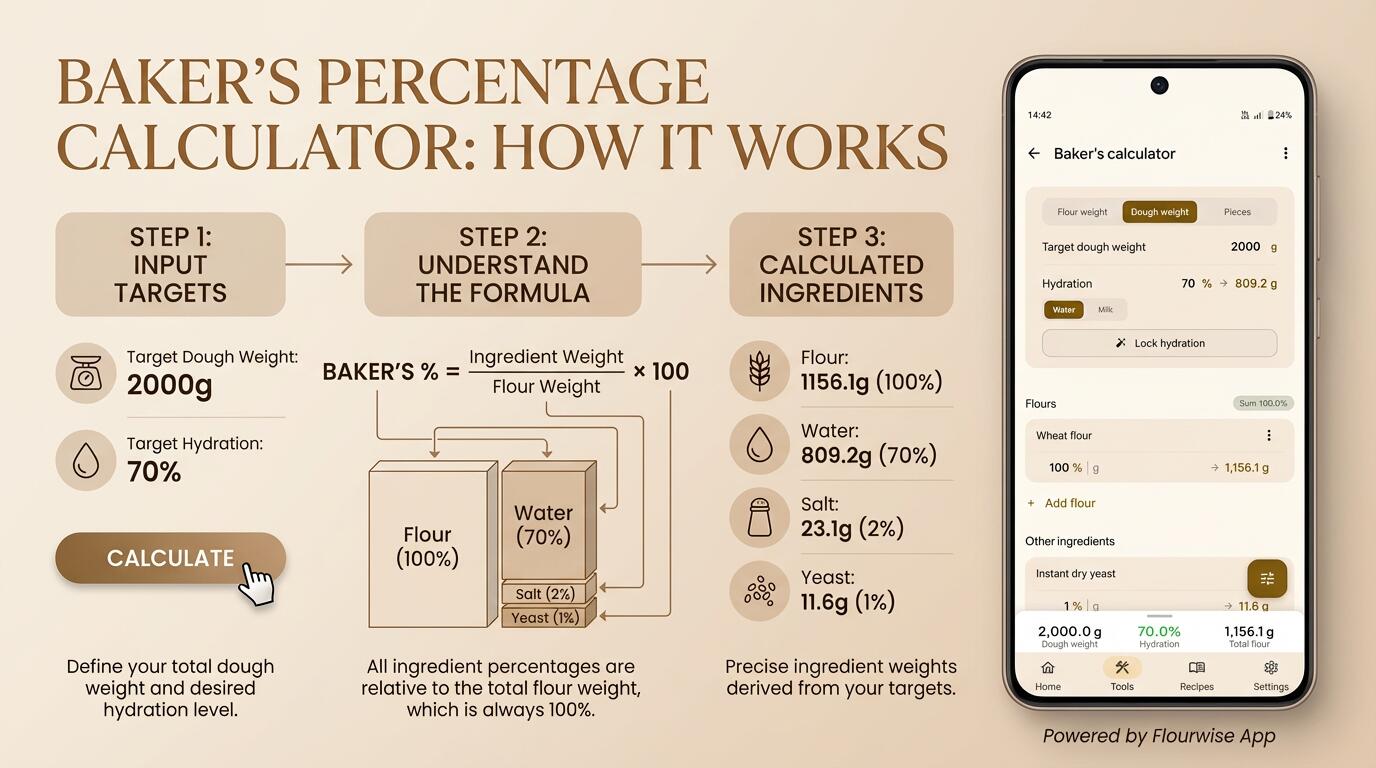
- The formula: Baker’s % = (Ingredient Weight ÷ Total Flour Weight) × 100
- Flour is always 100% – everything else is relative to flour weight
- Example: 700g water ÷ 1000g flour = 70% hydration
- Percentages add up to more than 100% – and that’s correct (they’re not parts of a whole)
- True hydration: Eggs, milk, and starter contain water too – factor them in for accurate calculations
↓ Full 7-min guide with step-by-step examples, real-world practice, and common mistakes to avoid
I started bread baking with volume measurements – “2 cups of flour, 1.5 cups of water.” The problem? Every time I scooped flour differently, or used a slightly different cup, my bread came out inconsistent. One week perfect, the next week a sticky mess or dry brick.
Then I bought a $15 kitchen scale and learned baker’s percentage. Suddenly, recipes weren’t mysterious anymore. I could scale any formula to any size, adjust hydration precisely, and replicate my successes every single time. A scale isn’t optional for serious bread baking – it’s essential.
Baker’s percentage is the universal language of bread baking. Once you understand it, you’ll finally know what “75% hydration sourdough” actually means and why your recipes work (or don’t).
What is Baker’s Percentage?
The one formula that changes everything
Baker’s percentage (also called baker’s math or baker’s formula) is a system where flour is always 100%, and all other ingredients are expressed as percentages of the total flour weight. This makes recipes infinitely scalable and easier to understand.
Example: Water % = (700g water ÷ 1000g flour) × 100 = 70%This formula works for every ingredient in your recipe: water, salt, yeast, eggs, butter, and everything else. I use it constantly – even for quick mental calculations when adjusting recipes on the fly.
Unlike regular percentages where everything adds up to 100%, baker’s percentages can total well over 100% because each ingredient is calculated independently relative to flour.
When I first learned about baker’s percentage, the “more than 100%” thing confused me for a day or two. I kept trying to make the numbers add up to 100%. Once I realized each ingredient is calculated separately against flour weight, it clicked immediately. Flour is your anchor at 100%, everything else floats relative to it.
How to Calculate Baker’s Percentage
Four steps from recipe to formula
Set Your Flour to 100%
Start by identifying the total flour weight in your recipe. This becomes your 100% baseline. If you’re using multiple types of flour, add them together.
Example
800g bread flour + 200g whole wheat = 1000g total flour (100%)
Note: “Total flour” includes flour in your starter or preferments too. When I first started making sourdough, I forgot to account for the 100g of flour in my 200g starter. My hydration calculations were off by 5-7%, and I couldn’t figure out why my dough felt so wet! This is where a calculator that automatically accounts for preferments really helps.
Apply the Formula to Each Ingredient
Divide each ingredient’s weight by the total flour weight, then multiply by 100.
Example with 1000g flour
- Water 700g: (700 ÷ 1000) × 100 = 70%
- Salt 20g: (20 ÷ 1000) × 100 = 2%
- Yeast 10g: (10 ÷ 1000) × 100 = 1%
Pro tip: After testing 30+ salt percentages, I’ve found 2% is the sweet spot for most breads. Below 1.8% tastes bland, above 2.5% starts tasting noticeably salty. Your mileage may vary based on personal preference.
Write Your Baker’s Formula
Express the complete recipe as percentages. This format is universal and infinitely scalable.
Flour 100% | Water 70% | Salt 2% | Yeast 1%
Total: 173% (this is normal – baker’s percentages don’t add to 100%)
When I share recipes with other bakers, I always use this format. It’s like speaking the same language – someone in Japan can take my “70% hydration, 2% salt” and scale it to any size batch they want.
Scale to Any Size
To scale, simply multiply each percentage by your desired flour weight.
Example: Double the recipe (2000g flour)
- Flour: 2000g × 100% = 2000g
- Water: 2000g × 70% = 1400g
- Salt: 2000g × 2% = 40g
- Yeast: 2000g × 1% = 20g
From Theory to Practice
Two ways to use baker’s percentage in real baking
Forward: From Recipe to Percentages
Let’s calculate baker’s percentage for a classic sourdough bread recipe – the same formula I use for my weekly bake.
Recipe Ingredients:
- Bread flour: 1000g
- Water: 700g
- Salt: 20g
- Sourdough starter (100% hydration): 200g
Calculating Baker’s Percentages:
- Flour: 1000g = 100% (always)
- Water: (700 ÷ 1000) × 100 = 70%
- Salt: (20 ÷ 1000) × 100 = 2%
- Starter: (200 ÷ 1000) × 100 = 20%
Baker’s Formula: Flour 100% | Water 70% | Salt 2% | Starter 20%
Total Percentage: 192%
Important note: This is “apparent hydration” because the starter contains both flour and water. Professional bakers and good calculators break down the starter to calculate true hydration – see the advanced section below.
Reverse: From Target Dough Weight to Recipe
Sometimes you know how much dough you need (for example, 2000g for two loaves) and want to calculate ingredient weights. I use this constantly when baking for specific pan sizes.
Example: Calculate ingredients for 2000g of 70% hydration dough
Step 1: Add up all percentages
100% (flour) + 70% (water) + 2% (salt) + 1% (yeast) = 173%
Step 2: Calculate flour weight
Flour = 2000g ÷ 1.73 = 1156.1g
Step 3: Calculate other ingredients
- Flour: 1156.1g (100%)
- Water: 1156.1g × 0.70 = 809.2g (70%)
- Salt: 1156.1g × 0.02 = 23.1g (2%)
- Yeast: 1156.1g × 0.01 = 11.6g (1%)
Total dough weight: 1156.1 + 809.2 + 23.1 + 11.6 = 2000g ✓
True Hydration: The Water You Can’t See
Why your hydration number is probably wrong
Here’s something that took me a few weeks to figure out: some ingredients contain significant amounts of water, which affects your dough’s true hydration. When I started adding eggs and milk to enriched doughs, my calculations were off because I wasn’t accounting for their water content.
This is critical for accurate hydration calculations, especially in enriched breads like brioche, challah, or milk bread. Most baker’s calculators ignore this completely – they only count the water you directly add. Flourwise is one of the very few that automatically accounts for water content in eggs, milk, and other enrichments, giving you true hydration instead of misleading numbers.
Water Content in Common Ingredients
| Ingredient | Water Content | Impact on 1000g Flour Recipe |
|---|---|---|
| Eggs (whole) | 75% | 100g eggs = 75g water equivalent |
| Milk | 87% | 100g milk = 87g water equivalent |
| Butter | ~15% | 100g butter = 15g water (usually ignored) |
| Sourdough Starter (100% hydration) | 50% | 200g starter = 100g water + 100g flour |
When I made my first brioche, the recipe called for 65% water plus 20% eggs (200g eggs per 1000g flour). I thought 65% sounded manageable. But those 200g eggs contain 150g of water! My true hydration was actually 80% – way higher than I expected. The dough was incredibly sticky and I thought I’d messed up. I couldn’t find any calculator that accounted for this – they all just added percentages without considering water content in ingredients. That’s why I built Flourwise to automatically calculate true hydration including eggs, milk, and other enrichments.
Example: True Hydration in Enriched Dough
Brioche Recipe:
- Flour: 1000g (100%)
- Water: 400g (40%)
- Eggs: 300g (30%)
- Milk: 100g (10%)
Apparent hydration: 40% (just counting added water)
True hydration calculation:
- Water from added water: 400g
- Water from eggs: 300g × 0.75 = 225g
- Water from milk: 100g × 0.87 = 87g
- Total water: 400 + 225 + 87 = 712g
- True hydration: 712 ÷ 1000 = 71.2%
That’s a 31-point difference from the apparent 40%! This explains why enriched doughs feel much wetter than their water percentage suggests.
Example: True Hydration with Preferments
When using preferments (poolish, biga, or sourdough starter), calculating true hydration gets more complex because the preferment contains both flour and water. This matters when you’re trying to replicate professional recipes exactly.
Sourdough with 100% Hydration Starter
Recipe:
- Bread flour: 1000g (100%)
- Water: 650g (65%)
- Sourdough starter (100% hydration): 200g (20%)
Apparent hydration: 65% (just counting the added water)
Breaking down the starter:
- Starter flour: 100g (50% of 200g starter)
- Starter water: 100g (50% of 200g starter)
True totals:
- Total flour: 1000g + 100g = 1100g
- Total water: 650g + 100g = 750g
- True hydration: (750 ÷ 1100) × 100 = 68.2%
This 3.2% difference is why I always calculate true hydration for my sourdough recipes. When a recipe says “70% hydration with 20% starter,” I need to know if they mean apparent or true hydration – it affects dough handling significantly. Flourwise handles this breakdown automatically – breaking down starters, accounting for egg/milk water content, and giving you the true hydration number every time.
Eggs contain 75% water and milk contains 87% water. A brioche with “40% water” plus eggs and milk can have a true hydration over 71%. A sourdough with “65% water” and 20% starter actually has 68.2% true hydration.
Stop Guessing at Hydration Calculations
You’ve seen the math. Percentages of percentages, water content in eggs and milk, rounding errors when you scale recipes up or down…
Flourwise does all of this automatically and correctly:
- Accounts for water in eggs (75%), milk (87%), butter, starter
- Calculates true hydration for enriched doughs
- Scales recipes while maintaining exact percentages
- Shows you the math so you understand what’s happening
Understanding baker’s percentage is essential. But doing the math by hand every time? That’s where mistakes happen.
What Hydration Actually Feels Like
Numbers are one thing, but dough feel is another
After baking hundreds of loaves at different hydration levels, here’s what I’ve learned:
| Bread Type | Hydration | What It Actually Feels Like |
|---|---|---|
| Bagels | 55-60% | Stiff and almost dry to touch, takes effort to knead, holds shape perfectly |
| Sandwich bread | 60-65% | Soft and pliable, easy for beginners, barely sticks to hands |
| Sourdough | 70-75% | Tacky but manageable, sticks slightly but releases easily, needs folding not kneading |
| Pizza (traditional) | 60-70% | Smooth and extensible, like playdough, stretches without tearing |
| Ciabatta | 80-85% | Very sticky, more like thick batter than dough, needs wet hands to handle |
The first time I tried 80% hydration, I thought the dough looked too wet – kept checking if I’d measured wrong. But after 3-4 stretch-and-folds, the gluten developed and it transformed into this beautiful, extensible dough. The bread had the most incredible open crumb I’d made up to that point. Now I know: wet dough = open crumb, but you need patience and technique.
Common Mistakes I Made (So You Don’t Have To)
Forgetting Flour in the Starter
For my first month of sourdough baking, I didn’t account for flour in my starter. My “75% hydration” was actually 78%, which explains why my dough always felt wetter than recipes described. If you’re using 200g of 100% hydration starter, that’s 100g flour + 100g water. Add those to your totals!
Flour Type Makes a Huge Difference
I once tried substituting whole wheat flour 1:1 in a 70% hydration recipe. The dough was impossibly stiff – whole wheat absorbs 5-10% more water than white flour because of the bran. Now I always add 5-7% more water when using whole wheat.
Temperature Affects Hydration Feel
In summer, my 75% hydration dough feels like 80% because warm dough is stickier and more extensible. In winter, the same recipe feels stiffer. The actual hydration doesn’t change, but handling does. I’ve learned to adjust my expectations based on kitchen temperature.
Why Use a Baker’s Percentage Calculator?
Look, I calculate percentages manually all the time for simple recipes. But for complex formulas with preferments, multiple flours, and enrichments? A calculator saves serious time and prevents errors.
The most common calculation errors I see (and that most calculators don’t help with):
- Egg and milk hydration: Most calculators completely ignore water content in enrichments – Flourwise is one of the few that accounts for the 75% water in eggs and 87% in milk
- Starter water and flour content: Some calculators handle this, but many still don’t break down preferments correctly
- Multiple flours: Easy to miscalculate total flour weight manually
- Scaling errors: Small rounding mistakes that compound
- Target dough weight calculations: Working backwards requires several steps
Conclusion
Baker’s percentage transformed my baking from following recipes blindly to understanding and creating them. Once you grasp the simple formula – everything relative to flour weight at 100% – you can scale any recipe, adjust hydration with confidence, and finally understand what professional bakers are talking about.
My advice: Buy a kitchen scale first (non-negotiable), then practice the calculations by hand for 5-10 recipes. After that, it’ll become second nature. For complex formulas with starters, eggs, or enrichments, use a baker’s percentage calculator that accounts for water content in all ingredients – not just the water you add. Most calculators don’t handle this, which is why I built Flourwise to do it automatically.
My biggest breakthrough came when I stopped thinking of recipes as fixed instructions and started seeing them as flexible formulas. Now I adjust hydration based on flour type, tweak salt to preference, and scale recipes to any size without hesitation. When I work with enriched doughs, I know the true hydration including egg and milk water content – something most calculators completely miss. Baker’s percentage gave me that freedom – and it’ll do the same for you.
Quick Reference
- Flour is always 100% – your anchor for all calculations
- Baker’s Percentage = (Ingredient Weight ÷ Total Flour Weight) × 100
- ”Total flour” includes flour in your starter or preferments
- Eggs contain 75% water, milk 87% – account for true hydration
- 2% salt is the sweet spot for most breads
- Higher hydration = more open crumb, but needs patience and technique
- Whole wheat absorbs 5-10% more water than white flour
Frequently Asked Questions
What is baker’s percentage?
Baker’s percentage (also called baker’s math) is a notation method where flour is always 100%, and all other ingredients are expressed as a percentage of the total flour weight. For example, 70% hydration means water weighs 70% of the flour weight.
Why do baker’s percentages add up to more than 100%?
Unlike regular percentages, baker’s percentages don’t represent parts of a whole. Each ingredient is calculated independently relative to flour. A recipe with 100% flour, 70% water, and 2% salt totals 172% - and that’s correct.
What is a good hydration level for bread?
It depends on the bread type. Bagels use 55-60%, sandwich bread 60-65%, sourdough 70-75%, and ciabatta 80-85%. Higher hydration creates more open crumb but is harder to handle. Start at the lower end and increase as you gain experience.
How do I calculate baker’s percentage from a recipe?
Divide each ingredient’s weight by the total flour weight, then multiply by 100. For example: 700g water ÷ 1000g flour × 100 = 70% hydration. Remember to include flour from starters or preferments in your total flour weight.
Do I need to account for water in eggs and milk?
Yes, for accurate hydration calculations. Eggs contain 75% water and milk contains 87% water. A brioche with “50% water” plus 20% eggs actually has about 65% true hydration. Most calculators ignore this completely – Flourwise is one of the few that automatically accounts for water content in all ingredients, not just the water you directly add.