DDT Calculator Guide: How to Calculate Perfect Water Temperature for Bread Baking
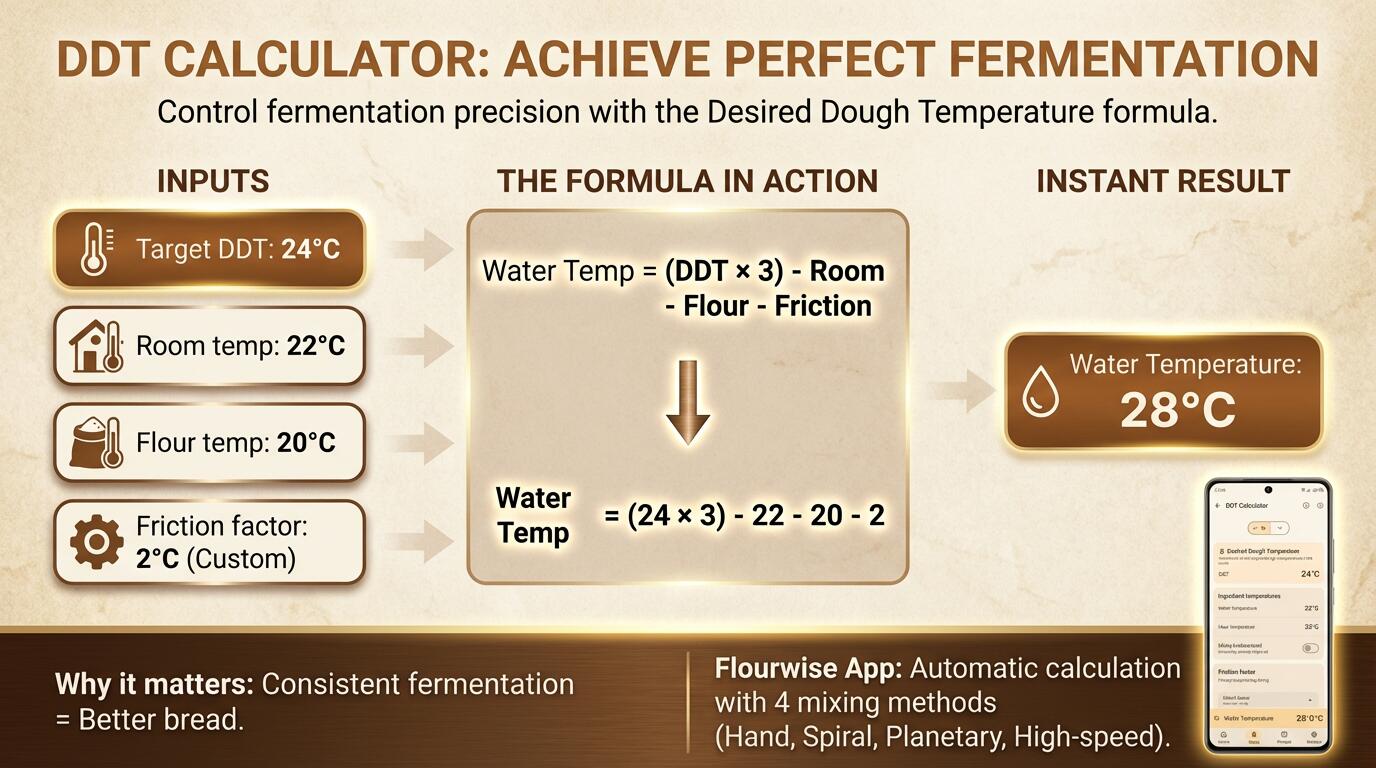
⚡ What You’ll Learn in 60 Seconds
- DDT formula: Water Temp = (DDT × 3) − Room Temp − Flour Temp − Friction Factor
- With preferment: Use (DDT × 4) and subtract preferment temp too
- Target DDT: 24–26°C (75–79°F) for most breads – sourdough, pizza, baguettes
- Friction factor: Hand mixing adds 0–2°C, stand mixers add more depending on speed and duration
- Key insight: Same recipe, different seasons? DDT is why. Control water temperature and your fermentation becomes predictable year-round.
↓ Full 7-min guide with worked examples, extreme temperature solutions, and real-world baking scenarios
In my early months of bread baking, I couldn’t understand why my sourdoughs behaved so differently with the seasons. Summer loaves fermented in 4 hours, winter loaves took 12. I was following recipes exactly – same ingredients, same timing. But I was missing the one variable I couldn’t see: dough temperature.
Then I learned about DDT (Desired Dough Temperature), and everything changed. Now my bread ferments on schedule, season after season, regardless of whether my kitchen is 18°C or 28°C. The secret? Calculating the exact water temperature needed to hit my target dough temperature every single time.
DDT isn’t just temperature control – it’s the difference between predictable fermentation and hoping your bread works out.
What is DDT (Desired Dough Temperature)?
The one number that controls fermentation speed
DDT stands for Desired Dough Temperature - the target temperature you want your dough to reach after mixing. This is crucial because:
- Yeast activity is temperature-dependent (optimal at 24-27°C / 75-80°F)
- Fermentation speed doubles for every 10°C increase
- Gluten development is affected by dough temperature
- Consistency - same dough temp = same fermentation timeline
The DDT calculator helps you determine what water temperature to use based on room temperature, flour temperature, and the heat generated by mixing (friction factor).
I used to just use “room temperature water” for everything. But “room temperature” in my kitchen ranges from 16°C in January to 26°C in July. That 10°C difference literally doubles fermentation speed. No wonder my timing was all over the place! Once I started controlling dough temperature with DDT calculations, my fermentation became predictable.
The DDT Formula Explained
Water Temp = (DDT × 3) - Room Temp - Flour Temp - Friction FactorWith Preferment (4-Factor Formula):
Water Temp = (DDT × 4) - Room Temp - Flour Temp - Friction Factor - Preferment TempWhere:
- DDT: Your target final dough temperature (usually 24-26°C / 75-78°F)
- Room Temp: Ambient temperature where you’re mixing
- Flour Temp: Temperature of your flour (use thermometer)
- Friction Factor: Heat generated by mixing (depends on mixing method)
- Preferment Temp: Temperature of your starter/poolish/biga (if using)
The multiplication factor changes based on how many variables you have: 3 for basic dough (room + flour + friction), 4 when using a preferment (room + flour + friction + preferment).
Step-by-Step: How to Calculate DDT
Five steps from measurements to perfect water temperature
Determine Your Target DDT
Different breads perform best at different dough temperatures. After testing each of these ranges extensively, here’s what I’ve learned:
| Bread Type | Ideal DDT | What I’ve Observed |
|---|---|---|
| Sourdough | 24-25°C (75-77°F) | Sweet spot for balanced yeast/bacteria activity. Above 26°C gets too sour for my taste |
| Yeasted Bread | 25-26°C (77-79°F) | Yeast loves this range. Fermentation is predictable and timely |
| Baguettes | 24-25°C (75-77°F) | Professional French bakers are strict about this – controls flavor development |
| Enriched Doughs | 26-27°C (79-81°F) | Butter inhibits fermentation, so slightly warmer helps compensate |
| Pizza Dough | 24-26°C (75-79°F) | Lower for slow cold ferment, higher for same-day pizza |
For most home bakers: Start with 24-25°C (75-77°F) as your default DDT. I use 24.5°C for almost everything now.
Measure Room Temperature
Use a kitchen thermometer to measure the ambient temperature where you’re mixing your dough. In winter, my kitchen drops to 18-20°C (64-68°F). In summer, it climbs to 26-28°C (79-82°F).
I used to measure room temp once in the morning and use that all day. Big mistake. My kitchen can swing 4-5°C from morning to afternoon depending on sun exposure and cooking activity. Now I measure right before I start mixing. Those few degrees make a real difference in the final calculation.
Measure Flour Temperature
Stick a thermometer into your flour bag. Flour stored at room temperature will typically match ambient temperature. Flour stored in a pantry or basement might be cooler.
Typical flour temperatures I’ve measured
- Room temperature storage: 20-22°C (68-72°F)
- Cool pantry: 16-18°C (61-64°F)
- Basement storage (summer): 18-20°C (64-68°F)
- Basement storage (winter): 12-15°C (54-59°F)
Determine Your Friction Factor
Mixing generates heat through friction. The friction factor varies by mixing method and needs to be determined for your specific setup.
General guidelines
- Hand mixing (gentle folding): Minimal heat, typically 0-2°C
- Stand mixer (low-medium speed): Moderate heat generation, varies by mixer type and speed
- High-speed mixer: More heat generated from intense mixing
The exact friction factor depends on your specific mixer, mixing speed, and duration. To find your actual friction factor, mix a test dough with estimated friction, then measure the final dough temperature. Calculate back: Friction Factor = (DDT × M) - Room - Flour - Water [- Preferment]
Calculate Water Temperature
Now plug everything into the formula and solve for water temperature.
Water Temp = (DDT × 3) - Room - Flour - Friction
Or × 4 if using preferment, and subtract preferment temp too
Example 1: Winter Sourdough (No Preferment)
My typical winter bake:
- Target DDT: 24°C
- Room temperature: 19°C (cold kitchen)
- Flour temperature: 17°C (cool pantry)
- Friction factor (hand mixing): 2°C
Calculation:
Water Temp = (24 × 3) - 19 - 17 - 2Water Temp = 72 - 38Water Temp = 34°C (93°F)Reality check: Yes, I actually use water that warm in winter! It feels hot to the touch but won’t harm the yeast. My dough comes out at exactly 24°C after hand mixing.
Example 2: Summer Sourdough with Starter
My typical July bake:
- Target DDT: 24°C (same target, different water!)
- Room temperature: 27°C (hot kitchen)
- Flour temperature: 25°C
- Friction factor (stand mixer): 8°C
- Starter temperature: 26°C (warm from counter feeding)
Calculation (4-factor formula):
Water Temp = (24 × 4) - 27 - 25 - 8 - 26Water Temp = 96 - 86Water Temp = 10°C (50°F)What I actually do: I chill water in the fridge overnight to hit 10-12°C. Without this calculation, my summer doughs would end up at 28-29°C and ferment way too fast, getting overproofed and sour.
The first time DDT told me to use cold water in summer, I thought the formula was broken. But I tried it anyway, and my dough hit exactly 24°C after mixing. It was magical – same dough temperature as my winter bakes, despite the room being 10°C warmer. This is why DDT works.
Skip the Math, Get Perfect Results Every Time
You’ve seen the formulas above. Multiple temperatures to measure, different factors to remember, easy to mess up that multiplication…
The Flourwise DDT calculator does all of this automatically:
- Input 3-4 temperatures → instant water temperature
- Saves your friction factor once you measure it
- Automatic °C ↔ °F conversion
- Warns you about extreme temperatures
The theory above helps you understand why it works. The app makes sure you actually do it right, every single time.
What if the Calculated Water Temperature is Extreme?
Practical solutions for edge cases
Water Temperature Too Cold (Below 4°C / 39°F)
This happens to me every summer. Solutions I actually use:
- Ice water: Fill measuring container with cold water and add ice cubes. Let sit 5 minutes, remove ice, measure temp. I can consistently hit 1-3°C this way.
- Refrigerate flour: Put flour bag in fridge overnight. Drops temp by 10-12°C, which adds 10-12°C to your water calculation.
- Mix in coolest room: My basement is 6-8°C cooler than upstairs in summer. Those degrees matter.
- Mix early morning: 6 AM is often 4-5°C cooler than afternoon
- Accept slightly higher DDT: Sometimes I just target 26°C instead of 24°C in peak summer. Fermentation is faster but still manageable.
Water Temperature Too Hot (Above 45°C / 113°F)
This happens in deep winter when everything is cold:
- Warm your flour: Place bag near (not on) radiator for an hour. I’ve raised flour temp from 14°C to 22°C this way.
- Mix in warmest room: My kitchen gets 5-6°C warmer than basement after cooking dinner.
- Reduce mixing intensity: Gentler mixing produces less friction heat.
- Use warmer DDT target: In winter, sometimes I target 26°C instead of 24°C. Fermentation is still slower due to cool ambient temp during bulk rise.
Never Use Water Above 45°C (113°F)
Above 45°C, you risk killing yeast and denaturing proteins. If DDT formula suggests 48°C water, adjust other factors instead.
DDT in Practice: My Real-World Scenarios
Winter Weekend Bake (January Morning)
Conditions: Cold kitchen 18°C, cool flour from pantry 15°C, making sourdough (DDT 24°C), using stand mixer (FF 8°C), starter at 20°C (cold from overnight fridge)
Water Temp = (24 × 4) - 18 - 15 - 8 - 20Water Temp = 96 - 61 = 35°CResult: I used 35°C water (feels warm to touch). Dough mixed to exactly 24°C. Bulk fermentation took 10 hours in my cool kitchen – predictable and perfect.
Summer Heat Wave (July Afternoon)
Conditions: Hot kitchen 29°C, warm flour 27°C, making pizza dough (DDT 25°C), hand mixing (FF 2°C)
Water Temp = (25 × 3) - 29 - 27 - 2Water Temp = 75 - 58 = 17°CResult: I used 17°C water (cold tap water, no ice needed). Dough hit 25°C. Without this calculation, I would’ve used “room temp” water at 29°C, resulting in 33°C dough – way too warm.
The Mistake That Taught Me DDT
Before I learned about DDT, I made sourdough on a hot August day. Room temp was 28°C. I used “room temperature water” (28°C). Mixed with my stand mixer. My dough came out at 31°C – I could feel it was too warm but didn’t know how to fix it. Bulk fermentation that should’ve taken 5 hours was done in 2.5 hours. I missed it, the dough overproofed, and I ended up with a flat, overly sour loaf. If I’d used DDT, I would’ve used ice water and hit 24°C dough temp instead. That mistake taught me why temperature control matters.
Why Consistent Dough Temperature Matters
After tracking 50+ bakes with controlled dough temperature versus uncontrolled, here’s what I’ve observed:
- Predictable fermentation: My sourdough bulk ferments in 8-10 hours at 24°C, consistently, regardless of season
- Consistent flavor: Warmer doughs (27°C+) produce noticeably more sour sourdough. Controlling temp at 24°C keeps flavor balanced
- Better planning: I can start dough at 8 AM and know it’ll be ready at 6 PM, every time
- Recipe replication: When I nail a recipe, I can replicate it exactly by hitting the same DDT
- Seasonal adaptation: Same recipes work year-round because I’m adjusting water temp to compensate for environmental changes
Advanced Tips from My Testing
Friction Factor Varies by Speed and Time
Mixing method, speed, and duration all affect friction factor. Longer mixing and higher speeds generate more heat. Once you establish your standard method, stick with it for consistent results and measure your actual friction factor for accuracy.
Autolyse Changes Everything
If using autolyse (flour + water rest before adding salt/starter), calculate DDT for the autolyse water temperature. During the 30-60 minute rest, dough temperature will equilibrate toward room temperature. This actually makes DDT less critical for autolyse methods, but I still calculate it for consistency.
Dough Temperature Drifts During Bulk
Your dough won’t stay at 24°C forever. In my testing:
- Room temp 20°C: Dough drops from 24°C to 21°C over 8 hours
- Room temp 26°C: Dough rises from 24°C to 25.5°C over 6 hours
DDT controls starting temperature, which sets the fermentation trajectory. The dough will drift, but starting at the right temp means it stays in the optimal range throughout bulk fermentation.
Preferment Temperature Matters More Than You Think
I used to keep my starter on the counter at 24-26°C. In summer, it sometimes hit 28°C. When I fed it and used it immediately at 28°C in the DDT formula, I needed much colder water. Now I plan ahead: if I want to use warmer water (easier to work with), I refrigerate my starter for 30 minutes before using to drop it to 18-20°C.
Common Mistakes I Made (And How to Avoid Them)
1. Measuring Dough Temp in Only One Spot
When calculating my friction factor, I first measured dough temp near the surface and got 22°C. Seemed off. I measured in the center and got 25°C. Big difference! Always measure in the thickest part of the dough mass for accurate readings.
2. Not Accounting for Bowl Temperature
I pulled a cold bowl from my 15°C basement and mixed dough. Final temp was 2°C lower than calculated. Now I bring bowls to room temperature before mixing, or I factor in “cold bowl effect” by adding 2°C to my target water temp.
3. Forgetting to Multiply by Factor Count
I once calculated (DDT × 3) when using a starter. Wrong! With starter, it’s (DDT × 4) because you have 4 temperature factors. I got my formula confused and ended up with dough 6°C too cold. Fermentation took forever. Easy mistake to make, but easy to avoid once you know the rule.
Conclusion
The DDT calculator is the single most impactful technique I’ve learned in my bread baking journey. It turned baking from unpredictable experiments into reliable, repeatable science. Once you master it, seasonal temperature swings become irrelevant – you’re in control.
Quick Recap
- Choose target DDT (24-26°C for most breads)
- Measure room temp and flour temp with thermometer
- Determine your friction factor (measure once with test dough)
- Apply formula: Water Temp = (DDT × M) - Room - Flour - Friction [- Preferment]
- Use calculated water temperature for consistent results
- M = 3 without preferment, M = 4 with preferment
- Fermentation speed doubles every 10°C temperature increase
Start using DDT today and experience the difference consistent dough temperature makes. Your bread will ferment on schedule, season after season, year after year. Many baker’s percentage calculators include built-in DDT calculation to simplify the process.
Frequently Asked Questions
What is DDT in bread baking?
DDT stands for Desired Dough Temperature - the target temperature you want your dough to reach after mixing. It’s typically 24-26°C (75-79°F) for most breads and is crucial for consistent fermentation. I use 24°C for sourdough and 25°C for yeasted breads.
How do I calculate water temperature for bread?
Use the DDT formula: Water Temp = (DDT × 3) - Room Temp - Flour Temp - Friction Factor. For recipes with preferment, use (DDT × 4) and also subtract preferment temperature. Measure all temps with a thermometer for accuracy.
What is friction factor in bread baking?
Friction factor is the heat generated by mixing. Hand mixing adds minimal heat (0-2°C), while electric mixers add more depending on mixer type, speed, and duration. Calculate your exact friction factor once by measuring actual dough temperature after mixing, then use that number for all future bakes with the same equipment and settings.