Baker's Percentage Chart: Hydration Levels for All Bread Types
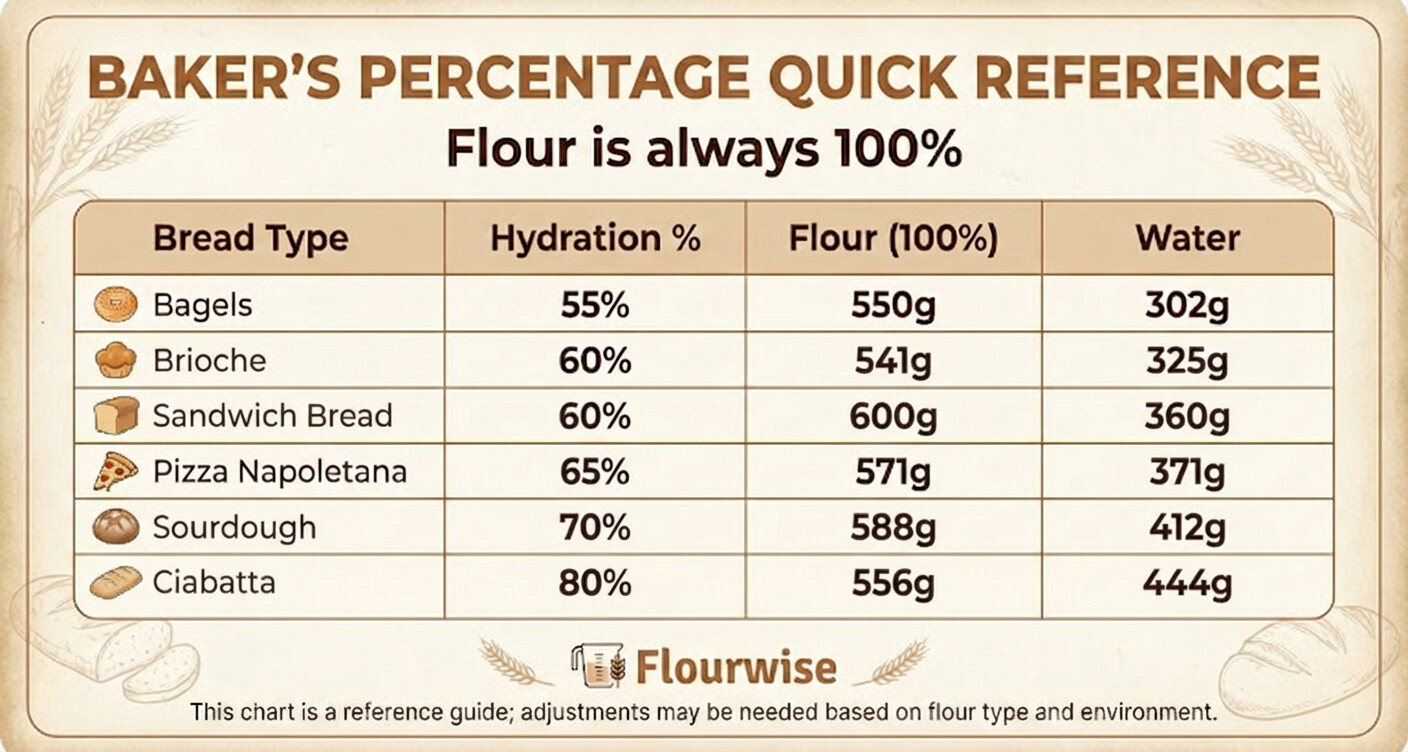
⚡ What You’ll Learn in 60 Seconds
- 55–60%: Bagels, pretzels – dense, chewy, easy to shape
- 60–65%: Sandwich bread, rolls – soft crumb, reliable results
- 65–72%: Sourdough, artisan bread – open crumb, great oven spring
- 75–85%: Ciabatta, focaccia – very open crumb, sticky to handle
- Key insight: Flour type matters as much as hydration – whole wheat needs 5–10% more water than white flour.
↓ Full 5-min guide with complete chart, flour adjustments, and my personal hydration sweet spots
I used to wing it with water amounts. “Add water until it looks right” was my grandmother’s advice, which worked great for her 40 years of experience but was useless for me as a beginner. One day I’d make perfect bread at “right” consistency, the next day a sticky mess.
Then I discovered hydration percentages and everything changed. Now I know exactly where to start with any bread type – and more importantly, I can replicate my successes.
These numbers are tools, not rules. Use them as educated starting points, then trust your hands and your experience.
Complete Bread Hydration Chart
Tested ranges from our baking experiments
Remember: In baker’s percentage, flour is always 100%, and hydration is the percentage of water relative to flour weight.
| Bread Type | Hydration % | Real-World Characteristics |
|---|---|---|
| Pretzels | 50-55% | Driest dough you’ll make, needs significant kneading time, incredibly tight crumb |
| Bagels | 55-60% | Dense, chewy, almost tough to knead – but that’s normal! Holds shape perfectly when boiled |
| Brioche | 55-65% | Enriched dough feels wetter than hydration suggests due to butter and egg content |
| Sandwich Bread | 60-65% | Soft, gentle on hands, perfect beginner dough – my go-to when teaching friends to bake |
| Baguette (Traditional) | 65-70% | Smooth and slightly tacky, develops great gluten structure, classic French texture |
| Pizza Napoletana | 60-70% | Smooth as silk, stretches beautifully without tearing, satisfying to work with |
| Country Bread | 68-72% | Rustic and forgiving, great for whole grain additions, consistent results |
| Sourdough Boule | 70-75% | My weekly bake – sticky but manageable with wet hands, gorgeous open crumb |
| Pizza (High-Hydration) | 70-80% | Modern style, incredibly soft, needs confident handling – worth the learning curve |
| Whole Wheat Bread | 70-80% | Bran absorbs tons of water – learned this after several dry, crumbly failures |
| Focaccia | 75-85% | Wet and bubbly, pools olive oil beautifully, impossible to shape without pan |
| Rye Bread | 75-85% | Very sticky and temperamental, lacks gluten structure, needs experience |
| Ciabatta | 80-85% | Extremely wet – more like thick batter, requires mixer or serious folding technique |
I tested bagels from 50% to 65% hydration. At 50%, the dough was unworkably stiff – I actually couldn’t knead it by hand. At 65%, they came out flat and didn’t have that characteristic bagel chew. The sweet spot is 55-58% for that perfect dense, chewy texture. Higher than 60% and you’re basically making round bread, not bagels.
Understanding Hydration Levels
What the numbers actually mean in your hands
Low Hydration: Stiff Doughs
Examples: Bagels, pretzels, some sandwich breads
- Requires significant arm strength to knead by hand
- Dough barely sticks to work surface
- Dense, tight crumb structure – you won’t see big holes
- Very chewy texture, holds shape aggressively
- Almost no oven spring compared to higher hydration breads
My first pretzel attempt was at 48% hydration following a German recipe. After 10 minutes of kneading by hand, my arms were exhausted and the dough still felt like a rock. I understood immediately why this requires a stand mixer – that stiff consistency is exactly what creates pretzels’ distinctive dense, chewy texture. Now I use a stand mixer for anything below 55% hydration.
Medium Hydration: Standard Doughs
Examples: Sandwich bread, baguettes, standard sourdough
- Comfortable to work with by hand – the “just right” zone
- Slight tackiness but releases from hands easily
- Moderate crumb openness, good balance
- Predictable fermentation and behavior
- Perfect range for beginners to learn dough handling
This is where I recommend everyone start. At 65% hydration, dough is forgiving enough to handle easily but high enough to produce good oven spring and crumb structure.
High Hydration: Wet Doughs
Examples: Artisan sourdough, high-hydration pizza, focaccia
- Sticky – requires wet hands or good technique to avoid mess
- Can’t really “knead” in traditional sense, needs folding
- Open, irregular crumb with dramatic holes
- Incredible oven spring – dough practically explodes in oven
- Requires confidence and experience to shape properly
I’ll never forget my first 75% hydration sourdough. The dough seemed impossibly sticky – stuck to everything, spread out flat. I kept wondering if I’d measured wrong. But I’d read you just need to be patient, so I did 4 sets of stretch-and-folds over 2 hours. The dough transformed – built structure, held shape, and baked into some of the best bread I’d made. High hydration requires patience and trust in the process.
Ultra-High Hydration: Very Wet Doughs
Examples: Ciabatta, some focaccias, experimental breads
- Barely resembles dough – more like thick pancake batter
- Impossible to hand-knead, requires mixer or extensive folding
- Extremely open crumb with massive holes
- Often mixed and shaped in a stand mixer or with wet tools
- Spectacular visual results but challenging technique
I make ciabatta at 82% hydration regularly. The “dough” is almost batter-like – you’re gently scooping and folding rather than traditional shaping. That extreme wetness is exactly what creates those massive irregular holes and incredibly light texture. The messier it looks during handling, the better the final result.
Start at the lower end of any hydration range and increase by 2-5% in future bakes. You can always add water – you can’t remove it.
Critical Variable: Flour Type
Same hydration, completely different dough
These Numbers Assume Bread Flour
All percentages in this chart assume bread flour (11-13% protein). Different flours behave completely differently at the same hydration:
- All-purpose flour (9-11% protein): Use 5-10% less water than bread flour. All-purpose can’t hold as much water due to lower protein content – recipes designed for bread flour will be too wet.
- Whole wheat flour: Use 5-10% MORE water than white flour. The bran absorbs water like a sponge – whole wheat at 65% feels like white flour at 55%.
- Rye flour: Use 10-15% more water. Rye is incredibly absorbent and lacks gluten, creates a very different dough structure.
- High-protein flour (14%+): Can handle 5-10% more water. More gluten = more water absorption capacity.
I once substituted 30% of bread flour with whole wheat at the same 70% hydration. The dough was impossibly stiff – I had to add another 50g of water mid-mix to make it workable. Now I automatically bump hydration by 2% for every 10% of whole wheat I add. So if a white flour recipe is 70% and I’m using 30% whole wheat, I go to 76% hydration.
How to Use This Chart in Real Life
From chart to kitchen
Starting a Brand New Recipe
- Choose your bread type from the chart
- Always start at the lower end of the hydration range – you can add water, can’t remove it
- Note your flour type and adjust accordingly
- Bake it, take notes on dough feel and final result
- Adjust by 2-5% increments in future bakes
I keep a baking journal (just a simple Google Doc) where I note hydration, flour brand, dough feel, and results. After 3-4 bakes of the same bread type, I’ve dialed in MY perfect hydration for MY flour in MY kitchen. Your “perfect” might be different – and that’s okay. These charts are starting points, not rigid rules.
Adjusting Existing Recipes
If your current dough feels:
- Too dry and tears when stretching: Increase hydration by 3-5% next time
- Too wet, impossible to shape, spreads out flat: Decrease hydration by 3-5%
- Good consistency but dense crumb: Increase hydration by 2-3% OR extend fermentation time
- Good consistency but too open/flat: Might be over-fermented rather than over-hydrated – check timing first
Environmental Factors Change Everything
After baking the same sourdough recipe for a year, I’ve noticed huge seasonal differences:
- Summer (humid): My 74% hydration feels like 78%. I now use 71-72% in July-August.
- Winter (dry heating): Same 74% feels like 70%. I bump to 76-77% in January-February.
- Warm kitchen: Warmer dough is stickier and more extensible. Your 75% at 28°C will feel wetter than 75% at 20°C.
- Flour freshness: Older flour (6+ months) absorbs less water. Fresh flour from the mill absorbs more.
Beyond Hydration: Other Key Baker’s Percentages
Hydration gets all the attention, but these matter just as much
These are my tested ranges after hundreds of bakes:
| Ingredient | My Range | What I’ve Learned |
|---|---|---|
| Salt | 1.8-2.5% | I use 2.2% for everything. Below 2% tastes bland to me, above 2.5% noticeably salty |
| Instant Yeast | 0.5-1% | 0.5% for overnight cold ferment, 1% for same-day bread. More yeast = faster but less flavor |
| Sourdough Starter | 10-20% | I use 15% for 12-hour bulk ferment. 20% if kitchen is cold or I’m in a hurry |
| Sugar | 2-10% | 2-3% for subtle sweetness, 8-10% for enriched breads like brioche |
| Butter/Oil | 3-20% | Dramatically affects texture. 3-5% makes bread softer, 15-20% creates brioche-like richness |
Stop Memorizing Hydration Charts
You’ve seen the ranges. 65-75% for pan bread, 75-85% for artisan, but what about your specific recipe with your flour?
Flourwise makes hydration adjustment effortless:
- Type your target hydration → instant weight calculation
- Add preferments → automatic hydration adjustment
- Change recipe size → all ratios stay perfect
- Switch between baker’s % and grams instantly
Charts give you starting points. The app lets you dial in exactly what works for your flour and technique.
My Personal Hydration Sweet Spots
After 200+ loaves, these are the numbers I keep coming back to
These are the hydration levels I’ve settled on for each bread type in my kitchen, with my flour brands, in my climate. Your optimal hydrations might differ – and that’s the whole point of keeping notes and iterating.
- Weekly sourdough74%(started at 70%, gradually increased)
- Pizza dough68%for traditional, 73% for NY-style
- Sandwich bread63%(soft and easy to slice)
- Bagels57%(perfect chew without being tough)
- Focaccia80%(wet enough for huge bubbles, not so wet it’s unmanageable)
Conclusion: Start Low, Learn Your Flour, Take Notes
This baker’s percentage chart is based on real testing, but it’s a starting point, not gospel. Every flour behaves differently, every kitchen has different humidity, and every baker has different preferences.
My recommendation:
- Pick a bread type and start at the lower end of the hydration range
- Take detailed notes on dough feel, handling, and final results
- Adjust by 2-5% increments in subsequent bakes
- After 3-4 iterations, you’ll find YOUR perfect hydration
- Don’t be afraid to deviate from “standard” ranges – if 78% works for you, use 78%
The most important lesson I’ve learned: these numbers are tools, not rules. Use them as educated starting points, then trust your hands and your experience. For automatic calculations, try a baker’s percentage calculator that handles the math while you focus on the craft.
Quick Reference
- Flour is always 100% – hydration is water as % of flour weight
- Low (50-60%): stiff, chewy – bagels, pretzels
- Medium (60-70%): standard, forgiving – sandwich bread, baguettes
- High (70-80%): sticky, open crumb – sourdough, focaccia
- Ultra (80%+): batter-like, massive holes – ciabatta
- Whole wheat needs 5-10% more water than white flour
- Always start low, adjust up by 2-5% per bake
Frequently Asked Questions
What hydration should I use for sourdough bread?
Start with 70% hydration for your first sourdough. This is wet enough for good oven spring and open crumb, but manageable for beginners. Once comfortable, experiment between 70-75% to find your preference. I settled on 74% after about 20 loaves.
What is the best hydration for pizza dough?
Traditional Neapolitan pizza uses 60-65% for easy handling and classic texture. NY-style uses 65-70%. I prefer 68% – high enough for good crust bubbles, low enough to stretch easily without tearing. Modern high-hydration (75-80%) produces incredible crust but requires experience.
Why does whole wheat flour need more water?
Whole wheat contains bran and germ which absorb significantly more water than refined flour. In my testing, whole wheat needs 5-7% higher hydration to match the consistency of white flour dough. Mix a 70% whole wheat dough and a 70% white flour dough side-by-side – the whole wheat will feel much stiffer.